The MENA region has a shortage of 3.5 million affordable dwellings, with Egypt, Iraq, Morocco and Saudi Arabia suffering from the biggest shortfalls.
For all the boom (and subsequent busts) in the regional real estate markets, there remains a shortage of a little more than 3.5 million units of affordable housing in the MENA region, according to Jones Lang LaSalle, the real estate consultants.
The largest shortfalls are in the markets of Egypt (1,500,000), Iraq (1,000,000), Morocco (600,000) and Saudi Arabia (400,000), but other Gulf markets also face shortages, brought upon by a host of factors.
According to JLL, these factors include:
- High land values / lack of access to affordable land.
- High capital costs associated with 'big ticket' infrastructure (eg: electricity, sewerage).
- Costs associated with providing multi modal public transport networks to remote locations.
- Low financial returns compared to other sectors of the residential market.
- Limited access to finance among low income households due to immature mortgage market.
- Problems with acceptance of system building techniques have restricted economies of scale.
The shortfall will only widen as the region's demographics change. The region has some of the largest concentration of young populations in the world, with around 30% of the population in the Gulf below 15 years of age - the wider MENA region has 31.5% under 15.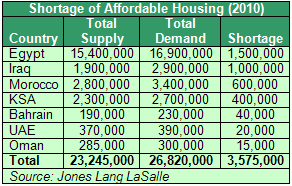
But home affordability remains a distant dream for many of the region. Interestingly, some of the countries where the Great Arab Revolt has played out successfully this year also have some of the worst house price-to-income ratio. An average house in, say, Tunis would cost a Tunisian nearly 25 times his annual salary, and an Egyptian in, say, Cairo would have more than 18 times his annual salary to secure a home.
Similarly, Banque Saudi Fransi estimates that to afford an apartment, an average Saudi must earn SR12,000 a month, and SR19,000 to buy a villa - which is beyond the reach of many as the average public service wage is SR8,644, although most employees earn an average wage of SR5,699.
Saudi Arabia's housing market continues to wrestle with a shortage of supply and mounting demand which has placed home ownership affordability out of reach for many young Saudis, notes the bank.
"As upward pressure on asking prices for apartments and villas gains rather than loses momentum, there is an urgent need for new units where they are required most, to provide middle- and lower-income citizens with single-family homes. The government is working on several fronts to try to alleviate supply constraints, ... dedicating SR55 billion ($14.7 billion) to programmes assisting lower income citizens obtain funding for home buys.... the king made a considerable call to allocate SR250 billion to the General Housing Authority to finance immediate construction of 500,000 new units."
The Kingdom's housing programmes is aimed at the 58% of Saudi households with an average monthly income of below SAR 5,000 (USD 1,400).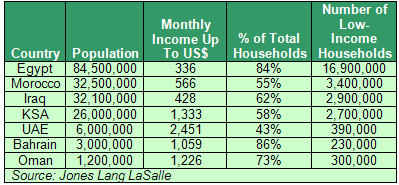
Egyptian Housing
JLL singles out Egypt as the market with the greatest potential for real estate developers, especially as it has the highest population in then region - at 85 million - and 80% of low-income levels.
"The Ministry of Housing has recognised the need to provide more affordable housing and the Ministry of Housing has announced plans to construct one million new residential units across 22 different cities throughout Egypt," says JLL.
"These units (with an average size of 63 sq m) are to be provided for those currently priced out of the private housing market. The proposal is for the government to provide the land and for the private sector to undertake the construction for an agreed price."
In Iraq, however, years of under investment in infrastructure has turned housing into a much greater issue. Lack of electricity, experienced developing and construction companies and low incomes has made it especially difficult to meet's Iraq shortfall of nearly a million houses.
But frustration is evident. Last week hundreds of protestors in Baghdad demanded better utility services and jobs, after a Shia cleric demanded that the government 50,000 new jobs or face demonstrations.
At the other end of the spectrum is Morocco, which JLL ranks as the most mature affordable housing market in MENA, with the government having applied experience from across Europe in providing social housing for low income local families for many years.
Morocco's public private partnership (PPP) arrangement was launched five years ago to reduce housing shortage by 25% by 2012. Under the programme, the government gave access to land and the developers had to sell the housing units at a set price to Moroccans.
"Such arrangements can be financially attractive to developers," notes JLL. "Addoha is Morocco's largest developer and the first to be listed on the Casablanca stock exchange since 2006. Addoha has achieved strong financial returns (with revenues up 57% in 2010) based on a business model with almost 80% of its projects targeting low and mid-income housing."
In the UAE, the development excesses of the previous decade and the subsequent crash in prices has made housing much more affordable.
"The shortage of affordable housing in the UAE is focussed on the Abu Dhabi metropolitan area," notes JLL. "There has been a major adjustment in pricing in Dubai in recent years which has effectively solved the shortage of affordable housing, while there is also a sufficient supply of affordable housing in the rural parts of Abu Dhabi Emirate and in the Northern Emirates."
A similar case is playing out in Qatar. DTZ Research says the level of new demand for residential accommodation has slowed considerably in comparison to the period 2005 - 2008, during which time the population doubled. In parallel, the level of supply in residential stock has increased at a faster rate as a number of developments, which started in response to the housing shortage, reach completion."
But that should change soon as the Qatar has earmarked an aggressive investment plan to boost its non-energy sector. Although Qatar' successful bid to host the FIFA World Cup is a long way in 2022, it has had a positive long-term on the overall outlook of the economy. The country is expected to invest $64-billion till 2022 on infrastructure investment which will include housing communities.
Meanwhile, Bahrain which saw its citizens in a pubic display of anger earlier in the year (and still continues to face sporadic protests) faces a major housing shortage of 40,000 which is unusually high given its relatively small population.
Conclusion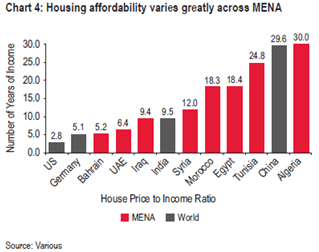
There appears to be a strong correlation between housing affordability and protests in the countries that suffer the greatest disparity in house price to income ratio. Granted Algeria is an outlier here with the highest ratios, but other countries in the table at the higher end seem vulnerable to protests.
Of course, it is not the only factor and other reasons are at play. The UAE, for example has a higher home-price-to-income-ratio than Bahrain but has much lower unemployment - thus has been spared any of the unrest Manama has seen this year.
But it is clear that housing affordability is a key factor driving dismay among Arab citizens.
A significant portion of the $150-billion being spent by Gulf states alone as a direct result of Arab Spring is ear-marked for housing - especially in Saudi Arabia - which has launched the most aggressive anti-Arab Spring stimulus package.
But while some governments are moving faster than others on this front - there is a need to bring private sector participation, fast-tracking implementation and creating the environment (such as mortgage laws and lower construction costs) that makes it possible for their citizens to buy a home they can call their own.
© alifarabia.com 2011