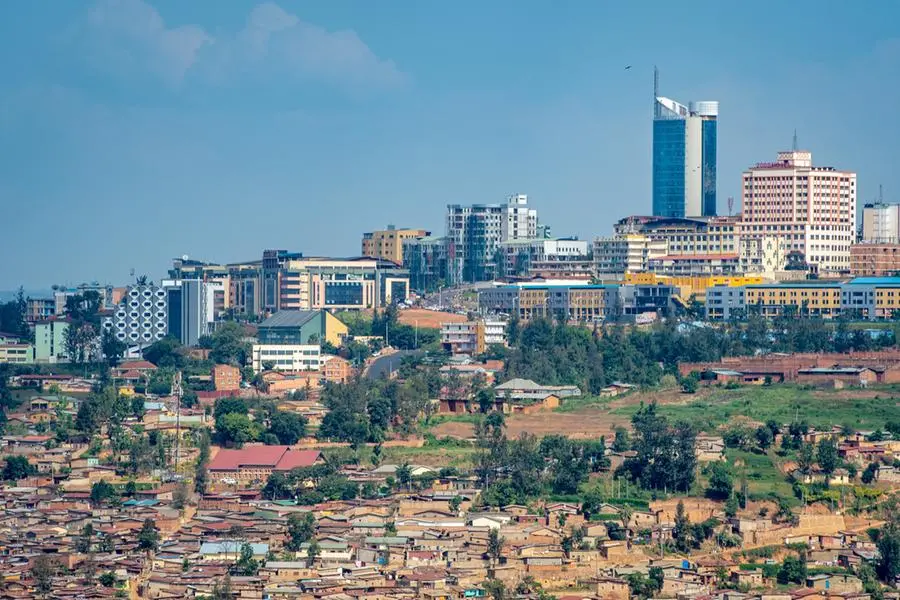
PHOTO
Germany has signed a development aid deal with Rwanda to implement a pending funding arrangement, after months of suspension due to the conflict in eastern Congo.
On October 6, Berlin and Kigali inked a grant agreement worth €18 million ($21 million, Rwf30.5 billion) to support programmes aimed at promoting inclusive social welfare and development.
The new aid agreement signals improving relations between the two countries, which had deteriorated earlier this year due to the conflict in the eastern Democratic Republic of Congo (DRC).
The German officials said the new deal had, in fact, been agreed in principle, long before Berlin suspended new funding aid to Rwanda over accusations that Kigali was supporting M23 rebels in eastern DRC and subsequently summoned the Rwandan ambassador in Berlin.“The Federal Ministry for Economic Cooperation and Development announced on March 4, 2025 the suspension of new financial commitments. The grant in question had in principle been agreed upon before this date,” a spokesperson from the German Embassy in Kigali told The EastAfrican.“The long-standing relations between Germany and Rwanda are wide-ranging and encompass numerous areas of mutual interest and cooperation.”German’s move in March had angered Rwanda, with the Foreign Affairs ministry terming Berlin’s move “counterproductive.”“Countries like Germany, which bear historical responsibility for the recurring instability in this region, should know better than to apply one-sided, coercive measures,” the ministry said in a statement then.
The new support will be implemented through projects under the Local Administrative Entities Development Agency (Loda), which focuses on funding development initiatives at the local government level.
Yusuf Murangwa, Rwanda’s Minister of Finance and Economic Planning, who signed the deal on behalf of the government, said the funds will strengthen nutrition programmes, cash transfers—including old-age and disability grants—as well as public works.
Gonza Muganwa, a political analyst, said there are several factors that may have influenced change of stance by Germany.
The lobbying pressure from the DRC and Belgium is no longer relevant in this situation. Germany has had strong development relations with Rwanda for some time,” Muganwa said, referring to a peace deal between Rwanda and the Democratic Republic of Congo, signed in June after US mediation.
The two countries, who have accused each other of fomenting rebellions against their stability, agreed to reach a definitive peace agreement later in the year.
Germany is among Rwanda’s main donors, having provided $98 million between 2022 and the end of last year.
Other Western development partners also paused aid and Belgium even cut diplomatic ties.
At the time, Germany said it was working with “bilateral partners” to restrict aid to Rwanda.
Germany has resumed aid even though the conflict in eastern DRC remains unresolved. But both Rwanda and DRC have since signed a peace deal mediated by the United States. Kinshasa is also negotiating with M23 rebels, with Doha, with Qatar acting as mediator.
Prior to this decision, Germany had informed Rwanda in advance and urged it to withdraw support for the M23.
When the war in eastern DRC escalated, Rwanda was accused of helping the rebels capture key strategic towns such as Goma and Bukavu in North Kivu and South Kivu. As a result, Rwanda faced global pressure over allegations of backing the M23.
Rwanda injects foreign aid directly into its national budget, with external grants accounting for a significant portion—8.3 percent of the 2025/26 budget.
While foreign aid remains a significant component, its levels have been a point of discussion due to concerns about the country’s dependency and recent trends of major donors reducing their funding. Nonetheless, Rwanda is known for its strategies to mitigate these effects.
In 2024, Rwanda maintained strong real GDP growth of 8.9 percent, exceeding the projected 8.3 percent. Of this growth, services contributed 5.2 percent, industry 1.8 percent, and agriculture 1.2 percent.
GDP growth is projected at 7.1 percent, 7.5 percent, and 7.4 percent in 2025, 2026, and 2027 respectively, before stabilising at 7.0 percent in 2028.
The agriculture sector grew by 5 percent, driven by the outstanding performance of food crops, which also grew by 5 percent due to good harvests in both agricultural seasons. This sector is projected to grow by 5.3 percent next year.
© Copyright 2022 Nation Media Group. All Rights Reserved. Provided by SyndiGate Media Inc. (Syndigate.info).