PHOTO
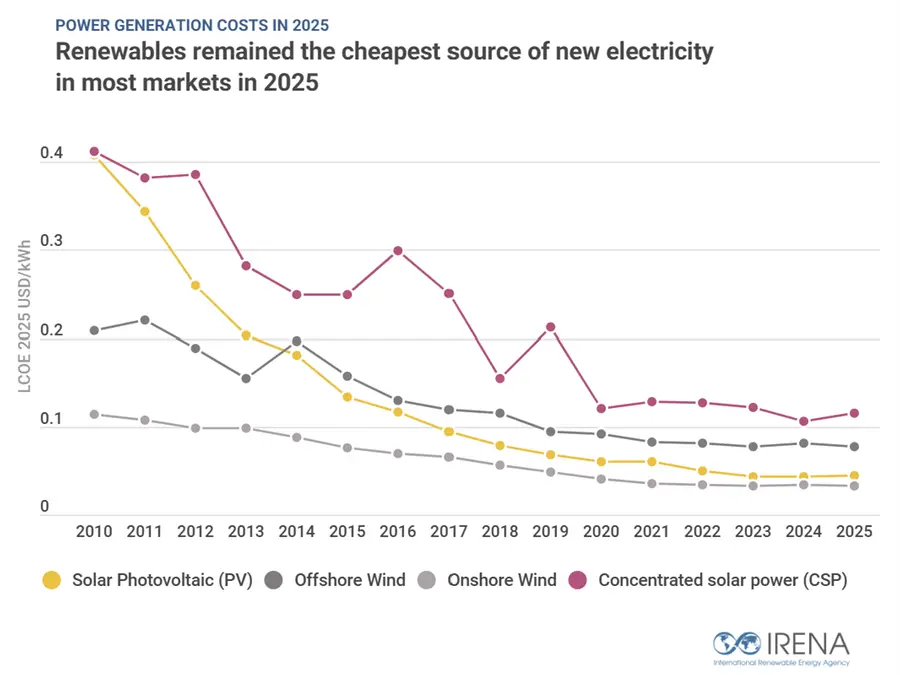
Abu Dhabi, United Arab Emirates - Renewable power costs remain low, making renewables the cheapest source of new electricity in most markets and further strengthening their cost advantage over fossil fuels.
Renewable Power Generation Costs in 2025, released by the International Renewable Energy Agency (IRENA) today, estimates that more than 90% of the utility-scale renewable capacity added in 2025 was cheaper than the lowest-cost new fossil alternative.
The cost advantage of renewables over fossil fuels continued to widen. In 2025, Solar PV remained at its 2024 level of USD 44 per megawatt hour (MWh), while wind continued to improve, with onshore wind falling by 4% to USD 33/MWh and offshore wind by 3% to USD 78/MWh.
Conversely, for new gas-fired generation, a turbine shortage roughly doubled the capital cost of a new combined-cycle plant in the United States, while costs climbed towards USD 100/MWh in higher gas price markets such as Italy, Germany and Japan. Furthermore, persistent uncertainty surrounding the crisis in the Middle East is likely to keep gas prices elevated throughout the year.
In total, installed renewables helped avoid an estimated USD 480 billion in fossil-fuel costs in 2025, turning renewables into a geopolitical shock absorber against fossil-volatile systems in energy crisis.
Francesco La Camera, Director-General of IRENA said: “The decline in renewable energy costs is delivering a powerful economic dividend. For countries that still rely heavily on fossil fuels, every additional megawatt of renewables strengthens economic protection against fuel-price volatility, shielding consumers, businesses and public finances from higher costs. Savings generated by existing renewable assets grow, providing a built-in hedge against future shocks. This energy crisis has shown yet again: expanding renewable capacity is a strategic investment in resilience and competitiveness.”
When the Strait of Hormuz closed in early 2026, causing import prices to spike across Asia and Europe, existing renewable electricity generation provided a crucial financial buffer.
Across the three import-exposed Southeast Asian economies Indonesia, Thailand and the Philippines for example, the existing renewable fleet avoided around USD 5.7 billion in coal and gas purchases in 2025. Valued at the higher fuel prices during the peak of the crisis in March-May 2026, those same volumes would have been worth USD 6.5 billion.
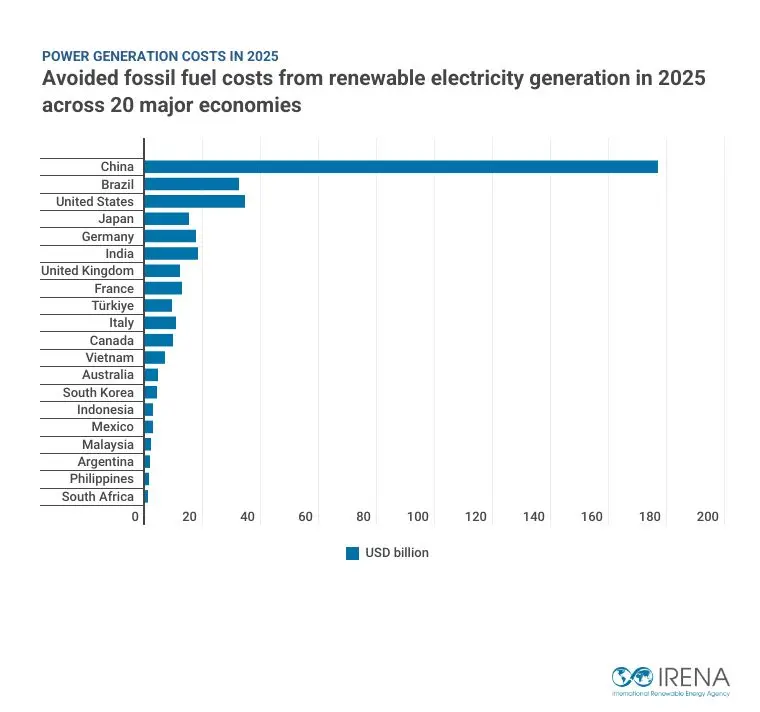
The economic benefits of renewable power go well beyond generation costs. Across 20 major economies assessed, accounting for about four-fifths of world’s renewable generation, renewable power in 2025 avoided an estimated USD 377 billion in fossil-fuel purchases.
The geographic distribution of economic benefits closely mirrors the global distribution of renewable energy capacity. China alone accounted for USD 177 billion or around half of all cost savings, reflecting the scale of its renewable fleet. The USA placed second in avoided fossil fuel costs with USD 35 billion, followed by Brazil with USD 32 billion, India with USD 18 billion, Germany with USD 18 billion and Japan with USD 15 billion.
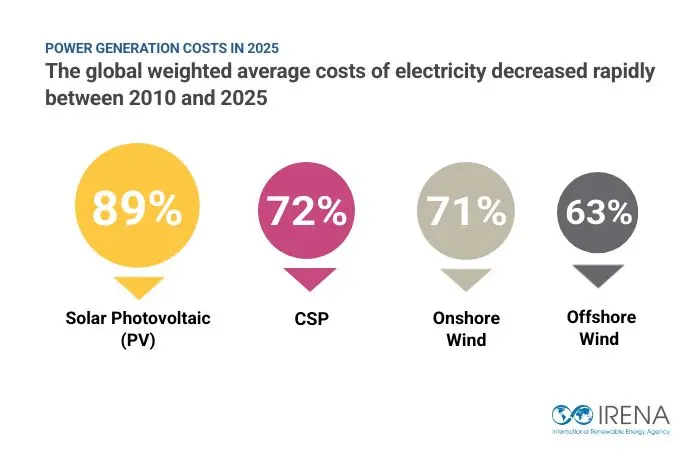
Since 2010, the cost of solar PV has fallen by 89%, concentrating solar by 72%, onshore wind by 71% and offshore wind by 63%. The massive expansion of manufacturing, especially in China, resulted in a highly competitive landscape characterised by thin margins and prices approaching production cost.
This phase of intense competition is shifting. Clean-tech manufacturing investment has halved, from a quarterly peak of USD 70 billion in 2023 to USD 35 billion by the end of 2025. And while China is reorganising its renewable industry, commodity and component prices are rising globally in parallel.
These developments, combined with a shifting trade and tariff landscape, are likely to exert upward pressure on total installed costs throughout this year. Over the longer term, however, IRENA's outlook suggests that costs will continue to decline to 2035, though far more slowly than before.
About the International Renewable Energy Agency (IRENA)
IRENA is the lead intergovernmental agency for the renewables-based energy transition in pursuit of a systemic change across the energy sectors. A global energy agency comprised of 172 members, with 13 additional countries in accession, IRENA provides knowledge, technical assistance and capacity building, project and investment facilitation. The Agency enables international cooperation and partnerships to fight climate change and promote sustainable development, energy access, energy security and resilient economies and societies.
Contact information:
Nicole Bockstaller, Chief, Communications Officer, IRENA, nbockstaller@irena.org