PHOTO
Doha – The College of Islamic Studies (CIS) at Hamad Bin Khalifa University (HBKU) convened a Joint Capacity-Building Seminar on Corporate Sustainability Reporting in collaboration with the Qatar Central Bank (QCB), Qatar Financial Centre Regulatory Authority (QFCRA), Qatar Financial Markets Authority (QFMA), and Qatar Stock Exchange (QSE).
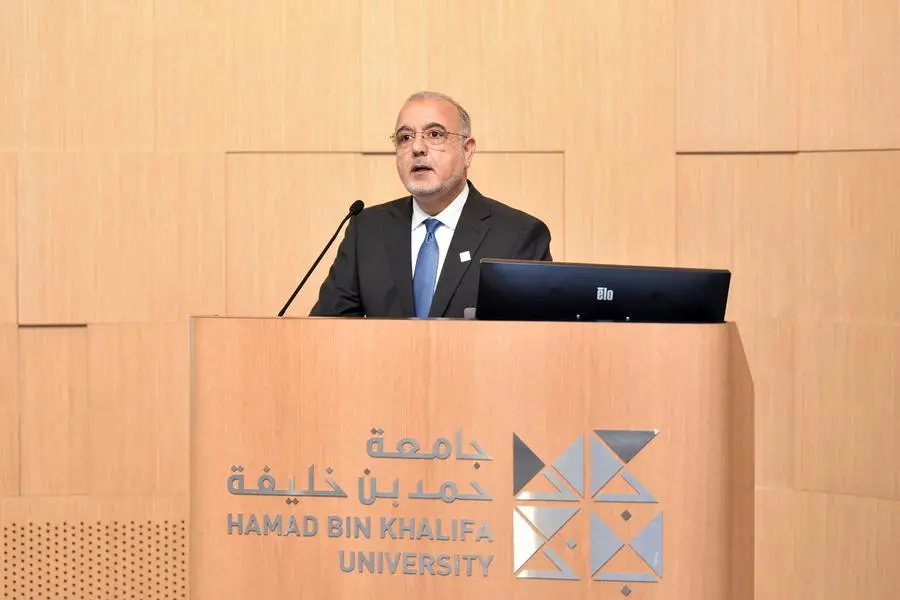
Held at HBKU’s Minaretein Auditorium, the seminar brought together regulators, academics, and industry professionals to advance Qatar’s adoption of the International Sustainability Standards Board (ISSB) frameworks. The event focused on practical strategies for implementing the newly published corporate sustainability reporting framework based on IFRS S1 and S2.
Opening the seminar, Dr. Adnan Abu-Dayya, Associate Vice President for Research at HBKU, highlighted the importance of building institutional capacity through applied collaboration. “As Qatar strengthens its sustainability ecosystem, partnerships between research and practice are instrumental,” he said. “This seminar provides a venue to exchange best practices and strengthen national readiness for global corporate sustainability reporting standards.”
Strengthening Foundations for Corporate Sustainability Reporting
Discussions throughout the day focused on how to start the journey in applying IFRS S1 and IFRS S2 standards. Speakers examined how sustainability strategies can be integrated into governance processes and data systems, ensuring that organizations are equipped to assess material sustainability and climate risks and engage stakeholders effectively.
Participants gained insights on the climate profile of the State of Qatar, with a focus on future projections and scenarios; and vulnerability-based risk assessment of physical risks due to climate change.
A dedicated segment reviewed practical experiences from listed companies and financial institutions that have started embedding IFRS S1 and S2 into their operations. Topics included board-level engagement, data collection challenges, and aligning internal practices with the ISSB requirements.
Collective Commitment to High-Quality Corporate Sustainability Reporting
Dr. Dalal Aassouli, Assistant Professor of Islamic and Sustainable Finance at CIS, emphasized the broader impact of reliable corporate sustainability disclosures. “High-quality corporate sustainability reporting enhances access to capital, builds market confidence, and drives innovation in financial systems,” she said. “It is an essential step toward achieving both national development and global sustainability objectives.”
The event concluded with a Q&A session, providing participants with an opportunity to engage directly with regulators and discuss implementation roadmap.
Through initiatives like this, HBKU continues to lead in advancing sustainable finance, building technical expertise, and fostering cooperative dialogue that supports Qatar’s transition toward a more transparent and resilient financial ecosystem.
About Hamad Bin Khalifa University
Innovating Today, Shaping Tomorrow
Hamad Bin Khalifa University (HBKU), a member of Qatar Foundation for Education, Science, and Community Development (QF), was founded in 2010 as a research-intensive university that acts as a catalyst for transformative change in Qatar and the region while having global impact. Located in Education City, HBKU is committed to building and cultivating human capacity through an enriching academic experience, innovative ecosystem, and unique partnerships. HBKU delivers multidisciplinary undergraduate and graduate programs through its colleges, and provides opportunities for research and scholarship through its institutes and centers. For more information about HBKU, visit www.hbku.edu.qa.
For more information about HBKU, its colleges, research institutes, and initiatives, please visit www.hbku.edu.qa.
To stay up to date on our social media activities, follow our accounts on: LinkedIn, Instagram, X, and Facebook.
For any media inquiries, please contact: media@hbku.edu.qa.
About the College of Islamic Studies
One of the longest established colleges at Hamad Bin Khalifa University (HBKU), the College of Islamic Studies (CIS) was formed as a home for contemporary Islamic studies dedicated to providing a uniquely composed platform that contributes to the intellectual debate and constructive dialogue on Islam in a global context. Continuously breaking new paths and seeking novel solutions for positive, global impact, HBKU’s CIS connects academic Islamic grounding with modern social sciences in its curricula, teaching platforms, research endeavors, as well as institutional values, instilling the college’s every facet with hallmarks of collaboration, innovation, and scholarship. For more information about HBKU’s CIS, visit https://www.hbku.edu.qa/en/cis.