PHOTO
(The views expressed here are those of the author, a columnist for Reuters.)
LAUNCESTON, Australia - The divergence between China's soft steel sector and its robust appetite for imported iron ore widened in August, highlighting the difference between reality and hope.
China, which accounts for just over half of global steel production, saw output drop for a third month in August to 77.37 million metric tons, according to official data released on Monday.
This was the weakest month since December, and was down 0.7% from August last and 2.9% below the 79.66 million tons recorded for July.
Steel output for the first eight months was 671.81 million tons, a drop of 2.8% from the corresponding period last year.
The weakness in steel is not being mirrored in iron ore, with imports and prices remaining robust.
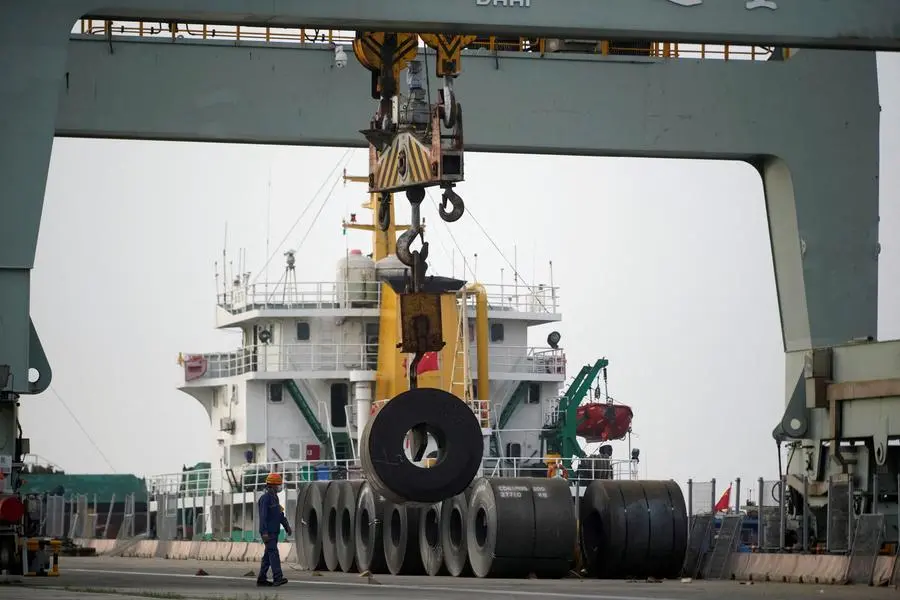
China, which buys about 75% of global seaborne iron ore, saw imports of 105.23 million tons in August, according to official data released last week, the third straight month they had been above 100 million tons.
It is likely this will extend to a fourth month in September, when commodity analysts Kpler forecasts imports of 112.2 million tons, which, if achieved, would be the highest since December last year.
At the same time iron ore prices are rallying, with benchmark futures on the Singapore Exchange ending at $105.50 a ton on Monday, just below the six-month high of $106.75 hit on September 9.
The front-month contract is up 13% from its low this year of $93.35 a ton reached on July 1.
Iron ore prices are responding to strong Chinese demand, but the real question is why are mills buying more of the key raw material in the face of lower steel output and contracting profit margins.
The answer is that they are still optimistic that Beijing's efforts to stimulate steel-intensive sectors, such as construction, will bear fruit.
The problem is that evidence for this is lacking, with new home prices dropping by 0.3% in August from the previous month, extending a downward trend that started in May 2023.
New construction starts are also weak, dropping 19.5% in August from the same month in 2024.
SEPTEMBER STEEL RECOVERY
On the positive side of the ledger there is optimism that steel output will recover in September after the soft August result, some of which was blamed on production curbs to limit pollution during the run-up to Beijing's military parade on September 3 to mark the end of World War Two.
But even if steel output does recover in September, there are questions as to how big or sustained this will be.
It is believed that Beijing has an informal target that annual steel production should be held to the same levels around 1 billion tons that have prevailed for the past five years.
Subtracting year to date steel output from 1 billion leaves about 328 million tons available for the last four months of the year, or an average of 82 million tons per month.
This suggests there is scope for output to rise in September and over the fourth quarter.
Visible inventories of steel and iron ore have been rising but are still at levels that suggest more could be added to stockpiles.
Inventories of steel rebar , monitored by consultants SteelHome, rose to 4.69 million tons in the week to September 12.
Rebar stockpiles tend to build over the northern winter and peak in March, and the current level is still below the March 2025 peak of 6.36 million tons and the 8.37 million from March 2024.
Iron ore inventories at China's ports rose to 132.6 million tons in the week to September 12, down from 149.4 million in the same week last year.
Enjoying this column? Check out Reuters Open Interest (ROI), your essential new source for global financial commentary. ROI delivers thought-provoking, data-driven analysis of everything from swap rates to soybeans. Markets are moving faster than ever. ROI can help you keep up. Follow ROI on LinkedIn and X.
The views expressed here are those of the author, a columnist for Reuters.
(Editing by Clarence Fernandez)