PHOTO
(The opinions expressed here are those of the author, a columnist for Reuters.)
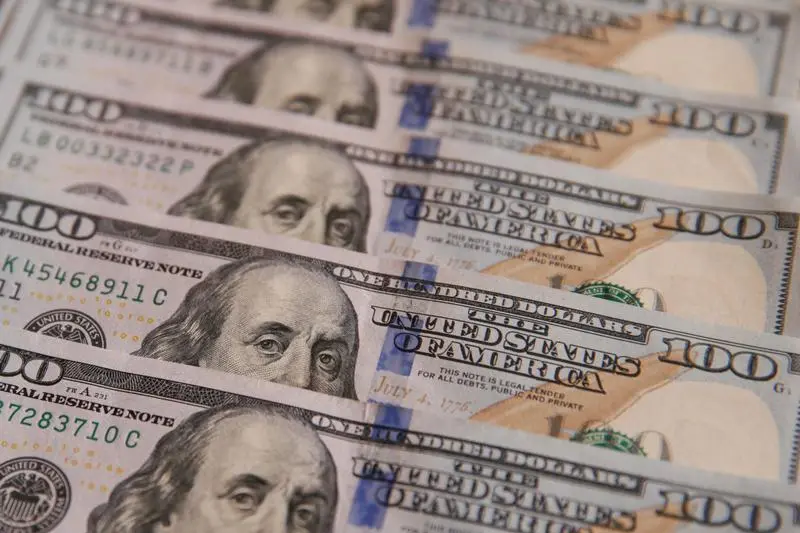
LONDON - The year is already so jarring that many in markets barely have time to digest one seismic news event from Washington before another one hits. But a dollar risk premium appears to be rebuilding regardless - most clearly in last week's sudden swoon.
Like all attempts by Wall Street to model measures of risk, there are many different ways to slice and dice what a dollar risk premium might look like and even what it might represent. A weakening exchange rate, by itself, may be perfectly reasonable and warranted. But sometimes pricing throws up obvious anomalies that raise red flags.
Risk premia typically capture uncertainty or doubt in the market beyond what can be explained simply by fundamentals and relative economic performance, even if precise measurement often just hinges on the inputs you use - or the analyst you read.
For currencies, that uncertainty shows up in two common places: how far an exchange rate moves from "fair value" models, and how much it deviates from what relative interest-rate gaps would normally suggest.
It was seen most clearly during the April tariff shock last year - when U.S. stocks, bonds and the currency fell in tandem amid U.S. capital-flight fears. The dollar plunged versus the euro despite a 50 basis point widening of the two-year transatlantic yield differential in favor of the U.S. in the month through April 10.
As last year wore on, that peculiar market behaviour appeared to normalise again to some degree. But it has reemerged after the fresh geopolitical, trade and Federal Reserve independence worries of 2026 so far.
This adds to anxiety that U.S. President Donald Trump's administration is happy to see the dollar weaken as part of its global trade reset. The greenback nosedived again to four-year lows against the euro and other European currencies last week and recoiled against Japan's yen after U.S. authorities pointedly checked dollar/yen rates on the market.
That latter move was read as a warning shot about intervention to weaken the dollar more broadly.
Once again, a risk premium seemed to reopen and the euro surged up through $1.20 even though the U.S. two-year yield gap in favor of the dollar had climbed some 20bps through January.
Writing before Friday's nomination of Kevin Warsh as the next Fed Chair steadied the dollar ship somewhat, strategists at Morgan Stanley detailed how they view this dollar risk premium. They said a gauge they watched had increased above averages seen since the "Liberation Day" tailspin last year.
Even though political and policy uncertainty had risen again this year, they said it hadn't yet exceeded last April's blowup. Still, they said currency hedging behavior now bears close watching.
The main measures they looked at were 10-day dollar moves versus major currencies that exceeded what rate differentials would imply. At one point last week, those deviations reached about 4%–5% against the euro, yen, Swiss franc and others.
"While we are neutral right now, we think that the stars continue to align that the dollar-negative breakout is coming," the Morgan Stanley team told clients.
RISK PREMIA AND THE ANTI-DOLLAR
Barclays currency analysts also reckon dollar risk premia have jumped again this year after the Greenland row and the joint U.S.-Japan currency action, and this has offset other dollar positives from economic and wider market performance.
"The size of the premium is first and foremost a function of confidence in U.S. policy-making," they told clients.
"The main second-round risk is that dollar weakness spills over to capital outflows and generalized U.S. asset price weakness."
To gauge it, they measure the dollar against the euro - "the main anti-dollar" and look how far it diverges from relative real 10-year yields. And that showed a premium of as much as 5% had reemerged, compared with roughly 7% in April last year. The premium is "wide but, by historical standards, not extreme", they wrote.
Reinforcing that view, one-month implied volatility in the euro/dollar pair spiked midweek last week to its highest since last May and close to 10%.
Warsh's nomination as new Fed Chair - and a perception that he may not be as aligned with Trump's demands to halve current interest rates as other candidates - may ease pressure for now.
But that assumes the frenetic, and at times alarming, news flow of the year so far begins to calm down a bit.
(The opinions expressed here are those of the author, a columnist for Reuters.)
Enjoying this column? Check out Reuters Open Interest (ROI), your essential new source for global financial commentary. Follow ROI on LinkedIn, and X.
Plus, sign up for my weekday newsletter, Morning Bid U.S. and listen to the Morning Bid daily podcast on Apple, Spotify, or the Reuters app. Subscribe to hear Reuters journalists discuss the biggest news in markets and finance seven days a week.
(by Mike Dolan; Editing by Marguerita Choy)