PHOTO
ORLANDO, Florida - Conditions are ripe for a strong rally in the 'safe haven' Japanese yen, with a global stock market selloff sparking volatility across asset classes. But the Japanese currency is falling fast, calling into question its long-perceived role as a preferred hiding spot for spooked investors.
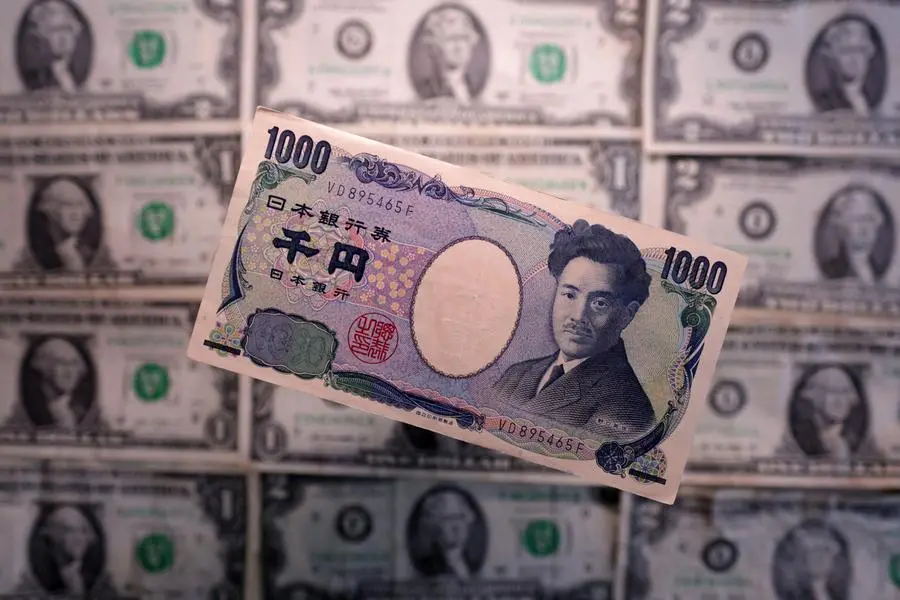
The yen this week has tumbled to a 10-month low against the dollar and the weakest level ever against the euro. It has been, by far, the worst-performing G10 currency in recent months, raising the prospect of Japanese authorities intervening to lend it some support.
Domestic issues are the key factor here. Japan's new Prime Minister Sanae Takaichi appears to be taking notes from the Donald Trump playbook: go large on fiscal stimulus and lean on the central bank to keep interest rates as low as possible, even if inflation is elevated.
Unsurprisingly, investors are in no rush to pile into the yen despite the global market jitters.
The yen's status as a major safe-haven currency, which it shares with the U.S. dollar and Swiss franc, is rooted in the large current account surpluses and ultra-low or zero interest rates that Japan ran for decades.
These conditions gave rise to the yen carry trade. Japanese investors recycled the surpluses into higher-yielding assets overseas, making Japan the world's largest creditor nation for many years. At the end of June, Japan held a net $3.62 trillion in overseas stocks and bonds, according to the International Monetary Fund.
In previous bouts of global market turbulence, repatriation of even a slender slice of that mountain of assets could deliver a quick, outsized boost to the yen.
But that's not happening now. Perhaps the tremors roiling global markets aren't strong enough yet. Or, to cite that dreaded phrase, perhaps this time is different.
CARRY THAT WEIGHT
To put it bluntly, Japan's domestic policy stance is not yen-friendly at all.
A ruling-party panel of lawmakers close to Takaichi has proposed a supplementary budget exceeding 25 trillion yen ($161 billion) to fund Takaichi's planned stimulus package. That's more than estimates floated recently and much larger than last year's $92 billion plan.
Meanwhile, Takaichi has also indicated she would prefer the Bank of Japan not to raise interest rates. Markets have reacted accordingly. Japanese government bonds have tumbled, sending yields to historic highs, and the swaps market indicates that the probability of BOJ rate hikes in the coming months has fallen sharply.
One might argue similar policy and political pressures are prevalent in the United States, and should therefore be pushing the dollar lower. That's fair, but these dynamics have been at play for months, so are surely priced in by now. Takaichi has been in power barely a month.
"The 'safe haven' status is challenging when so many of the negative shocks are Japan-based," says Steven Englander, head of G10 FX strategy at Standard Chartered. "The yen is super-low yielding in real and nominal terms. It takes a lot to overcome that."
FROM BOTH SIDES
The BOJ's tightening process was already slow and gradual. It last raised its policy rate in January, doubling it to 0.5%, meaning Japan's real interest rates adjusted for inflation are still deeply negative. This is fertile ground for carry trades.
Exchange rates are obviously two-sided, so it is a cruel twist for yen bulls that the BOJ could be slowing its tightening process just as the Federal Reserve seems to be doing the same with its easing plans. As the yen has been the worst-performing G10 currency in the second half of the year, the dollar has been the biggest gainer.
A deeper rout in U.S. and global markets in the coming weeks could unwind some of these yen carry trades and restore the Japanese currency's safe-haven allure.
On the other hand, with Japan's domestic policy mix being what it is, maybe that will be more of a challenge this time around.
(The opinions expressed here are those of the author, a columnist for Reuters)
Enjoying this column? Check out Reuters Open Interest (ROI), your essential source for global financial commentary. ROI delivers thought-provoking, data-driven analysis of everything from swap rates to soybeans. Markets are moving faster than ever. ROI can help you keep up. Follow ROI on LinkedIn and X.
(By Jamie McGeever. Editing by Mark Potter)