PHOTO
(The opinions expressed here are those of the author, an investment strategist for Panmure Liberum)
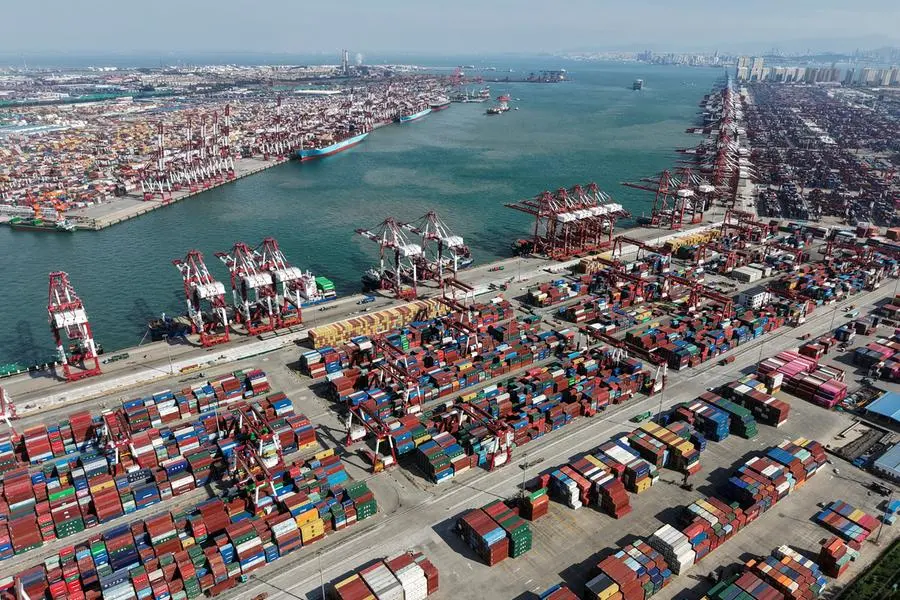
LONDON - China's export machine is slamming into Europe again. European manufacturers are feeling increasing pressure from a surge of cheap Chinese imports for the second time in two decades.
The European Union likely has little interest and few effective tools to fight a second "China shock." Yet there is a flip side. This so-called "trade diversion" may allow the European Central Bank to cut interest rates more aggressively than markets expect, lifting GDP growth in 2026 while keeping inflation anchored around 2%.
INDUSTRIAL CORE UNDER FIRE
Chinese overcapacity and the drop in U.S. demand due to tariffs introduced in 2025 have revived fears in Europe of a second China shock, which could potentially be much worse than the first.
While the continent was flooded with low-value consumer goods after China joined the World Trade Organization (WTO) in 2001, today's disruption hits Europe's industrial core: autos, machinery, and high-tech equipment. The European Commission this year set up a Surveillance Task Force to monitor trade diversion - more accurately described as price dumping.
Its data show Chinese exporters increasingly targeting the EU with apparel, appliances, furnishings, industrial raw materials, and high-tech products.
The numbers are stark. Over the last 12 months through October, imports of industrial robots from China have risen 171%, while prices fell 31%. Imports of integrated circuits are up 84%, with prices down 6%. Car imports have more than doubled while prices dropped 15%. The result is intensifying margin pressure on European manufacturers of high-tech goods, who must now deal not only with weak Chinese demand and U.S. tariffs, but also competition from cheaper Chinese products in their home markets.
WHY BRUSSELS WON'T RETURN FIRE
The EU has threatened targeted tariffs on Chinese imports to level the playing field, similar to its 2024 measures on Chinese electric vehicles (EVs).
Yet, those EV tariffs are a cautionary tale: they narrowed but did not erase China's price advantage. Chinese EVs continue to gain market share in the EU, albeit at a slower pace.
All this is bad news for European industrial manufacturers and the automotive industry, who are lobbying Brussels to introduce more aggressive tariffs to stop the trade diversion.
There are three reasons why the EU is unlikely to opt for a broad-based escalation with China.
First, Europe is heavily dependent on China, much more so than the U.S., both as an export market and as a source of vital inputs. Retaliatory Chinese tariffs could hurt EU manufacturers abroad more than higher EU tariffs would help them at home. Second, the EU desperately needs to lower energy costs. EU industrial electricity prices average 0.199 euros per kilowatt-hour, about twice as much as in the U.S. and 50% more than in China, according to the International Energy Agency.
One way to address this is accelerating the build-out of wind and solar energy, but both are highly reliant on Chinese components and equipment. Aggressive tariffs risk slowing or reversing the green transition and making it more expensive. Finally, and possibly most importantly, some EU leaders are increasingly advocating a European pivot toward Beijing as several member countries benefit from large Chinese investments.
Hungary, Spain, and Germany in particular now host large Chinese factories for batteries and EVs. These plants create jobs and tax revenues, but also shift political influence away from traditional European manufacturers and toward their Chinese competitors.
BLESSING IN DISGUISE
While this latest China shock is clearly negative at the sector level, there is a twist.
Over the last 12 months through October, the price of Chinese imported goods has declined by an average of 20%. These imports directly influence prices in roughly 23% of the euro zone's inflation basket. In a recent blog post, ECB economists estimated that Chinese trade diversion could reduce euro zone inflation by up to 0.15 percentage points in 2026.
Unlike in the U.S. or Britain, euro zone inflation is already close to the central bank's 2% target and is poised to drop below this level even without the additional disinflationary impulse from China. But the added downward price pressure could help.
In this environment, the ECB may be able to cut interest rates more aggressively than is currently expected. Easier monetary policy should then support stronger GDP growth in 2026.
So even though Europe's second China shock will deepen the structural challenges facing the bloc's industrial base, it may – at least in the short run – prove to be a blessing in disguise.
(The views expressed here are those of Joachim Klement, an investment strategist for Panmure Liberum.)
Enjoying this column? Check out Reuters Open Interest (ROI), your essential new source for thought-provoking, data-driven financial commentary. Markets are moving faster than ever. ROI can help you keep up. Follow ROI on LinkedIn, and X.
(Writing by Joachim Klement Editing by Marguerita Choy)