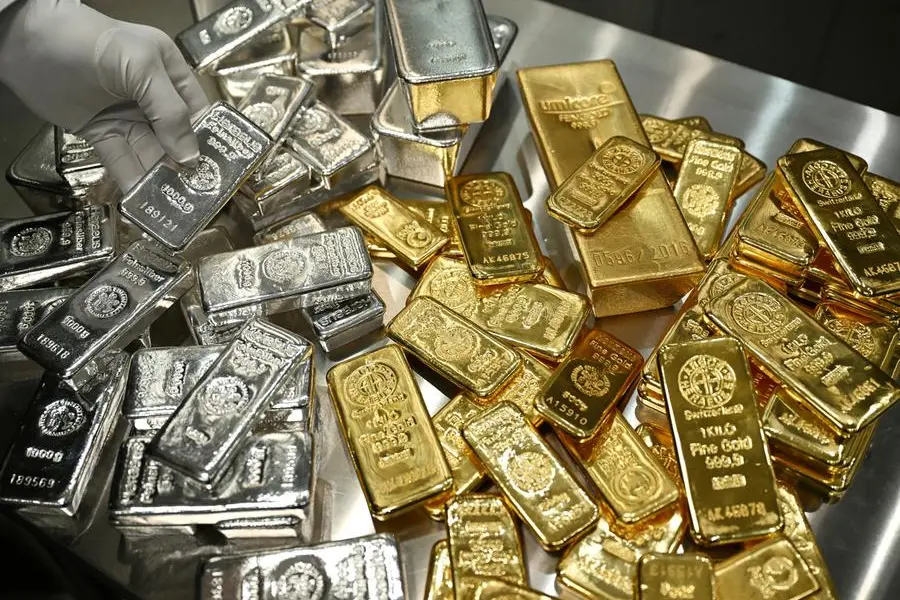
PHOTO
(The views expressed here are those of the author, a columnist for Reuters.)
LAUNCESTON, Australia - Silver may be viewed as something of a bridesmaid to gold in precious metal markets, seemingly overshadowed by its more talked about rival.
But silver is quietly outperforming gold in generating returns to investors and perhaps has a more compelling long-term outlook given a structural supply deficit and surging demand from renewable technologies such as solar panels.
Spot silver has been in a sustained uptrend since October 2023, leaping by 163% from a low of $20.67 an ounce on October 3 of that year to a record high of $54.38 on November 13.
It has since retreated 5.6% to close at $51.33 an ounce on Wednesday.
Spot gold rose by 142% from a low of $1,813.90 an ounce on October 3, 2023 to a record of $4,381.21 on October 20, before retreating 5.0% to close at $4,163.51 on Wednesday.
While silver hasn't massively outperformed gold, its stronger gains have come without the high media profile assigned to perhaps the more glamorous of the two precious metals.
Silver also has a track record of delivering higher percentage returns than gold, with a rally of 431% between October 2008 to a then-record high of $48.24 an ounce on April 27, 2011.
Gold also rose over that time period to its then all-time high of $1,920.30 an ounce on September 6, 2011, but its gains were a more modest 168%.
The media tends to focus more on gold when it rallies given its role throughout history as a store of value and its appeal as jewellery.
The current uptrend was supercharged after the return of Donald Trump to the U.S. presidency, which sparked expectations of monetary policy easing, but also of a risk of a loss of confidence in U.S. assets such as Treasuries as his administration sought greater control over the Federal Reserve.
Central bank buying and strong investor interest in both gold exchange-traded funds and bars and coins helped propel gold's rally.
Silver does ride on gold's coattails to a certain extent, but its lower value means its more costly to store physical silver, which does limit some of its investment appeal.
SOLAR SURGE
The more compelling bullish case for silver lies with increasing industrial demand and limited scope to boost mined output.
Industrial demand rose to 689.1 million ounces in 2024 from 644 million the prior year, according to LSEG data.
Of this, 243.7 million ounces was for use in solar panels, up from 191.8 million the prior year and up 158% from the 94.4 million in 2020.
Global solar capacity additions were about 600 gigawatts (GW) in 2024, and are expected to rise to close to 1,000 GW by 2030.
The International Energy Agency expects 4,000 GW of new solar capacity will be installed from 2024 to 2030.
This suggests that solar alone is going to drive silver demand higher by close to 150 million ounces a year by 2030, which would represent an additional 13% on top of the 2024 physical demand of 1.169 billion ounces.
While other sources of silver demand may be squeezed by higher prices, such as jewellery, it's likely that the market will struggle to keep up with demand.
The market deficit, as calculated by LSEG, was 501.4 million ounces in 2024, up sharply from 19.4 million in 2023.
The majority of mined silver is produced as a byproduct of other metals, such as copper, lead, zinc and gold.
This means supply gains are largely dependent on the supply-demand economics for those metals, rather than on silver's fundamental outlook.
Silver supply may well increase in coming years given positive sentiment towards copper and gold, but expanding output from existing mines or developing new projects is a lengthy process and may take some time to materialise.
Silver supply may also be constrained by the expected closure of some mines by 2030, with an article on industry website Mining Technology published in July forecasting that global silver production will drop to 901 million ounces by 2030 from an expected 944 million this year.
Enjoying this column? Check out Reuters Open Interest (ROI), your essential new source for global financial commentary. ROI delivers thought-provoking, data-driven analysis of everything from swap rates to soybeans. Markets are moving faster than ever. ROI can help you keep up. Follow ROI on LinkedIn and X.
The views expressed here are those of the author, a columnist for Reuters.
(Editing by Sonali Paul)