New orders and employment grow solidly
The Saudi British Bank "SABB" has published the results of the headline SABB HSBC Saudi Arabia Purchasing Managers' Index™ (PMI™) for July 2011 - a monthly report issued by the bank and HSBC. It reflects the economic performance of Saudi Arabian non-oil producing private sector companies and establishments through the monitoring of a number of variables, including output, new orders, exports, input prices, output prices, quantity of purchases, stocks and employment.
PMI data signalled a sharp slowdown in the rate of expansion of Saudi Arabia's non-oil private sector economy at the start of Q3. Noticeably weaker rises were recorded in both output and new orders, while job creation also moderated. Reflecting this, the headline seasonally adjusted SABB HSBC Saudi Arabia PMI™ registered a 10-month low of 60.0 (down from 62.8 in June). Nevertheless, the PMI remained comfortably above the neutral mark of 50.0, suggesting that business conditions continued to improve at a marked pace.
KSA non-oil private sector companies recorded further growth of new business in July, which respondents linked to favourable market conditions, good demand and new product launches. However, the rate of expansion slowed noticeably from June's near-record high to a nine-month low. This was despite a faster increase in new export business. New work from abroad rose at an unprecedented rate in the latest survey period.
In line with a weaker trend in new order growth, output rose at a much slower pace during July. Nevertheless, activity continued to expand at a robust pace. Medium-sized firms registered a stronger increase in output than small or large companies.
Unfinished business continued to accumulate during July. However, the rate of increase remained only marginal and much weaker than the average for the past year.
To manage current workloads and company expansions, as well as to comply with the government's new Nitaqat system, firms recruited additional workers in July. Employment rose solidly, but at a milder rate than in the previous four months.
Buying activity increased at a much slower rate in July, reflecting an easing trend in new order growth. Input stocks continued to rise solidly.
Key Points:
· Output rises at slowest pace since February 2010
· Jobs growth continues to slow, but remains solid
· Input price inflation broadly stable in July
· Charges rise at slowest pace for five months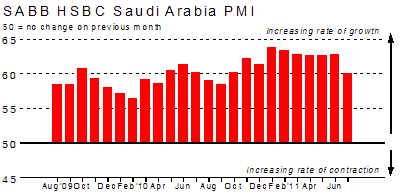
Panellists reported longer lead times in July for the first time in the survey history. Firms blamed greater demand for inputs, low manpower at suppliers and payment problems for delays. That said, the rate of deterioration was only slight.
Input price inflation was broadly stable in July, as a sharper rise in staff costs was outweighed by a slowdown in purchase price inflation. In relation to the series trend, the overall rate of increase was nonetheless substantial.
Companies took advantage of favourable demand conditions to pass through some of their increased input costs to customers in July. Charges rose solidly as a result, but at the slowest pace for five months.
-Ends-
© Press Release 2011