Hay Group releases its annual salary report for the Kingdom of Saudi Arabia this week. The consultancy reports steady salary growth in the Kingdom over the last 12 months, and forecasts another solid 12 months of growth ahead, driven by Nitaqat and rising living costs.
More than 250 organisations in the Kingdom including those in the public sector, banks, and oil, gas and petrochemical companies contributed to this year's report which analyses salary information for almost 240,000 employees comprising both nationals and expatriate workers.
Wendell D'Cunha, Manager of Reward Information Services at Hay Group said that increases this year have been marginally lower than forecast but still in line with inflation:
"This time last year we forecast a 5 per cent increase in basic pay for 2011. The actual average salary increase is 4.4 per cent however there are significant differences depending on industry sector and nationality. Including allowances, the average guaranteed cash package has increased by 7.5 per cent on average for Saudi nationals."
"Over the last eight years, average real* salary increases equate to inflationary increases, ensuring that the value of money people earn has not diminished. Within the last three years, increases have been lower than inflation; if this trend continued then we would see the purchasing power of individuals lessen."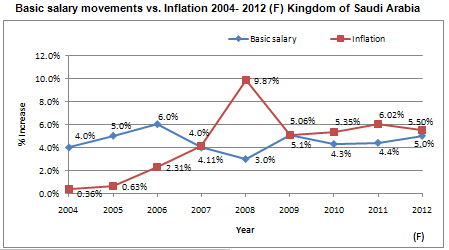
He continued: "Hay Group is forecasting a continued steady increase in pay movements in the year ahead. The average increase is predicted to be 5 per cent for the Kingdom which will see pay movements converging with inflation rates."
Another key finding from the report is that 30 per cent of organisations reported that employee retention has become more difficult over the last 12 months, which is an increase of 10 per cent on last year's figure. Average staff turnover now stands at 8 per cent.
Chance Wilson, General Manager of Hay Group in Saudi Arabia, says the Government's Nitaqat programme and rising costs of living in the Kingdom contribute to the steady growth in salaries in the Kingdom:
"The report shows that Saudi nationals are paid 13 per cent higher than the general market average when we look at total cash. Pressures on organisations to achieve their target quota of Saudi nationals are apparent in the trends we see in the 2011 report which are part of a wider socio-economic story."
He continued: "Compared to five, or even three, years ago Saudi nationals are much more in demand and are now in the favourable position of being able to pick and choose between employers. Because organisations are obliged to comply with legislation committed to building national capability, it has become an attractive market for Saudi candidates. Saudi nationals can sell themselves a lot better and the competition for high quality Saudi talent has become more intense."
Mr. Wilson says expatriate workers also shape the pay market:
"Another dynamic driving salary movement is the escalating cost of hiring expatriate workers. Because of rising living costs, recruiting and re-locating a skilled expatriate worker is expensive when you consider housing and schooling in a city like Riyadh. Companies cannot afford the mobility allowances they used to."
He concluded: "As the full force of the Nitaqat programme comes into play, we are likely to see more favourable reward packages offered to Saudi nationals in comparison to the overall market."
* 'Real salary increases' are calculated by taking into account both actual salary increases and the rate of inflation to calculate the 'real' pay movement.
The Hay Group Compensation Report in Saudi Arabia is published on an annual basis. The latest report was published in September 2011. The report covers salary administration, cash compensation, allowances and non-cash benefits. Similar studies are done in each country in the Middle East and North Africa region.
Please note: these findings should be credited to 'global management consultancy Hay Group', and not 'Hay' or 'Hays', which are separate and unrelated organisations.
-Ends-
About Hay Group
Hay Group is a global consulting firm that works with leaders to turn strategies into reality. We develop talent, organise people to be more effective, and motivate them to perform at their best. With 84 offices in 48 countries, we work with over 7,000 clients across the world. Our clients are from the public and private sector, across every major industry, and represent diverse business challenges. Our focus is on making change happen and helping organisations realise their potential. For more information, please visit www.haygroup.com/uae.
For further information:
Miss Joanne Rogers
M: +971 50 554 1663
E: joanne.rogers@haygroup.com
© Press Release 2011