NCB Quarterly Review of Contract Awards in The Construction Sector
HEADLINES
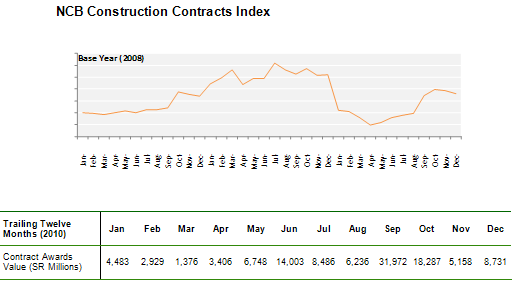
Construction Contracts Award Index during Q4 2010*
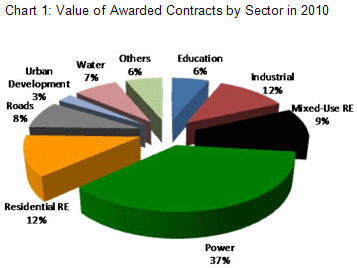
The ongoing trend of increasing awarded contracts in the construction sector during the past several years continued in 2010. Numerous mega-projects were driven by government mandates as well as private initiatives to further the development of the kingdom's physical and social infrastructures. Consequently, the value of awarded contracts in 2010 reached SAR107 billion. Most of the value of awarded contracts were driven by heavy spending sectors such as power, water and residential real estate. The power sector alone accounted for 37% of the value of all awarded contracts (Chart 1). Based on the last 3 years, it is a common occurrence for the value of awarded contracts to spike up during the second half of the year and 2010 was no different. Nearly 70% of the value of awarded contracts occurred during H2'10.
Since most of the awarded contracts were signed during the second half of 2010 the Construction Contract Index (CCI), which was lagging during the first half of the year, shot up 101 points to reach 180.2 points between the Q1'10 and Q4'10. The CCI reached its highest point of the year during Q4'10 when it peaked at 196.9 points in November. While the CCI ended lower in 2010 than it did in 2009, reaching 259.4 points, it finished 10 points higher than in 2008. As mentioned in previous reports, 2009 was an exceptional year in terms of contracts being awarded. This was mainly due to the unusually higher than average value of awarded contracts in the power and petro-chemical sectors. Nonetheless, 2010 shaped up to be a solid year for the construction sector as infrastructure related sectors such as roads and water accounted for a higher value of awarded contracts compared to the previous two years.
October
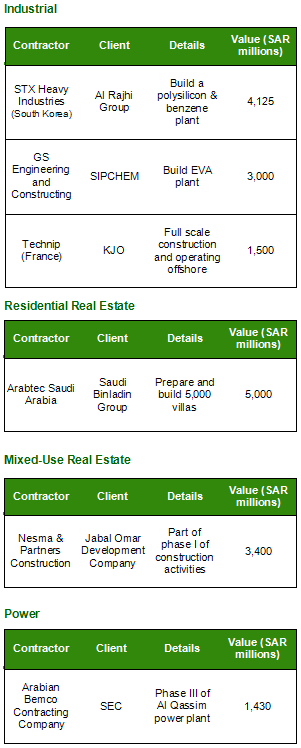
The value of awarded contracts in October reached SAR13.3 billion. The industrial and residential real estate sectors accounted for 46% and 40% of the total value of awarded contracts, respectively. The industrial sector's largest contract was awarded by Al Rajhi Group to South Korea's STX Heavy Industries to build a polysilicon plant as well as a benzene plant in the amount of SAR4.1 billion. Per the agreement, STX Heavy Industries will complete the building of the plants at the Yanbu industrial complex by 2014. A second contract in the industrial sector in the amount of SAR1.5 billion was awarded by the Saudi Arabia/Kuwait joint venture, Khafji Joint Operations (KJO) to France's Technip. The contract calls for Technip to handle all the engineering, procurement, fabrication, installation, commission and start-up of two wellhead jackets, two power distribution platforms and a main composite submarine cable.
The Saudi Binladin Group awarded a sizeable contract in the amount of SAR5.0 billion to the local Arabtec Saudi Arabia within the residential real estate sector. The contract calls for the construction of 5,000 new villas in the Eastern Province of Saudi Arabia. Arabtec Saudi Arabia, which is an affiliate of Dubai-based Arabtec Holding is expected to prepare the site and build the villas over a 48 month period.
The education sector had an awarded contract by the Ministry of Higher Education to various local contracting companies in the amount of SAR790 million. The contract was for the construction of housing units for the teaching staff of King Abdul Aziz University in Jeddah.
November
The value of awarded contracts during November dipped compared to October. However, there were many awarded contracts that were signed in the roads sector between the Ministry of Transportation and various local contracting companies, which totaled SAR2.2 billion. The contracts were awarded across the kingdom. The range of work to be completed will be the expansion of road networks, construction of road bridges and maintenance of streets and highways.
The power sector had the second largest total value of contracts worth SAR1.8 billion. Saudi Electricity Company (SEC) awarded the local Arabian Bemco Contracting Company to construct the third phase of the Al-Qassim power plant for SAR1.4 billion. Phase three of the project is expected to add an additional 560MW in power capacity.
Within the industrial sector, a copper mine contract was awarded by Bariq Mining to Canada's SNC-Lavalin in the amount of SAR1.1 billion. SNC will perform engineering, procurement and construction management (EPCM) at Bariq Mining's Jabal Sayid project in Hail. The scope of work includes ore crushing, conveying and stockpiling facilities; facilities for concentrating, storage and loading; as well as mine infrastructure including power, water and tailings disposal facilities. The project is expected to be completed during the first half of 2012.
December
The mixed-use real estate and industrial sectors accounted for 73% of the SAR8.7 billion in awarded contract values during December. The mixed-use real estate sector's largest contract was Jabal Omar Development Company's award to Nesma & Partners Construction to work on part of the first phase of the Jabal Omar development in Makkah. Construction work will be on the section of the project adjacent to Ibrahim Al Khalil Street. Nesma & Partners is expected to complete this part of the first phase within 24 months from commencement. The Jabal Omar development is designed to include 37 towers with a total built up area of 2 million square meters. The total land area of the development covers 230,000 square meters.
Within the industrial sector, a SAR3.0 billion contract was awarded by Saudi International Petrochemical Company (SIPCHEM) to South Korea's GS Engineering & Construction (GS). GS will be responsible for the engineering, design, procurement and construction for SIPCHEM's ethylene vinyl acetate (EVA) plant in Jubail. The facility is expected to have a capacity of 200,000 tons a year of EVA when completed in the second quarter of 2013. The project is part of SIPCHEM's SAR15 billion phase III expansion to its existing facilities.
Another significant contract award took place in the transportation sector as Saudi Railways Organization (SRO) awarded a SAR379 million contract to Saudi Archirodon. Saudi Archirodon will be tasked with building dual high-speed railway lines between Riyadh and Dammam. The railway, which is expected to be completed by mid 2012, will be for passengers and cargo services. The awarded contract is one of many that will comprise of SRO's master plan for the kingdom by 2040.
Outlook
The kingdom's initiatives to expand its long-term sustainable development by focusing on capital expenditures has allowed the construction sector to flourish. We expect the construction sector to continue its ongoing trend of strong growth. The 2010-2014 ninth five-year development plan's allocation of SAR1.44 trillion to capital expenditures will allow for a large amount of construction activities to continue during the medium to long-term. Furthermore, the kingdom's 2011 budget reiterates the commitment to enhance its infrastructure, healthcare, and social and economic development projects. As previously mentioned in our 2011 budget report, we project that the government's revenues will be SAR753 billion and expenditures at SAR677 billion, representing a surplus of SAR77 billion.
For 2011 we expect a similar proportion of contract awards to be distributed across the sectors, similar to 2010. Heavy spending sectors like power, water and petrochemical will continue to absorb a large portion of the value of awarded contracts. However, the government's projected expenditures of SAR150 billion in the education sector will allow for the construction of schools, campuses and educational related facilities. Additionally, the government's projected spending of SAR68.7 billion on health and social affairs will allow for the construction of new hospitals, social centers, and community welfare offices.
Appendix
NCB Construction Index Methodology
The purpose of the NCB Construction Index is to inform our readers of the scale of awarded construction projects in the Kingdom. The index tracks construction contracts that have been awarded only. It may take approximately six to eighteen months for awarded contracts to begin implementation and the length of the construction period averages around three years but is largely dependent on the size and scope of the project. Consequently, the index serves as an indicator for construction activities that will be implemented in the future.
Data from various available publications and reports are used to identify awarded construction contracts. Awarded contracts that do not state the value of the contract are excluded from the index. Additionally, construction contracts that meet the United Nations construction classifications are included in the analysis.
The NCB Construction Index begins with January 2008 as its base year. The base year is assigned an index score of 100 points and the index is also measured on a six-month moving average. Therefore, outliers are designed to have a reduced effect on the calculation of the index. In general, an index score that is higher than the base year of 100 reflects the expansion of awarded construction contracts while any value below the base year reflects a contraction.
-Ends-
© Press Release 2011