A Dubai Chamber study indicates that the GCC and India can expand and explore a strong economic growth momentum
Dubai- UAE: In the aftermath of the global economic crisis and changing economic milieu, GCC and India have a huge opportunity to explore and expand on the economic synergies between the two blocs and build on their still strong economic growth momentum, indicates a recently-released Dubai Chamber of Commerce & Industry study.
Since 1990, GCC economies have witnessed high growth rate. Substantial diversification and strengthening of non-oil sector and transformation of leading sectors in the GCC economy has widened the scope for economic cooperation with other major economies of the world. Indian economy on the other hand has been growing at above 9% over last few years and is expected to grow over 7% in spite of the global economic crisis. The economy has a huge market and with the opening up of key sectors for investment, it provides many new investment opportunities.
Following liberalization of key sectors in India, there have been large amount of foreign funds flowing in sectors like telecommunication, housing and real estate, construction activities and petroleum and natural gas. Since these are the sectors in which GCC economies have huge capability buildup and experience, India presents itself as a natural market for expanding their operations. Following are some of the key sectors that are identified as providing large investment opportunities and also been leading the discussions on the free trade agreement between the two blocs.
Infrastructure: Indian growth policies are centered on infrastructure creation. GCC companies have huge experience in infrastructure creation and maintenance in domestic market. They can thus make full use of the market opportunities in India to expand their operations and reap on economies of larger scale. This can stretch to many fields like ports, power, roads, real estate construction services, etc. GCC investors can also make use of their capability build up in related high profit sectors like commercial real estate, hotel construction etc.
Agriculture and Food Processing: India is an agricultural country and is geographically very close to GCC. This makes the Indian economy an ideal source for sourcing and developing agro based value chain in the GCC region. GCC, with a presence of an advanced processing and packaging industry, combined with highly developed transportation sector, has huge opportunities in expanding into a cost effective agro based value chain.
IT Services: Indian investors in turn have huge opportunities for investment in knowledge and skill based services in GCC, particularly in fields like IT, space technology, etc. Already India's IT products and services export to the GCC is growing at above 30% rate annually, according to industry estimates.
Education: With greater emphasis on education sector and push for scientific research facilities in the Gulf region, universities and research institutes from India can use their expertise and the market opportunities to expand in the region.
Other economic activities: GCC countries can benefit from India's experience in meeting needs and challenges of Small and Medium Enterprises and turning them into profitable ventures. Indian experience in creating a sound banking system can also be very useful for GCC countries in creating a sound banking system in the region.
Buoyant manufacturing and services sector in India coupled with booming stock market have made India a very attractive investment destination. Various investment opportunities have already been driving high volume of capital flow between the two blocs. FDI flows from GCC to India over April 2000 till December 2008 comprised 1.59% of the total FDI flow into the Indian economy. While combined data for India's share in FDI flows into GCC is difficult to find, individual country's information sources reveal that India has been one of the major source of FDI flow into GCC as well. In UAE, India is the third largest investor after UK and Japan, constituting 11% of total FDI flow into the country in 2006, according to UAE Ministry of Economy.
Oil Thrust: In spite of the emphasis on economic diversification into non oil sector among GCC countries and high potential to explore commercial and economic relationships beyond oil, current economic relationship between the GCC countries and India is based largely on oil and merchandise trade.
Continued growth momentum has propelled the energy requirements of the India economy. In 2007, India consumed approximately 2.8 million bbl per day, making it the fifth largest consumer of oil in the world. Oil demand grew to nearly 3 million bbl per day in 2008. (figure 1).
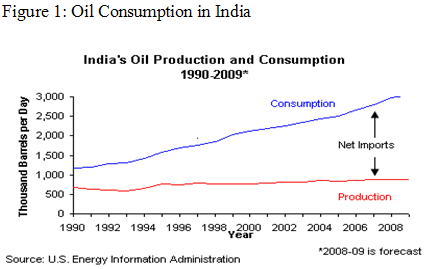
India meets 70% of its energy needs through imports and GCC has been the principal oil source for India. In view of further increase in oil demand from the economy, security of supplies, oil facilities etc are crucial for India's long term energy security interests. For the GCC companies as well, over the next five years, half of the incremental global oil demand is expected to come from Asia following surge in Asian economies. Already ranked 5th in global petroleum demand, India is likely to be a key market for GCC oil producers over next many years. India and GCC energy relationship also presents huge opportunities in the related sectors like fertilizers, pharmaceuticals, etc, for the Indian private sector to invest in and reap profits.
Trade: Trade remains the bedrock of the deep ties between India and GCC countries. The value of total trade, i.e. exports and imports, between India and GCC has crossed USD 91 billion in 2008(figure 2) and has grown at an average annual growth rate touching 50% between 2004-2008.
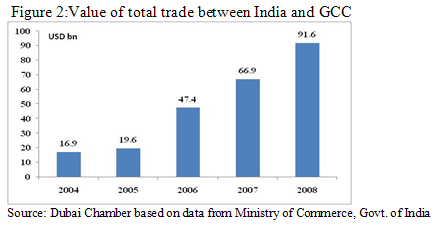
While UAE and Saudi Arabia are the largest two partners in terms of value of trade with India, trade with each of the six countries in GCC has however increased over the years. The two economic blocs are among the top five trading economies for each other. GCC is the single largest origin of imports and second largest destination of exports for India. GCC's share in India's trade has increased from 8.6% in 2004 to 18.7% in 2008.
GCC and India thus have multi dimensional partnership. While trade and oil continue to lead the economic ties between the two blocs, there exists emerging synergy in new investment areas like infrastructure, ICT, food processing industry and skill based industries. The opportunities extend beyond the buyer seller relationship to a partnership level, involving joint ventures and transfer of technology arrangements and can benefit both economies immensely.
-Ends-
Established in 1965, the Dubai Chamber of Commerce & Industry is a non-profit public entity, whose mission is to represent, support and protect the interests of the business community in Dubai by creating a favorable business environment, supporting the development of business, and by promoting Dubai as an international business hub.
© Press Release 2010