Emerging Markets significantly more positive than developed markets
Qatar most confident in the region - Egypt least confident
Dubai, 2nd February 2010: Business confidence among the Middle East's small and medium-sized enterprises (SMEs) is high according to a survey conducted in Q409 by TNS for HSBC. Qatar, Saudi Arabia and Egypt in the Middle East were included in the survey.
Across the region, a growing proportion of small businesses are optimistic for their prospects in 2010 signaling increasing capital investment and recruitment.
Qatar business confidence was the highest at 159 points followed by Saudi Arabia at 125 points and Egypt at 110 points.
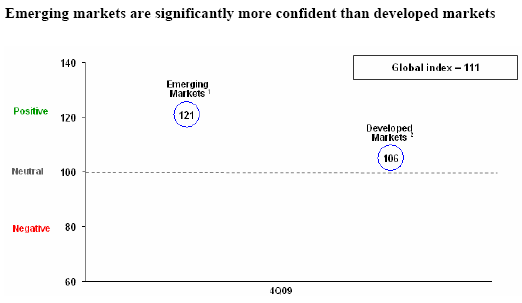
Globally, the SME indices tracked by HSBC in most countries and territories hold a positive outlook, with the Middle East at 125, Latin America at 118, the US and Canada at 107 and the UK at 101. France is just below neutral at 94. But emerging markets in Asia, the Middle East, Latin America and Eastern Europe are significantly more optimistic than the developed markets of the US, Canada, the UK and France, with an average index of 121 versus 106.
The semi-annual HSBC Small Business Confidence Monitor gauges the six-month outlook of SMEs on local economic growth, capital investment plans and recruitment.
This was the first time that Middle East countries were included in the list of 20 markets, capturing the views of more than 6,000 SMEs in Asia, the Middle East, Europe, North America and Latin America - the largest international survey of its kind. The results were used to calculate an index ranging from 0 to 200 where 200 represents the highest confidence level, 0 represents the lowest, and 100, neutral. The survey was conducted in October and November 2009 by research agency TNS.
Nicholas Levitt, Regional Head of Business Banking HSBC said: "Confidence levels appear to be back to pre-financial crisis levels. The Middle East outlook correlates strongly to the global emerging market outlook, and as a major international trading hub, the region is well-placed for future growth."
Outlook on local economic growth
47 per cent of the region's SMEs expect local GDP growth to increase over the next six months. 36 per cent expect the pace to remain the same, and only 17 per cent expect growth to slow.
Outlook on capital expenditure
The Middle East region is the second most confident region, after India when it comes to investing in their own businesses in 1H10. 47 per cent are planning to increase their capital expenditures, 41 per cent say they will maintain current levels and only 11 per cent are planning reductions.
Outlook on recruitment plans
Recruitment sentiment in the Middle East is strongest globally. 36 cent of the region's SMEs say they will increase staff in the next six months and 58 per cent saying they will keep staff levels the same.
Recruitment is generally stable across the 20 markets in the survey.
More SMEs to become international
The HSBC Small Business Confidence Monitor also asked SMEs about the extent of their cross-border trade and other international business, such as overseas operations. Across all markets, 3 in 10 SMEs surveyed say they have some level of cross-border trade or international business. In Qatar, the number is nearly 7 in 10.
In Qatar 69 percent of SMEs surveyed were involved in international business, in Saudi Arabia it was 27 per cent and in Egypt 33 per cent.
When SMEs were asked if they plan to engage in international business in the next two years, 72 per cent of Qatar SMEs planned to grow their international business. In Egypt it was 28 per cent and in Saudi Arabia 19 percent.
Top reasons for doing business internationally are the sales and revenue opportunities as well as access to international markets as SMEs seek to diversify their risk beyond domestic markets.
Top international business locations for the region are Greater China, South-East Asia and Europe.
Doing international business is not without its challenges. Among regional SMEs that are already international and those that are not, the top barriers cited were unstable financial conditions, such as fluctuating exchange rates and interest rates, costs of essential services such as shipping, logistics and storage as well as government regulations.
HSBC: Unlocking the global potential of small business
Nicholas Levitt, added: "There is a rebalancing of the world economy, and emerging markets are becoming more and more important as a driver of growth. Small businesses are at the heart of this growth, driving local job creation, investment and productivity. And as they grow and develop and look to world markets for new opportunities, HSBC are uniquely placed, with its international connectively and its on-the-ground expertise, to help small business unlock its global potential."
Footnotes
1: Emerging markets include Hong Kong, India, Indonesia, Mainland China, Malaysia, Singapore, Taiwan, Vietnam, Egypt, Qatar, Saudi Arabia, Turkey, Argentina, Brazil, Panama and Mexico
2: Developed markets include US, Canada, UK and France
3: The survey was conducted by research company TNS in October and November 2009.
-Ends-
HSBC Bank Middle East Limited (HSBC)
HSBC is the largest and most widely represented international bank in the Middle East. HSBC Bank Middle East Limited has 46 branches throughout the United Arab Emirates, Oman, Bahrain, Qatar, Kuwait, Jordan, Lebanon, Algeria, Pakistan and the Palestinian Autonomous Area. In addition to the branch network the Bank maintains representative offices in Tehran, Iran and Tripoli, Libya. This extensive regional coverage is strengthened by another member of the HSBC Group, HSBC Bank Egypt SAE; and by its associated companies; The Saudi British Bank; British Arab Commercial Bank Limited; HSBC Saudi Arabia Limited; SABB Securities Limited; SABB Takaful Co.; and Dar Es Saalam Investment Bank.
Media enquiries
Andrea Jaishankar on +971-4-423-5635 or mobile: +971-50-5526329.
Email: andreajaishankar@hsbc.com
Press Release 2010