The Middle East North Africa 'MENA' region, as defined by the World Bank, contains 20 countries, spans five time zones, and is home to 362 million people. In population and land area, it is com- parable to the United States.
Tarnbir Kaur, CAE, Director- Association Management & Consulting, MCI Dubai said, "The Arabic language and Islamic culture that dominate within the region have created a shared cultural heritage, and people's shared historical experience has to a certain degree strengthened a regional collective consciousness. But there are also enormous differences both within and among the countries of the Levant (Jordan, Lebanon, and Syria), the Gulf (Bahrain, Kuwait, Oman, Qatar, Saudi Arabia, the United Arab Emirates, and Yemen), and Egypt and other countries of North Africa".
Official statistics about associations in the region are hard to find especially in the wake of the Arab Spring however within the region Egypt and Saudi have the most vibrant local and regional associations. Associations in the Levant region are more developed in nature and have been around for around 60-70 years due to a greater freedom for set up and operations of not for profit entities. The culture of volunteerism is prevalent throughout the region largely due to the religious influence.
There are many successful regional and local associations engaged in activities similar to the western associations namely conferences, meetings and small events. Events function as the lifeline of such association providing funds to sustain continued operations.
The chart below gives an overview of the types of the events that were organized in Middle East.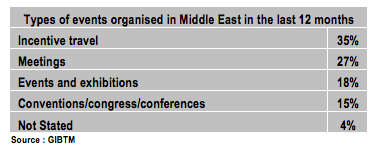
Some associations especially the medical ones find it easier to raise funds through sponsorship by pharmaceutical companies. Others rely more on membership fees and revenue generated out of their certification programmes. While training conferences are conducted by associations for skill enhancement, associations also come out with regular publications that provide up to date information for the readers. International associations with certifications and strong professional development courses will find many takers in the region.
Some associations especially the medical ones find it easier to raise funds through sponsorship by pharmaceutical companies.
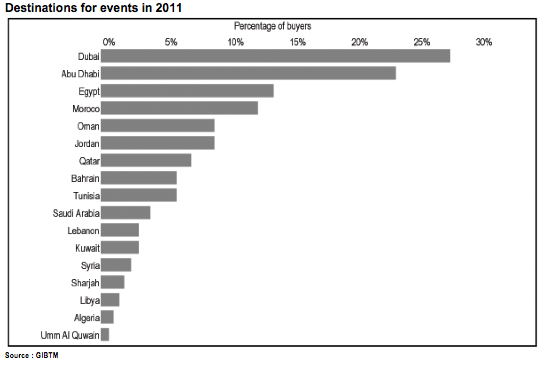
The visual below also gives an overview of the various countries where events were organised in 2011 in the Middle East. Clearly Dubai and Abu Dhabi lead the region with Egypt as a surprising #3.
One of the repercussions of the Arab Spring has also been a greater scrutiny of associations in the region. Egypt is passing a new legislation that will involve much more government control in the operations of associations as well as legal hurdles in setting up of not for profit associations especially those headquartered abroad.
It is easier to legally incorporate local and regional associations as most of board has local members and this is a key requirement for most associations. In Dubai there are plans to set up a Dubai Association Centre (DAC) which will enable international, regional and national associations to set up their Middle East HQ in Dubai. The legislation is currently awaiting approval in the Rulers Court.
International associations keen to have a presence in the Middle East region will have success if they review alternative approaches to a Chapter or Affiliate model.
Another area that international players will need to remember is the increased influence of Government and semi government organisations. According to the Economist the Middle East has strikingly few private companies, less than one-third of the number per person in Eastern Europe. In Egypt the public sector accounts for 40% of value added outside agriculture - an unusually large share for a middle-income country.
Such private firms as do exist tend to be large and closely connected to the state. The average Middle Eastern company is ten years older than in East Asia or Eastern Europe because new entrants are kept out by pervasive red tape. Given this scenario cooperation with big National players such as Qatar Telecom, Saudi Telecom, Mubadala in Abu Dhabi, Kingdom Holding and others will be critical for success.
There are many reasons for associations to be positive and invest in Middle East region.
Some of them are:
Need for skill development:
Half of the population in Middle East is below the age of 20 and where unemployment rates of 25% 'exceeds that of any other region in the world', the International Monetary Fund said in its April 2011 regional outlook for the Middle East and Central Asia. Joblessness 'is largely a youth phenomenon', with people between the ages of 15 and 24 accounting for 40% of all people without jobs in the region, and this figure rising to as much as 60 % in Egypt and Syria, the IMF said. There is also a serious mismatch between the skills young people possess and those that firms seek.
Focus on education from government:
The region's leaders are committed to improving education as most of the current leaders and rulers were educated in the US and Europe thus giving them a wider view of the world and a commitment to transform their countries as well.
Increasing role of women in the workforce:
In Saudi Arabia, King Abdullah has vowed to get more women working and his government is hiring too. He pledged 66,000 jobs in teaching and healthcare, mostly for women. In 2006, Kuwait's parliamentary elections allowed women to cast ballots and stand as candidates for the first time. Today more than 30 women hold ministerial positions in the MENA region.
Increase in mobile and internet penetration:
The role of the digital media has been amplified by the Arab Spring where social networks such as Facebook and Twitter have enabled change. As per a Booz & Company report the number of broadband users in the region is expected to reach 143 Mn in 2014 and the number of mobile users to 393 Mn.
ABOUT MCI
MCI is a globally integrated association, communication and event management company. Since 1987, MCI has created corporate events, meetings and incentives; association and governmental conventions, congresses, exhibitions; and managed and provided consulting to associations. MCI's mission is to help companies, governments and associations bring people together to create meaningful connections and win.
With offices currently in 47 cities in Europe, the Middle East, Asia-Pacific, North and South America, MCI is a thought leader in building community around brands, products and services for companies and institutions. MCI's 1200 plus employees represent 50 different nationalities and speak 60 different languages offering local knowledge in a completely international team.
Visit the MCI website www.mci-group.com or Press Center at www.mci-group.com/presscenter for the latest company information. The MCI Press Kit is available for download at www.mci-group.com/presskit.
For more information on the press activities, contact:
Shenoy
ekadaa PR
Dubai, UAE
Tel: +9714-3912100
Fax: +9714-390 4740
Email: shenoy@ekadaa.com
© Press Release 2012