14 July 2008
The UAE's real GDP growth rate is projected to slow down to 7.2 per cent this year against 7.4 per cent in the previous year, says a new Merrill Lynch report.
The forecast by the world's leading financial and advisory company is in line with the UAE's Ministry of Economy statement last week that real GDP grew by 7.4 per cent last year.
The report said the UAE's nominal gross domestic product (GDP) growth is expected to rise from last year's $190 billion (Dh697.3bn) to $237.5bn in 2008.
It, however, forecast that inflation in the UAE will rise this year to average around 12.1 per cent against 11.1 per cent last year.
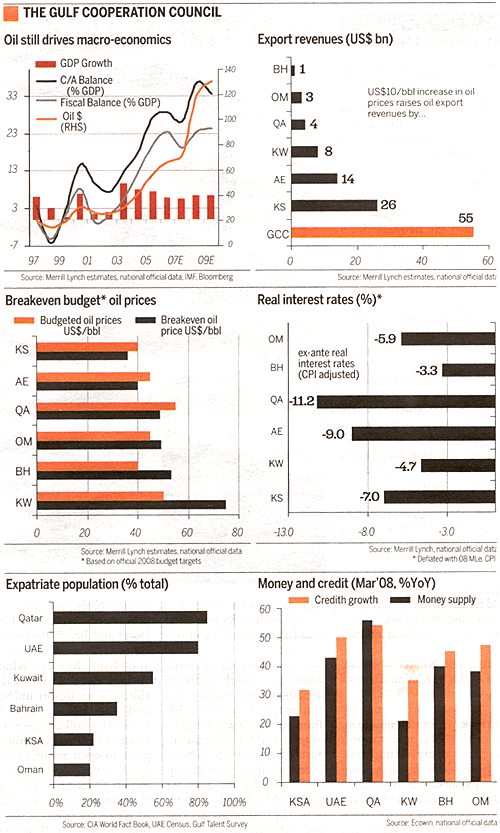
The Merrill report said the country would post fiscal balance of 35 per cent of GDP this year compared to 29.2 per cent in the previous year. The UAE's account balance is likely to jump from last year's 19.5 per cent to 34 per cent of GDP this year.
The report forecast that real GDP growth rate of Gulf Co-operation Council (GCC) region will rise by 1.1 per cent to 6.4 per cent this year, while the region's nominal GDP is projected to cross $1 trillion mark this year. The nominal GDP is likely to jump from $812.7bn in 2007 to $1,001bn this year.
Merrill predicted that inflation in the Gulf region would jump by 3.7 per cent this year to average around 10.4 per cent against 6.7 per cent in the previous year.
The GCC countries' current account surplus would surge by around 10 per cent to 36.2 per cent of GDP this year. The bank sees GCC countries, home to around 40 per cent of the world's proven oil reserves and 25 per cent of natural gas reserves, a safe haven for investment amid the ongoing troubles in financial markets and weakening global
economy. Despite the high inflation threat, the global bank sees GCC a success story as the oil windfall continues to boost infrastructure spending; reliance on petrodollar is diminishing; and sovereign wealth funds' investment income is gradually substituting oil revenues. Merrill said the regional countries have accumulated $750bn over the past five years in current account surpluses and with oil prices around $140 per barrel, they are likely to receive another $360bn in 2008 in their external surpluses - which is around $1bn a day.
Despite the recent easing in fiscal policy to fight inflation through unorthodox policies - such a higher wages and subsidies, and lower import tariffs, GCC is are prudent in their fiscal spending, saving 70 per cent of its oil windfall.
The lowest breakeven oil price that will bring 2008-2009 budgets in to balance is in Saudi Arabia ($36/bbl), followed by UAE ($40/bbl) and Qatar ($49/bbl). In other words, Saudi Arabia, can maintain the current level of budget spending even if the oil price were to fall to $36/bbl from the current $140/bbl.
The highest breakeven is in Kuwait ($75/bbl), but that is mainly due to the one off-budget transfer of $20bn to capitalise the social security system in 2008-2009 fiscal year.
The chunk of oil revenues is still feeding into SWFs and official reserves, which is expected to reach $2trn at the end of 2008, according to IIF estimates.
"Assuming oil prices stay at $135/bbl on average for the rest of 2008 and 2009 - along with deeply negative real interest rates, our GDP growth forecast is 6.4 per cent for 2008 and 6.2 per cent for 2009," the report added. Despite the recent moves by some of the GCC countries to increase reserve-requirement ratios and some of the petrodollars being invested offshore through SWFs, the region is still flushed with liquidity.
Merrill warned that the monetary expansion and credit growth could still push assets prices higher in the short term in the region.
The UAE's real GDP growth rate is projected to slow down to 7.2 per cent this year against 7.4 per cent in the previous year, says a new Merrill Lynch report.
The forecast by the world's leading financial and advisory company is in line with the UAE's Ministry of Economy statement last week that real GDP grew by 7.4 per cent last year.
The report said the UAE's nominal gross domestic product (GDP) growth is expected to rise from last year's $190 billion (Dh697.3bn) to $237.5bn in 2008.
It, however, forecast that inflation in the UAE will rise this year to average around 12.1 per cent against 11.1 per cent last year.
The Merrill report said the country would post fiscal balance of 35 per cent of GDP this year compared to 29.2 per cent in the previous year. The UAE's account balance is likely to jump from last year's 19.5 per cent to 34 per cent of GDP this year.
The report forecast that real GDP growth rate of Gulf Co-operation Council (GCC) region will rise by 1.1 per cent to 6.4 per cent this year, while the region's nominal GDP is projected to cross $1 trillion mark this year. The nominal GDP is likely to jump from $812.7bn in 2007 to $1,001bn this year.
Merrill predicted that inflation in the Gulf region would jump by 3.7 per cent this year to average around 10.4 per cent against 6.7 per cent in the previous year.
The GCC countries' current account surplus would surge by around 10 per cent to 36.2 per cent of GDP this year. The bank sees GCC countries, home to around 40 per cent of the world's proven oil reserves and 25 per cent of natural gas reserves, a safe haven for investment amid the ongoing troubles in financial markets and weakening global
economy. Despite the high inflation threat, the global bank sees GCC a success story as the oil windfall continues to boost infrastructure spending; reliance on petrodollar is diminishing; and sovereign wealth funds' investment income is gradually substituting oil revenues. Merrill said the regional countries have accumulated $750bn over the past five years in current account surpluses and with oil prices around $140 per barrel, they are likely to receive another $360bn in 2008 in their external surpluses - which is around $1bn a day.
Despite the recent easing in fiscal policy to fight inflation through unorthodox policies - such a higher wages and subsidies, and lower import tariffs, GCC is are prudent in their fiscal spending, saving 70 per cent of its oil windfall.
The lowest breakeven oil price that will bring 2008-2009 budgets in to balance is in Saudi Arabia ($36/bbl), followed by UAE ($40/bbl) and Qatar ($49/bbl). In other words, Saudi Arabia, can maintain the current level of budget spending even if the oil price were to fall to $36/bbl from the current $140/bbl.
The highest breakeven is in Kuwait ($75/bbl), but that is mainly due to the one off-budget transfer of $20bn to capitalise the social security system in 2008-2009 fiscal year.
The chunk of oil revenues is still feeding into SWFs and official reserves, which is expected to reach $2trn at the end of 2008, according to IIF estimates.
"Assuming oil prices stay at $135/bbl on average for the rest of 2008 and 2009 - along with deeply negative real interest rates, our GDP growth forecast is 6.4 per cent for 2008 and 6.2 per cent for 2009," the report added. Despite the recent moves by some of the GCC countries to increase reserve-requirement ratios and some of the petrodollars being invested offshore through SWFs, the region is still flushed with liquidity.
Merrill warned that the monetary expansion and credit growth could still push assets prices higher in the short term in the region.
By Waheed Abbas
Emirates Business 24/7 2008