With a civil war raging in Syria and other flare-ups and tensions elsewhere in the region, Jordan's economic prospects look challenging.
After clocking an average of 6.5% yearly growth from 2000 to 2009, economic growth petered out to 2.3% in 2010 and 2.5% in 2011, according to the International Monetary Fund.
"As one of the most open economies in the Middle East, Jordan remains highly dependent on commodity imports (oil and grains), tourism receipts, remittances and FDI flows, and external grants," says the IMF in its latest report on the country.
"Jordan is also facing risks from a further deterioration in its terms of trade, unrest in neighbouring countries, and the prospect of further disruptions to natural gas pipeline flows from Egypt."
The outlook for 2012 is slightly improved, at 2.8%, but hardly reminiscent of the glory years of the previous decade. Barclays Capital expects a 2.6% growth, while Citibank is even more pessimistic, forecasting a 2.5% GDP growth in 2012.
Improvement in the financial services' performance and rising trade with Gulf countries will underpin much of the subdued growth.
But while the Gulf states have benefited from high oil prices, major oil importers such as Jordan are struggling to make fiscal ends meet.
A combination of weak external demand, high energy prices, and limited capital inflows led to a 16% year-on-year fall in foreign exchange reserves in February.
"This is the largest annual fall in reserves in at least the past decade. FX reserve cover has come down from 10 months of imports at the start of 2011, to under seven months," says Farouk Soussa, analyst at Citibank.
"This prompted the Central Bank of Jordan to raise domestic policy rates by 50 basis points in January, the second hike in the past year, further putting the brakes on a fragile domestic economy."
BREAD & FREEDOM PROTESTS
Sporadic 'bread and freedom' protests have raged in the country, inspired by revolutionary protests elsewhere in the region. The government has made efforts to address issues of corruption and institute political reform, including a constitutional court bill, but it has down little to quell protests.
Anti-government activists have been arrested in the past few months, charged with rioting and insulting the King.
"We still do not expect the situation to escalate significantly in the near term, but maintain our view that the political situation will remain fragile in the absence of tangible progress on the reform agenda," said Citibank's Soussa.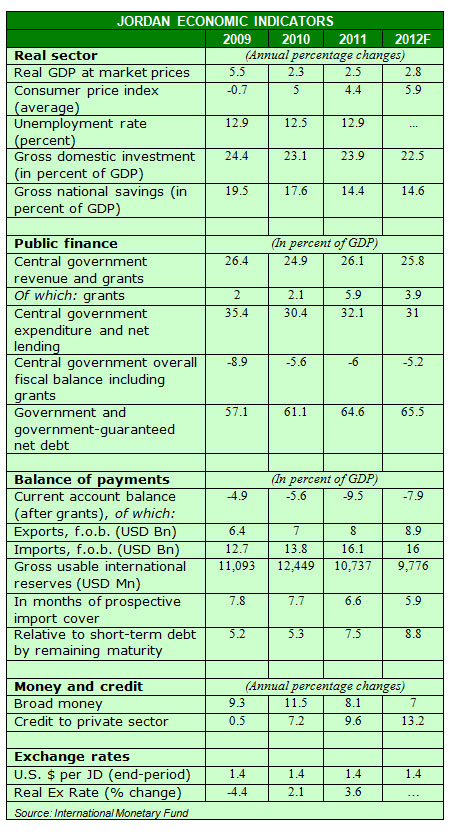
BUDGETARY CHALLENGES
After much debate, the Jordanian parliament approved the 2012 budget, which shows a 4.6% fiscal deficit, lower than the deficit of 5.5% in 2011. However, the budget expects a 3% expansion - a figure with which almost no independent observer would agree with.
The government also expects to cut expenditure by 1.7% in the fiscal year.
"We expect the government to meet its plan on the expenditure side, but forecast that total revenues including grants will fall 2.2% year-on-year compared to last year given the current political and growth environment," wrote Fahad Al-Turki, an analyst at Barclays Capital, in a recent note.
This could result in a fiscal deficit of JD 1.3bn, or 5.9% of GDP (9.8% excluding grants), compared with 6.1% of GDP in 2011 (11.6% excluding grants).
"Accordingly, we forecast that the net debt-to-GDP ratio will reach 66.6% of GDP, compared with 66.4% at the end of 2011, maintaining its current level above the legislated debt ceiling," said Mr. Al-Turki. "Given the above, Jordan's key fiscal challenge remains generating enough domestic revenues and restructuring spending to lower its public debt. Until end-2012, gross fiscal financing needs are likely to reach about JD 5.3bn, on our estimates, or 24% of GDP. The bulk of this (JD 4.5bn) consists of debt service repayments falling due next year, of which 53% is held by banks."
The IMF says that the 2012 overall deficit is expected to narrow by about 1% of GDP relative to the 2011 outturn, reaching 5.25% of GDP.
"With this, and given likely borrowing for own-budget entities, the public debt-to-GDP ratio would rise slightly to 65.5% by end-2012. Further fiscal consolidation will be essential over the medium term to return fiscal and external balances to a sustainable level."
Financing has also been hurt by falling foreign direct investment, which shrank 18% year-on-year by September last year. The troubled outlook may dissuade would-be investors to delay their investment decisions, although Gulf states may step in if the fiscal situation takes a turn for the worse.
While not much progress has been made regarding Jordan's application to join the GCC, the membership proposal does underline Jordan's importance to the regional bloc. Closer economic ties with the Gulf will no doubt help the country's investment flows and relieve some of the pressures of unemployment, which officially stands at 12.9%.
"Given Jordan's pivotal role for regional security, we expect support to be forthcoming, although a further deterioration in debt dynamics appears likely," says Barclay's Al-Turki.
© alifarabia.com 2012