With the Moroccan equity market decimated by the Arab Spring, investors are backing the less-risky assets, writes Zawya analyst Nader El Boustany.
Morocco's GDP per capita as of 2011 is USD 5,100, a substantially low amount compared to its neighboring oil-rich economies. Affected by the Arab Spring, Morocco's economic growth in 2011 was set at 4.6% per annum, considerably lower than previous expectations. In terms of market performance, the Casa All Shares Index has suffered considerable losses during 2011, ending the year 12.86% lower than the level at which it started.
Mutual funds focusing on Morocco are of a mixed nature. Fixed income funds are the dominant asset type, accounting for 36% of total Moroccan funds. According to Zawya Funds Monitor performance data, the average return of the fixed income funds sector for 2011 was 2.67%, significantly higher than the average return from equity funds, which lost 10.05% in the same period. It is clear that the Arab Spring has taken its toll on the Moroccan equity market, thus paving the way for fixed income securities to gain the preference of investors.
The Moroccan Casa All Shares Index - 2011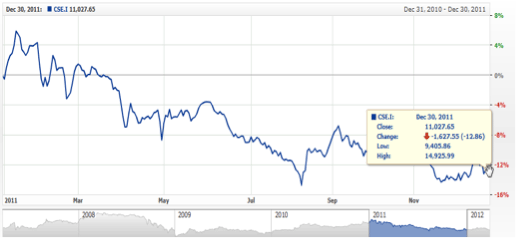
Source: Zawya
The aggregate assets under management of Morocco-domiciled funds as of December 2011 are USD 15,698 million, up 20% over the December 2010 level of USD 13,081 million. The funds industry recorded a net outflow of USD 300 million during the first quarter of 2011. This changed to a net inflow of USD 310 million during the second quarter of the year. The third quarter witnessed another inflow, registering a total of USD 184 million. As regional stock markets have become less appealing to the risk-averse investor, fixed income products are attracting the capital that has been shifting within the MENA region as a whole.
2011 was a bountiful year for mutual funds across Morocco as 13 new funds were introduced. With the number of domiciled public mutual funds reaching 185 as of the fourth quarter of the year, fund managers were keen to attract investment into their products.
Known for its well regulated and structured operational framework, the Moroccan funds industry managed to attract local capital thanks to products tailored to meet investors' needs and risk appetites.
Although the funds industry in Morocco is not as notorious as the GCC funds industry, it is widely recognized for its stable mutual funds performance, especially in the balanced and fixed income funds. With increasing local interest in its funds, Morocco should be broadening its exposure to the neighboring financial markets by opening up its doors for foreign investment into the industry.
Sources: http://www.zawya.com/funds/
The World Fact Book
© Zawya 2012