The image and strategies of Gulf sovereign wealth funds have been refined by the global financial crisis, but they remain enigmatic
The Gulf's immense sovereign wealth funds (SWFs) have recovered from the dark-days of 2009, when both the value of their investments and their capital inflows from oil revenues plummeted. They are once again engaged in a flurry of headline-grabbing activity. Their confidence, public image, and investment strategies have all changed considerably in recent years.
Nonetheless, in spite of widespread domestic and international interest, most remain highly secretive, including about the size of their portfolios. There is even ambiguity about which entities are genuine SWFs, in contrast with other kinds of investment vehicles owned by Gulf states and their ruling families.
Estimates of the sizes of the SWFs, particularly the largest, the Abu Dhabi Investment Authority (ADIA), vary considerably. Recent estimates of ADIA from two leading US-based researchers, the SWF Institute and Monitor Group, range from $395 to $627 billion, while the consultancy Booz Allen estimated it to be as high as $875 billion in late 2007.
A reasonable ballpark figure is probably closer to $450 billion, extrapolating from analysis conducted in 2009 by the Council of Foreign Relations' Centre for Geoeconomic Studies. (The centre made sensible assumptions about inflows into ADIA over the previous decade, from balance of payment data, and likely investment performance).
Only two of the smaller funds, Bahrain's Mumtalakat and Abu Dhabi's Mubadala, publish annual audited balance sheets. The others all score poorly on a transparency index constructed by the SWF Institute. The Saudi Arabia Monetary Agency (SAMA), states the size of its foreign security holdings in monthly bulletins, but these figures may be misleading, as it is believed that they use book not market values. In Kuwait, where the National Assembly receives an annual closed-door presentation of the Kuwait Investment Authority's accounts, it is illegal to disclose any data on its assets.
Overall, the Gulf's SWFs are estimated to be worth over $1.4 trillion, equivalent to a third of global SWF assets and about two per cent of global assets under management - on par with the size of the hedge fund industry. This is equivalent to about 140 per cent of the region's combined GDP (ranging from 30 per cent for Oman to 250 per cent for Kuwait), and nearly 10 times its central banks' holdings of foreign currency reserves.
The precursor to all modern sovereign wealth funds was established in Kuwait in 1953, before independence. Initially the Gulf states used their reserve funds mainly as a short-term tool to stabilise their budgets across years in which oil prices, and hence government revenue, fluctuated.
They gradually developed longer-term visions for the funds. In Kuwait, this was made explicit in 1976 when a new Future Generations Fund was formed into which it was legally mandated that at least 10 per cent of oil revenue should be deposited every year. That was also the year in which ADIA was established, to formally separate the investment management function from the department of finance.
In Saudi Arabia, SAMA - the central bank - retains the responsibility for managing foreign assets, and for that reason some analysts do not classify it as a true SWF. Indeed, Saudi Arabia is conspicuous by not being a member of the IMF-initiated International Forum of Sovereign Wealth Funds (IFSWF). Oman is also not a member.
So what exactly counts as an SWF? The Santiago Principles, a set of voluntary best-practice standards drawn up in 2008 by the precursor to the IFSWF, utilises a largely negative definition. It excludes from the SWF family "foreign currency reserve assets held by monetary authorities for the traditional balance of payments or monetary policy purposes, state-owned enterprises [and] government-employee pension funds." It also excludes funds that solely invest in domestic assets.
Given these exclusions, the Gulf SWFs do not represent the totality of their states' investment assets and equally not all of $1.4 trillion under SWF management is invested abroad. There is also a complicated relation between SWFs and the private investments of members of the royal family.
For example, in 2008 the Qatar Investment Authority (QIA) made a major investment in UK bank Barclays alongside Challenger, a private investment vehicle of the prime minister, Shaikh Hamad bin Jassim bin Jabr al Thani, who is also the chairman of the QIA.
The SWF landscape is complex. Whereas Kuwait, Bahrain and Saudi Arabia have broadly unitary governance structures for their sovereign wealth, the other three states maintain a dizzying array of funds and subsidiaries. In Qatar the QIA operates through a range of specialised vehicles such as Hassad Foods, which concentrates on agricultural investments (in part with a view to assisting domestic food security) and Qatari Diar which focuses on real estate. Oman's State Reserve Fund holds the bulk of its sovereign wealth, but two other funds - Oman Oil Company (whose portfolio includes non-oil industrial investments, internationally and domestically) and the Oman Investment Fund - appear to operate independently.
In the UAE the division is both between and within the emirates. While the bulk of Abu Dhabi's assets remain in the core ADIA, perhaps 15 per cent are spread across three independent funds. Mubadala, associated with the crown prince, Shaikh Mohamed bin Zayed al Nahyan, was founded in 2002 to focus on investments that could assist Abu Dhabi's economic diversification, such as the Dolphin Energy gas pipeline from Qatar.
Meanwhile, the International Petroleum Investment Corporation (IPIC), chaired by Shaikh Mansour bin Zayed, has in recent years invested outside its nominal focus sector, particularly through its Aabar Investment subsidiary. It has taken stakes in carmakers Daimler and Tesla, not to mention Virgin Galactic (with plans for an Abu Dhabi spaceport). Finally, the Abu Dhabi Investment Council was split from ADIA in 2007, mainly to manage domestic assets, particularly banks, yet it still dabbles internationally, purchasing a 90 per cent stake in New York's landmark Chrysler Building.
The Investment Corporation of Dubai is usually categorised as the emirate's SWF, although most of its holdings are domestic, barring those through its Dubai International Capital subsidiary. Dubai World, with its complex array of international investments, particularly through its subsidiary Istithmar, appears to fit the SWF-definition better. However, its investments were financed in large part by $59 billion of debt, rather than surplus revenue, leading to Dubai's default and restructuring in 2009-10. Ras al Khaimah has its own small SWF and a federal Emirates Investment Authority was even established in 2007, to manage the UAE's stakes in over 30 firms across the GCC.
The investment strategies of the SWFs vary considerably. Few funds publish information about their asset allocation. Therefore, most information on their strategies is pieced-together from anecdotal accounts and from major transactions which attract media coverage.
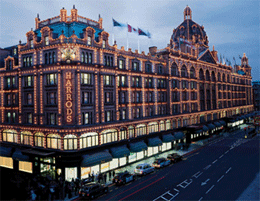
At one end of the spectrum is SAMA, which invests cautiously, largely in low-risk government bonds, particularly in the US. At the other end are highly interventionist funds, such as QIA and the IPIC, which often take large, even controlling, stakes in companies. These two funds have been responsible for the bulk of major SWF investments in the last two years, ranging from QIA's purchase of Harrods department store in London for $2.2 billion last May, to IPIC's ongoing $5.7 billion takeover bid for Spanish oil company CEPSA.
Major investments can boost a country's image on the global stage (Qatar in particular seems to be utilising trophy investments to build its brand) and can also lead the companies to set up facilities and share expertise with the investing Gulf state, contributing to their economic diversification. Other funds, such as ADIA, invest in a diverse range of bonds, equities and alternative investments, but tend to spread their holdings thinly, a strategy which also keeps them out of the headlines.
The global financial crisis in 2008 and its aftermath had significant impacts on Gulf SWFs. Some suffered capital losses of 30-40 per cent (SAMA was less affected given its focus on bonds). Although these losses largely proved to be temporary, as markets began recovering from mid-2009, they catalysed reviews of allocation, risk management and governance. There was a slowdown in activity in 2009, in part because of a drop in oil surplus inflows, with even QIA taking a pause in deals in the first half of the year. As investments have resumed, there has been a rebalancing of portfolios towards emerging markets, with QIA, for example, investing $6 billion in the Agricultural Bank of China.
The crisis, unexpectedly, improved the public image of SWFs. As far back as 1981, Time magazine worried about the potential geopolitical influence SAMA could wield if it adopted a less conservative investment strategy. Concerns grew in 2007-08 as the Gulf SWFs used their record surpluses to take large stakes in major western companies. However, as global capital dried up in 2009, some economists and companies hailed the SWFs as saviours as they helped recapitalise banks such as Barclays, buying 30 per cent of its stock, and enabling it to avoid a UK government bailout. The complaints about SWF influence will return, but in the meantime they made tidy profits, with IPIC for example earning 40 per cent on its $5.7 billion investment in Barclays.
Another trend in recent years has been debt financing. While the kind of leverage utilised by Dubai World is unlikely to be attempted again, some solvent SWFs have been able to raise debt on favourable terms, for example IPIC raised $4.4 billion in March to fund its takeover of CEPSA. Qatari Diar's $3.5 billion bond issue last July was seven times oversubscribed.
The high oil prices that are expected to continue in the coming years will further boost the Gulf SWFs, which should collectively receive inflows of over $150 billion a year. Having survived a crisis, the funds are also growing more confident and sophisticated. There will undoubtedly be plenty of poor and controversial investments in the coming years, but the funds will remain an important part of the global financial system. They are better placed than ever to fulfil their role of diversifying state income and providing security for future generations.
The Gulf 2011