Egypt, Iraq and Lebanon are among the top 10 sovereigns most likely to default, according to CMA Datavision data.
"Continued economic uncertainty in Egypt did not help CDS prices which widened to 502bps this quarter," noted CMA in its credit risk report for the fourth quarter.
Egypt saw its spreads widen the most in the world after Argentina in the last quarter of 2012.
Moody's recently placed Egypt's sovereign rating for a possible downgrade.
The rating agency's said its decision to initiate the ratings review on Egypt's sovereign rating were driven, by:
(1) the re-emergence of unsettled political conditions;
(2) the increased uncertainty surrounding Egypt's ability to secure financial support from the IMF;
(3) the measures by the Central Bank of Egypt to limit foreign-currency cash withdrawals from the country's banks; and
(4) the continued rise in the Egyptian government's already high fiscal financing costs.
Egypt is now the most likely Middle Eastern state to default, and seventh most likely globally, according to CMA data.
North Africa's largest economy had a torrid fourth quarter as domestic political tensions boiled over once again. President Mohammad Morsy is fast becoming a hugely divisive figure as his Muslim Brotherhood party appears to tighten control over the country's affairs, much to the dismay of the liberal movement that overthrew Hosni Mubarak.
In light of the strong opposition to Mr Morsy, the International Monetary Fund is dragging its feet on the $4.8-billion loan to the country.
"Based on the latest published data, it is expected that liquidity dynamics will deteriorate and yields on government securities will head north in the absence of sizable foreign funding and the recovery in the EGP carry trade," said Pharos Research.
"According to our knowledge most banks approached their maximum limit of holding government securities end of 2011, which was partly a reason for the Central Bank of Egypt's decision to cut RRR by 400 bps during H1-2012.
"Accordingly, we expect the liquidity pressure to re-emerge and yields to overshoot during 2013 in the event of failing to secure the IMF loan or other sizable foreign currency inflows."
Meanwhile, Iraq also emerged as a country teetering on the edge of a default, as domestic unrest in the country has pushed sovereign spreads.
Prime Minister Nour-Al Maliki's government saw three weeks of mass protests recently, with tens of thousands of Sunnis taking to the streets.
The year 2012 also saw the highest number of deaths in the country since 2009.
"Overall, 2012 has been more consistent with an entrenched conflict than with any transformation in the security situation for Iraqis in the first year since the formal withdrawal of US troops," said Iraqbodycount.org on its website.
Meanwhile, Baghdad's confrontation with Kurdistan Regional Government brings even more instability in a region which is already racked by violence and uncertainty.
Iraq's tensions and political dissension has overshadowed an impressive economic performance in the year.
Iraq's GDP grew 10.2% in 2012, with oil production crossing three million for the first time in decades.
Lebanon also remained in the list of ten sovereigns most likely to default. The resilient country has suffered as Syrian descends into a civil war, and tensions in neighbouring Jordan and Palestine territories.
Tourism fell 17.5% in the country, as regional and domestic problems kept visitors away. Even traffic from traditional markets such as Saudi Arabia (down 35%), Jordan (down 31%) and Europe (down 8%) was considerably poor.
"The Lebanese credit default swaps which reflect the perceived default risk of the government, stood at 450 bps by end December 2012, narrowing from 472 bps in December 2011, after peaking during August at 558 bps and re-hitting highs following October's best achieved low of 396 bps," notes Blominvest Bank in a report.
The Lebanese eurobond yield spreads against their U.S. benchmarks remain lower than what is suggested by credit default swaps, potentially hinting that offered yields on the Lebanese eurobonds are not fully reflective of the assessed risk premiums seen by international investors, said the Lebanese bank.
REST OF MIDDLE EAST SPREADS TIGHTEN
While Egypt, Iraq and Lebanon risks escalated in the eyes of international investors, the rest of the Middle East saw a major tightening of spreads.
"The Middle East tightened 25%, with Bahrain tightening 29.5%, as positive economic outlook for 2013 should keep oil prices at or above the $100 level."
Sovereigns like Dubai, which were perceived to be among the world's most vulnerable a few quarters ago, saw their spreads tighten considerably over the past quarter.
Meanwhile, Saudi Arabia, Abu Dhabi and Qatar led the region as the safest sovereigns in the world.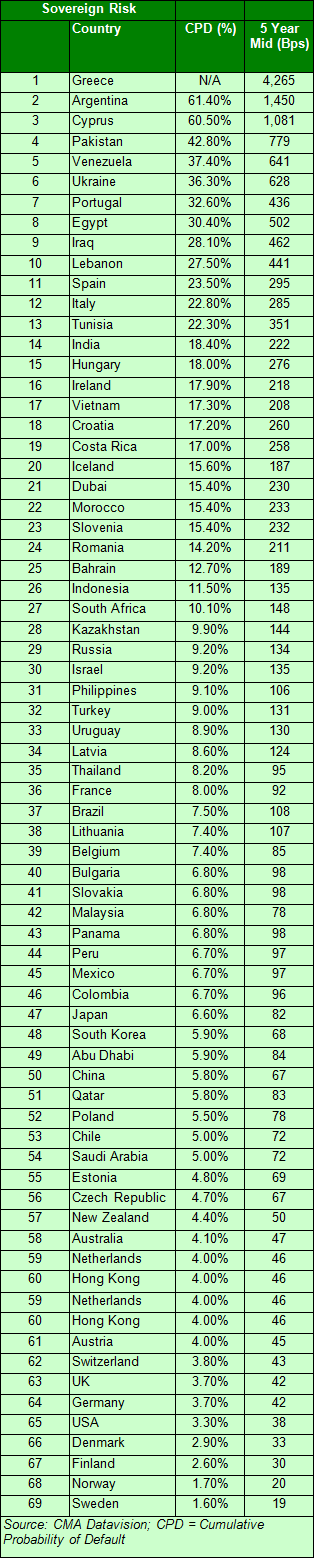
© alifarabia.com 2013