Saudi cities Riyadh and Jeddah-Makkah were among the best performing metropolitan areas in the past year, according to the latest The Brookings Institution.
The institute surveyed 300 metropolitan regions which account for 48% of global output, but a mere 19% of the population, underlining how concentrated urban areas can be engines of growth.
"Three-quarters of the fastest-growing metropolitan economies in 2012 were located in developing Asia, Latin America, and the Middle East and Africa," the report notes.
"By contrast, almost 90% of the slowest-growing metro economies were in Western Europe and North America. These recent trends reflect the accelerating shift of economic growth from developed metro areas in the global West towards developing metropolitan areas in the global South and East."
Instead of looking at just GDP growth in the year, the survey also examined the annualized growth rate of employment, to develop a new ranking system.
"These two indicators reflect the importance that people and policymakers attach to achieving rising incomes and standards of living (GDP per capita), and generating widespread labour market opportunity (employment). They are combined into an economic performance index on which the 300 metro areas are ranked for 2012."
According to this metrics, Riyadh emerged as the Middle East's best performing metropolis and the third best in the world, improving on its performance last year when it was ranked 15th.
Meanwhile, the Jeddah-Makkah conurbation fared well too, emerging as the 14th best performing metropolitan in the world. The area was ranked 25th in the previous edition of survey.
Equally important, Riyadh's employment growth was 4.5%, while Jeddah clocked a near 4% growth in jobs this year, as the Kingdom's pumped billions over the past few years to bring the unemployment rate down below 10%.
"Seven metro areas in Middle Eastern countries (Kuwait, the United Arab Emirates, and Saudi Arabia) and eight metro areas in African nations (Egypt, Morocco, and South Africa)," the institute notes in the report.
"This study includes only five Sub-Saharan African metro areas (all in South Africa), because of the small size of their metro economies and severely limited data availability/reliability for other metropolitan areas in this region."
However, other Middle East cities did not fare as well. Casablanca (53), Kuwait City (55), Cairo (84) and Alexandria (94) were among the 100 best performing cities. The two Egyptian cities performance is commendable given they were both hit by the Arab Spring revolution that swept the nation.
Meanwhile, Abu Dhabi - led by the oil sector - was the 110th best performing economy, but Dubai saw its economy shrink 2.7% this year, according to The Brookings Institution data.
Riyadh, Abu Dhabi and Jeddah-Makkah were also among the top 10 best income growth rates, according to the data.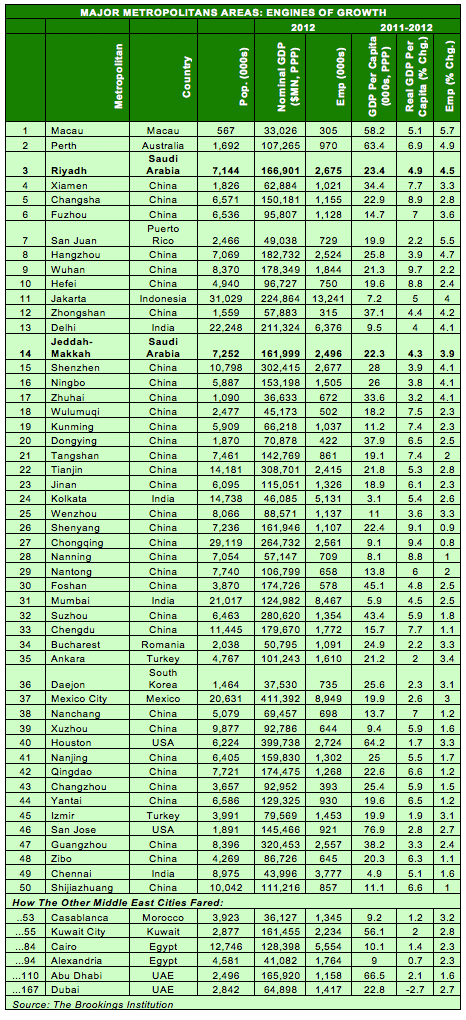
CHINESE CITIES DOMINATE
Globally, Chinese cities dominated the list, with 34 of the 48 mainland Chinese metro areas among the 60 best-performing cities in the world.
It was, however, Macau, a special administrative region in China, which emerged as the world's best performing city.
"The metro area registered growth rates of 5.1% in GDP per capita and 5.7% in employment, the latter topping all other metro areas in 2012. While it suffered declines in both employment and GDP per capita between 2008 and 2009, Macau rebounded strongly, recovering to pre-recession levels and growth rates in both indicators."
Meanwhile, only two European cities - Oslo in Norway and Hannover in Germany, made it into the top 60 best performing metropolitan areas, reflecting the severe recession in the Eurozone over the past year.
Mostly, however, metro cities outpaced growth in their countries. About
one-quarter of the 300 metro areas had faster gains in GDP per capita than in 2011.
Employment growth rate in the 300 metropolitan areas held steady at 1.4% from 2011 to 2012, but their GDP per capita growth decelerated rapidly, from 1.9% in 2011 to 0.7% in 2012. Developing metro areas exhibited the same pattern of stable employment growth and markedly reduced GDP per capita gains, while developed metro areas posted lower growth rates on both indicators, the report notes.
"Metro employment growth patterns relative to 2011 varied significantly across regions. Metro areas in developing Asia- Pacific, the Middle East and Africa, and North America posted faster gains in employment in 2012 than in the prior year."
UN HABITAT SURVEY
The Brookings Institution survey is vastly different from the recent City Prosperity Index, surveyed by the UN Habitat.
According to the UN criteria, Amman emerges as the city with the region's highest prosperity, with Cairo and Casablanca. No other Arab cities featured in the list.
However, Alifarabia.com research extrapolated from UN Habitat data published in State of the World's Cities 2012-2013 - Prosperity of Cities, to determine the fastest-growing cities in the region in terms of population.
And the results were startling: Sanaa, in troubled Yemen is set to emerge as the fastest growing city in terms of population over the next three years.
READ: Fastest-Growing Arab Cities
© alifarabia.com 2012