Middle East's 30 richest people collectively lost USD5-billion, according to Forbes data. In all, sixteen billionaires lost part of their fortunes last year. Find out who lost and gained the most.
Middle East's richest people lost more than USD5 billion in 2011, according to data gleaned from Forbes list of world's billionaires.
It was a poor year for Mideast's richest even though there was at least one more ME billionaire in the list than last year's 29 representatives. No less than 16 saw their wealth shrink as the troubled regional and global economic environment took its toll on bank balances.
Sulaiman Al Rajhi, the Arab world's fourth richest man, according to Forbes data - was the biggest 'loser' as he saw his wealth shrink by USD 1.8 billion to finish with USD 5.9 billion this year.
But rather than losing money, he is apparently giving it away.
"In front of an audience of businessmen, Sulaiman Al Rajhi announced plans in May 2011 to donate the bulk of his fortune to charity," wrote Forbes. "How can you satisfy your hunger while your neighbor is spending the night hungry?" he asked. His drop in net worth from $7.7 billion in 2011 reflects an estimated donation of part of his fortune."
Other billionaires' losses were more economic in nature.
The Arab world's richest man, Prince Waleed Bin Talal Al Saud, was the second biggest loser, as he saw his wealth decline by USD1.6 billion. Still, he managed to retain his position of the richest Arab in the world, with USD 18-billion.
However, his shrinking wealth pushed him further down the global rankings to 29th from 26th position last year.
Prince Waleed was once ranked the fifth richest man in the world by Forbes, but has steadily been falling in the rankings as the stock market has not been kind to him coupled with the rise of other emerging market entrepreneurs.
At his peak, Prince Waleed has amassed USD223.5-billion in 2005. But the nephew of Saudi King Abdullah Bin Abdulaziz may see yet another surge when the 140-character wonder Twitter goes public (eventually).
The prince's Kingdom Holding invested USD300-million in Twitter last year - an ironic investment given that the microblogging site played a huge role in Arab Spring, a movement which the Saudi Government is fighting tooth and nail.
"Some consider Alwaleed's investment in Twitter as political. This is not true. It is an investment and exchange in new media that is not restricted to Football Scores on Twitter," wrote his wife Princess Ameerah Al-Taweel on her Twitter account.
Of course, Prince Al Waleed is not new to American businesses having invested in Apple, Citigroup and a whole host of other blue-chip companies including Rupert Murdoch's News Corporation empire over the decades.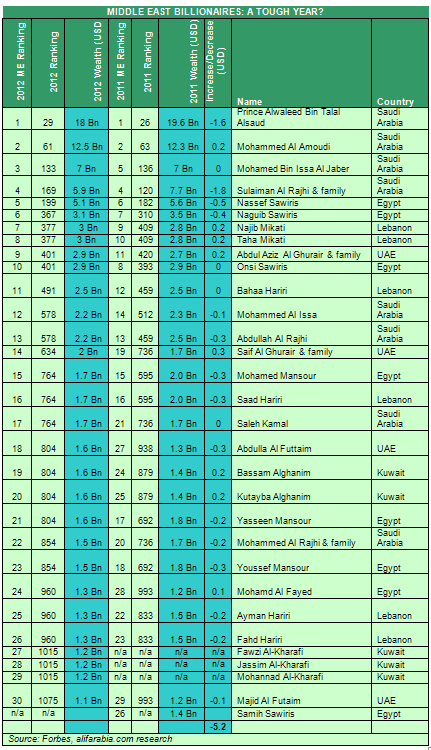
EGYPTIAN BILLIONAIRES
The Sawiris family bore the brunt of the Egyptian revolution which ousted Hosni Mubarak's regime. Brothers Naguib and Naseer Sawiris together saw their wealth depreciate by USD900-million and a third brother - Samih- dropped of the list altogether.The Sawiris family saw their interest in telecom, construction and investment suffer as the Egyptian economy contracted last year due to massive political unrest in the country.
Surprisingly, father Onsi Sawiris preserved his wealth at USD 2.9 billion - the same as last year.
Egypt's Mansour family also lost USD 800 million last year. Brothers Mohamed, Yasseen and Youssef saw their fortunes negatively affected as the Egyptian revolution impacted on their business.
Mohamed Mansour and his brothers are the biggest sellers of GM vehicles in the world. Strong sales in their Caterpillar business throughout Africa, Russia and Iraq are making up for a slump in Egypt, writes Forbes.
Their shares in the country's second biggest real estate developer, Palm Hills, plunged following accusations of state land misappropriation in March, but the charges have since been cleared.
"Other Mansour interests include the largest supermarket chain in Egypt, and the Philip Morris franchise which is experiencing a big jump in sales of Marlboro cigarettes to stressed-out Egyptians," wrote Forbes.
GLOBAL RICHES
The depressed fortunes of the Arab World's richest is in sharp contrast to their global counterparts.
The world's richest raised their combined wealth by USD100-billion to amass US4.6 trillion and added 16 more to their ranks this year compared to the last one, to reach 1,226 billionaires, according to Forbes.
Mexican tycoon Carlos Slim Helu remained the world's richest man with an estimated wealth of USD69-billion. Microsoft founder Bill Gates is not far behind with USD61-billion and his bridge buddy legendary investors Warren Buffett is third with USD44-billion. LVMH's Bernard Arnault (USD41-billion) and Zara-owner Amacio Orega (USD37.5-billion) complete the top five.
Of course, the Forbes list - like many others - is nothing more than educated guessstimates.
The actual wealth of those included may vary and there is a good chance many media-shy and reclusive billionaires - many of which may well reside in the Middle East -- did not make the list. Many rich Gulf expats are also absent from the list too.
Even more important, Gulf rulers and their families who enjoy great wealth and immense control over some of the public sector companies are nowhere to be found in the survey.
Still, as a measure of growth, the Forbes lists shows that even the Middle East's richest could not escape the global and regional economic turmoil.
© alifarabia.com 2012