Change is in the air in Sub-Saharan Africa, which is encouraging many analysts to compare the continent with advances made by Asian economies.
But there are a number of caveats in place. Africa has shown economic promise in the past without following through on its potential. Analysts point to the early 1950s when many newly-independent countries showed promise on the back of their resource riches, only to descend into chaos, civil wars, dictatorships that ruined any chance of economic success.
Could it be different this time around?
"As was the case in previous boom periods, high external demand for natural resources - particularly oil, but also land and cash crops - is at the heart of this rapid growth," wrote Stephen Broadberry and Leigh Gardner, analysts at Centre for Competitive Advantage in the Global Economy (CAGE) in a report.
"Without institutional change, therefore, further growth reversals can be expected. Indeed, the multi-party democracies established in the 1990s are already showing considerable strain in several countries across the continent, with military coups and ethnic violence hindering what is already a fragile electoral process."
The CAGE analysts compare African economic growth to the pre-industrialized Europe of the 13th century. While that shows certain promise if Africa can emulate the progress of its northern neighbors, it also reveals how far the region has to go to bring stability and entrench economic growth.
"Growth reversals remain a serious threat to Africa's future prosperity, and therefore it is incumbent on policymakers to focus a great deal more on the introduction of measures that can encourage the development of a robust civil society."
But not everybody agrees that the region will have to labor for centuries before it can lift itself out of the poverty hole.
Renaissance Capital, which is investing billions in Africa, notes that the continent can see the fastest economic growth in global history.
It took the United Kingdom, for example, 400 years to double its GDP per capita from USD 1,090 in 1400 to USD 2,080 by 1800 - but rapid technological changes could accelerate that growth.
"What took the UK centuries can now be a matter of decades, or even years. The US and Germany 'borrowed' and then improved on UK technology in the 19th century, Japan did the same more quickly in the 20th century and China accelerated the process still further over the past 30 years," wrote Charles Robertson, chief economist at Renaissance Capital in an e-book on the continent. "Today Africa has the greatest room to boom on the back of two centuries of global progress."
Sovereign ratings to lure investors
There are close to 30 democracies in Africa and most countries are going through a second or third iteration of meaningful elections, which suggests some maturity in the political process.
There is also a meaningful effort to institutionalize government, seek foreign investments and connect with global markets, which would go a long way in holding authorities accountable.
Fitch Ratings notes that the number of rated sovereigns in Sub-Saharan Africa has grown from one in 1994 (South Africa) to 12 in 2012, which could play a key role in connecting the region to international investors.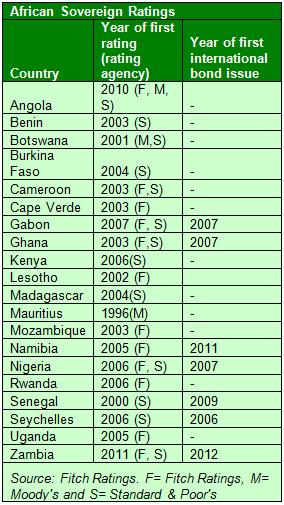
Indeed, sovereign ratings can play a key role in attracting foreign capital and encourage developments and show countries are ready to participate in the global economy.
"Sovereign ratings could help promote sound economic policies as countries felt the pressure to keep up with other rated peers; eventually, sovereign ratings provided a baseline for private investors to evaluate the business environment of a country (e.g. political risk, ease of doing business). Sovereign bond issuance would facilitate access to a new source of investment capital to promote investment and development," noted Arnaud Louis, analyst at Fitch Ratings.
According to Fitch's econometric estimates, sovereign ratings have contributed to net FDI flows in SSA between 1995 and 2011, adding on average of about 2% of GDP of FDI every year into rated countries, said Louis.
This openness to global markets has meant foreign direct investment in the SSA region rose from around USD 6 billion each year between 1995-1998 to USD 35 billion each year from 2007 and 2011.
"Governance variables are expected to be positively correlated with FDI. The literature suggests that governance variables are an important factor to account for FDI flows in SSA," said the ratings agency. "Fitch has retained three different variables published by the World Bank, "government effectiveness", "control of corruption" and the "rule of law"."
Conversely, a return to resource nationalism, which was recently suggested in countries like South Africa, has already led foreign investors to seek other markets in Africa and divert new investments away the South African economy.
Despite major efforts to institutionalize growth, nobody denies that Africa still has to do much work to get further ahead and be comparable to Asian economies, or meet the standards of pre-industrialized Europe.
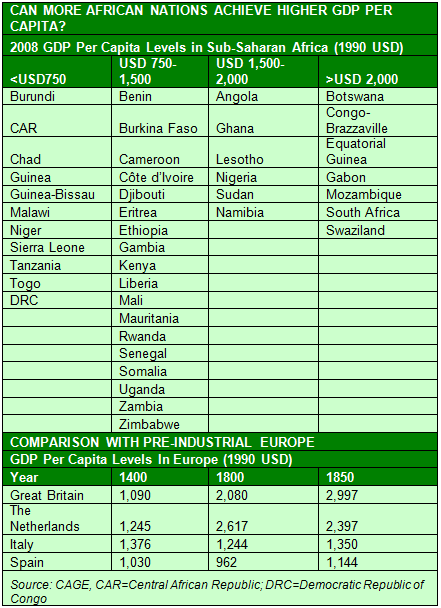
CAGE analysts note that the European comparison shows economic growth can be followed by severe reversals, and it will take institutional transformation to make changes permanent.
"Institutions in many African countries still have many of the features of limited access social orders and, as a result, it is incumbent on policy-makers to focus a great deal more on introducing measures that can encourage the growth of a robust civil society and a number of strong domestic organizations that can thrive outside state control," CAGE analysts concluded.
Also Read: A Renaissance view on investing in Africa
Africa's fastest growing cities
© alifarabia.com 2013