One of the world's biggest oil companies says crude oil's reign as the world's biggest energy source may be over within half a century.
That's not a long time in the oil industry which plans for projects decades into the future.
Royal Dutch Shell's new forecast for the global economy predicts two likely paths for the global economy:
1) The first path may lead to economic disappointment and 'trapped transitions', more moderate growth, but less instability;
2) The second path may lead to higher growth with more reform, even though there might be more social and political instability.
In both scenarios, crude oil will lose out to other energy sources.
In the moderate pathway, Shell expects abundance of gas and moderate overall energy demand to lead to a plateau in oil consumption by the 2030s and a subsequent decline over the following decades.
"In the 2030s, natural gas becomes the largest global primary energy source, ending a 70-year reign for oil. Before that, coal's reign as the number one global energy source had lasted around 50 years (circa 1910-1960), taking over from traditional sources of biomass like wood, peat, dung, and agricultural waste."
Moderate oil prices may put pressure on expensive projects outside OPEC, said the company in a recent forecast.
Even OPEC could face several political and social upheavals.
"Major resource holder countries begin to suffer diminished incomes [as] social unrest grows. While there are responses to popular demands for political reform in some countries, oil prices that are moderate, on average, perpetuate instability and constrict supply... the intense pressures within OPEC and the need to incorporate growing production from Iraq also result in periodic over-production against quota and periods of price depression."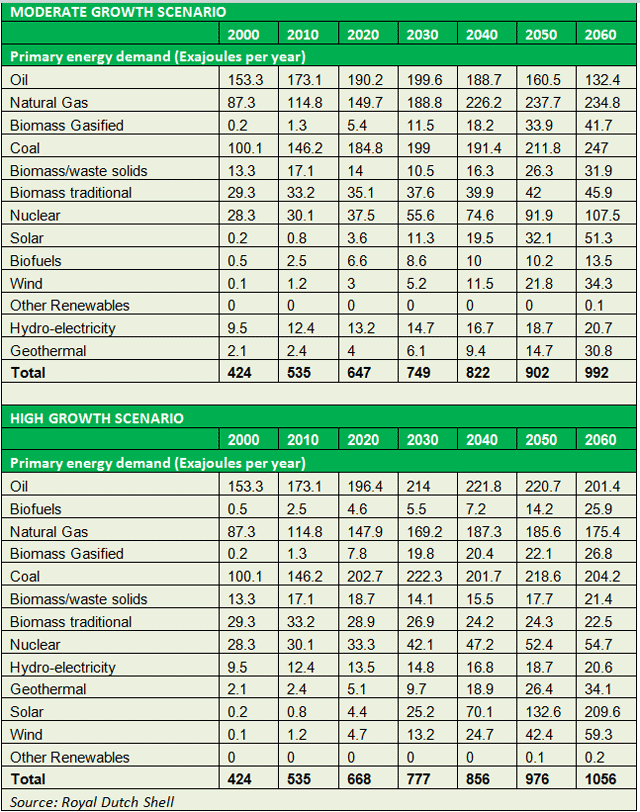
Higher growth scenario
Crude oil fares much better in the higher growth era, but still loses out to solar as the world's dominant energy source.
"The countries that produced more than 75% of current global oil production in 2012 find their share increasing even further," wrote Shell. "OPEC countries hold the majority of low-cost growth potential, and increase recovery further with more expensive technology. However, such developments are initially limited by geopolitical instability and a resulting underinvestment in most OPEC countries."
In this scenario, the company expects greater investment in frontier oil projects such as the Arctic, technologically-advanced fracking and drilling techniques will ensure greater access to shale plays in Canada, Venezuela, Russia and Kazakhstan.
"In time, OPEC's spare capacity buffer is eroded, and markets adapt to higher price volatility and new commercial and strategic stock management. In the longer term, sufficient stability returns to OPEC for investment to pick up, but the stretch to meet strong demand growth keeps prices high, enabling the development of the higher-cost conventional and resources plays outside OPEC."
Despite these massive jumps in crude production, solar power may emerge as an even greater force and become the world's biggest energy source by 2060.
In fact, by 2100, solar could make up 37.7% of energy demand, with oil accounting for a mere 10% - but of course such declines will be mitigated by the fact that overall consumption of all energy sources will rise significantly as more countries enter the emerging economies status, the oil giant predicted.
No consensus on oil
The Shell report is in contrast to a similar report by competitor ExxonMobil which predicts a limited role for solar and other renewables energy in its own long-term forecast.
"Oil, gas and coal continue to be the most widely used fuels, and have the scale needed to meet global demand, making up about 80% of total energy consumption in 2040," the company said in its forecast published last year. "For both oil and natural gas, an increasing share of global supply will come from unconventional sources such as those produced from shale formations."
International bank HSBC had warned in a 2011 report that the world may not have much oil left to meet rising global demand which is set to increase 110% in 50 years.
"Even if demand doesn't increase, there could be as little as 49 years of oil left. Gas is less of a constraint, but transporting it and using it to meet transport demand is a major issue. Coal is the most abundant with 176 years left, but this is the worst carbon culprit," HSBC said in its 'Energy In 2050' report.
Meanwhile, the International Energy Agency's forecast till 2035 suggests oil will maintain its dominance over global markets.
"Fossil fuels - oil, coal and natural gas - will continue to meet most of the world's energy needs. Fossil fuels, which represented 81% of the primary fuel mix in 2010, remain the dominant sources of energy through 2035 in all scenarios, although their share of the mix in 2035 varies markedly."
Shell's two scenarios suggest the world is going through a rapid transformation and the surge in shale plays in the United States, coupled with lack of investments and uncertainty in OPEC countries may provide an opportunity for new players and new developments that could alter the hydrocarbons industry.
Pressure on governments to include the cost of climate change in their economic calculations and more energy-efficient policies will also have long-term consequences on oil production and OPEC countries.
The future is likely to unfold somewhere between those two paths identified by Shell. Either way, oil producers cannot sit still while the world around them goes through seismic shifts.
alifarabia.com 2013