As safe haven-seeking investors cast their eyes over the political storm in the region, Abu Dhabi appears to be a safe harbour.
While investors tiptoe their way around the political turmoil of Bahrain, the unrest in Oman, and the restlessness in Saudi Arabia and Egypt, the UAE comes across as a calm oasis and inviting place to park their funds.
Much of the UAE's stability has to do with Abu Dhabi solid economic fundamentals.
"The social and political unrest in parts of the Middle East will create winners and losers. In our view, Abu Dhabi will be one of the winners," says a Standard Chartered Bank report.
"There are no signs of political and social tensions, and the emirate is benefiting from the impact of the unrest as it exports more oil at higher prices. This is having a direct impact on growth, and also boosts government revenues and Abu Dhabi's net foreign assets position."
Citigroup analysts agree, predicting that the UAE may be a net beneficiary of the political turmoil experienced in other parts of the Middle East. Due to its relative political stability, Citibank believes there is a possibility of a diversion of commercial, investor and tourist activity from less stable parts of the region.
"The external sector is the main driver of the recovery, with gains being posted both in export growth, and a reduction in imports," Citibank wrote in a recent report.
"In Abu Dhabi, government spending and ongoing mega-projects continue to drive economic activity, although the real estate sector will be a drag on growth for the next 2-3 years, in our view, due to contagion and the substitution effect from Dubai."
Abu Dhabi's gross domestic product (GDP) is projected to increase by 5.5 per cent in 2011 and an even 5% in 2012 and 2013 respectively, according to Standard Chartered.
2030 Vision
Abu Dhabi has chalked out a vision for its economic strategy that targets oil GDP to rise 4.5% on average each year till 2030. Non-oil GDP will be nearly double of that growth, rising by 8.8% in the year, while the compound annual growth rate of the overall economy will be a robust 6.7% each year, taking Abu Dhabi's GDP to $415.7-billion by 2030.
The emirate expects to spend $400 billion during this period to create a dynamic economy with a population of three million and nearly eight million tourists each year.
"By 2030, we envision Abu Dhabi among the locations of choice for globally-significant industrial projects, and Abu Dhabi economy diversifying well across several non oil sectors, including the key financial sector," said Ahmad Abu Ghaida, Director of Economic Planning at the Abu Dhabi Department of Economic Development at a conference.
"A robust 8.5% (sic) average year-on-year growth rate in the non-oil sector throughout this period will see non-oil activities driving the Emirate's economy at 64% of real GDP by 2030, versus 40% in 2005, and Abu Dhabi's real GDP climbing to USD 415 billion, or fivefold its 2005 level"
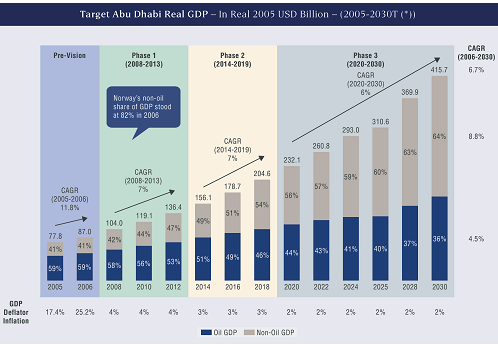
Source: Abu Dhabi 2030 Vision document
While the emirate is looking to raise oil production to 3.5 million by the next decade to ensure oil revenues continue to flow into the economy, the key non-oil GDP growth areas are: aviation, tourism, healthcare equipment and services, transportation, media, education, financial services and life sciences.
For the above targets to be reached, much work needs to be done.
In the early half of the last decade, Abu Dhabi shed its conservative outlook and launched on an ambitious economic plan, mirroring that of Dubai. Worse, it got caught up in Dubai's real estate boom and embarked on a construction spree of its own.
"Despite strong fundamentals, Abu Dhabi's real estate sector could not escape the correction in the regional real estate sector," notes Dubai-based Al Mal Capital. "While residential prices declined 47% between 3Q 08 and 2Q 10, office rentals tumbled 37% during the same period."
Indeed, Aldar Properties, Abu Dhabi's largest real estate developer, needed a bailout from the government.
"We believe, despite overall shortage in the Abu Dhabi's residential market, prices should continue to decline until 2014 due to demand for housing units, especially for medium to high income segment," Al Mal notes.
Abu Dhabi's real estate problems are important to highlight as it shows that even the strongest economic fundamentals can not protect against bearish market forces.
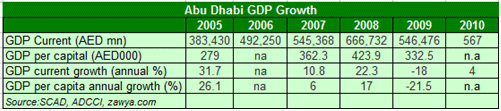
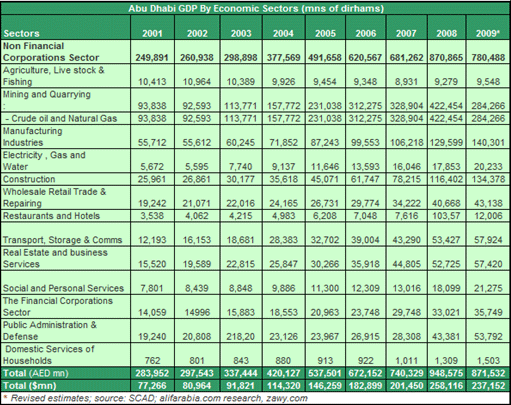
It was a tough time for the emirate and it felt the full force of the global financial crisis. The emirate's GDP declined by 18% in 2009 compared to 2008, with the energy sector leading the decline on the back of falling oil prices.
Abu Dhabi Chamber of Commerce and Industry (ADCCI) estimates show that the emirate's economy rose 3.8% in 2010, to reach AED567.3-billion. Non-oil GDP rose 5.1%, while the oil sector grew by 2.7%. ADCCI expects the emirate's economy to hit AED590-billion in 2011 - or a rise of 4%.
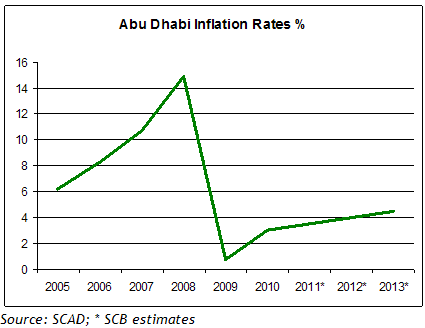
Meanwhile, the emirate's tearaway inflation has been tamed primarily due to home prices declining. While food and energy prices are expected to rise over the next year or so, Standard Chartered expects inflation to rise only modestly to 3.5% this year, and four per cent next year.
Here are some of the key strengths, weaknesses, opportunities and threats facing the Abu Dhabi economy
STRENGTHS
* With 97.8 billion barrels of oil reserves (7% of global reserves) and 214.4 trillion cubic feet of gas reserves, the UAE is one of the largest holders of fossil fuels reserves in the world.
* Oil prices are comfortably high at over $100 a barrel, providing plenty of fiscal cushion to Abu Dhabi which has a breakeven oil price of around $40, according to Fitch Ratings. Oil prices are forecast to remain high for the foreseeable future.
* The SWF Institute ranks the Abu Dhabi Investment Authority as the largest fund in the world with $627-billion, primarily invested abroad. Since 2007, the ADIA has started deploying smaller funds/sovereign wealth enterprises (SWE) with mandates to diversify the AD's economy, while keeping ADIA focused on investing abroad, the IMF notes. The SWEs are adding new dimension to the emirate's growth and adding significantly to AD's traditional oil engine and to non-oil activity.
* There is no known home-grown Islamist movement and it is unlikely that one will develop in the foreseeable period but it is possible that foreign Islamist groups could try to target Western interests in the UAE, according to the EIU.
* S&P has an AA/A-1 rating for Abu Dhabi. "The stable outlook balances the Emirate's strong financial position and prudent policies against geopolitical risks, contingent liabilities, and potential impediments to growth stemming from undeveloped institutions," notes S&P.
WEAKNESSES
* Power generation is a weak link for the entire UAE. The Abu Dhabi's 2030 Vision envisions that the emirate will be liberalising the sector to solve the problem.
"In meeting future demand, Abu Dhabi will benefit from the liberalisation and deregulation of some elements of its utilities sector (mainly power generation), which is key to ensuring robust, demand-sensitive power and water provision."
Meeting the emirate's power needs is also straining its oil production as increasingly the government is using oil to keep electricity flowing. The emirate is spearheading a drive to increase alternative energy - including nuclear and solar - in a bid to free up oil production for lucrative export purposes.
* Abu Dhabi's economic fortunes remain tied to oil prices. While crude prices are expected to remain high for the foreseeable, analysts are already talking of demand destruction due to high oil prices and continued economic troubles in the EU that could impact oil prices. This was visible as recently in 2009 when relatively low oil prices saw Abu Dhabi's GDP contract by 18%.
* Dubai's economy will remain a drag on Abu Dhabi. Abu Dhabi banks especially have a strong correlation to Dubai's economy.
* Abu Dhabi and the UAE would be better off relying more on their local labour forces and less on the transient expatriate population to fill private-sector jobs, notes Standard Chartered Bank. This challenge needs to be tackled through incentives, education and job creation. Currently, expatriates dominate the workforce.
* The commercial legal system of the UAE is widely acknowledged as inadequate, according to the Economist Intelligence Unit (EIU). Lack of bankruptcy laws, real estate laws and commercial and business laws could impact growth.
* While Abu Dhabi government-related entities (GRE) have contributed significantly to the U.A.E. growth, the recent bailouts and expansion of GRE borrowings in several emirates underscore the need to have a proper risk management framework, the IMF warns, recommending a greater role for Debt Management Office (DMO). Broadening the regulation on real estate exposure would also help manage risks, IMF states.
* Improved corporate governance and transparency are also key to mitigating risks posed by GREs. "It would be important to delineate clearly between the commercial and non-commercial operations carried by GREs, clarify the government support strategy to the GREs, and standardize the accounting, auditing, and financial reporting practices of GREs," the IMF recommends. Better information disclosure about GRE financial accounts would also help attract investors and ultimately translate into lower funding costs.
OPPORTUNITIES
* While a stable GCC is in the interest of all parties, Abu Dhabi will benefit from negative investor sentiment towards its Gulf counterparts such as Bahrain, Oman and even Saudi Arabia.
* Rising populations in high income segments have turned the emirate and the UAE into a magnet for international businesses. Shortages of retail, housing and commercial office space are great opportunities for real estate companies and related businesses.
The UAE has amongst the fastest growing populations in the world (CAGR of 5.6% during 2001-2009). It has one of the youngest population bases even among GCC countries, with approximately 53% of the population is between the ages of 20 and 39, compared to the GCC average of 44% for the same age group.
A recent UAE official report estimates the country's overall population stood at 8.36 million, on the back of a rising expatriate population. The last census in 2006 had estimates of 5.01 million, leading to a surge in population levels and suggesting that media reports of a great expatriate exodus from the UAE in the aftermath of the 2008 financial crisis were greatly exaggerated.
* The government's emphasis on transportation, life sciences, media, education, tourism, finance and transportation offers great prospects for companies focused on these sectors. With the market undersupplied in all these areas, new companies have a great opportunity to add value.
* The emirate's housing sector will remain under pressure till at least 2014, according to Al Mal Capital.
* The chronic power needs of the UAE, while currently a weakness, are also an opportunity for new and alternative energies including nuclear, geothermal and solar.
* The financial crisis in Dubai has resulted in greater integration and co-operation between the two key emirates of Abu Dhabi and Dubai. The two emirates can build on this integration and collaborate more on their economic plans, which is especially important as both emirates continue to diversify their economies and focus on similar sectors.
THREATS
* While the UAE has been free of domestic political disturbance, 133 Emiratis sent a petition to the UAE President and the Supreme Council, calling for direct elections. One of the bloggers who signed the petition is now in detention, notes a CNN report. While few analysts expect this episode to escalate, it is does offer a rare insight into the political and social aspirations of some portions of the Emirati population.
* The UAE has a complex relationship with Iran. The Persian country remains an important trading partner but the new sanctions against Tehran have hurt trade between the two nations. The UAE also has a long-standing dispute with Iran over the sovereignty of Abu Musa and Great and Lesser Tunb islands.
The crisis in Bahrain has brought to the fore the latent hostility between the Gulf states and Iran, which could potentially escalate and, at the very least, distract the emirate from its economic programmes.
* Dubai leaders may call upon their brothers in Abu Dhabi to bail them out once again. Abu Dhabi granted a $10-billion loan to Dubai last year, and at least one analyst does not rule it out as a possibility.
"As higher oil prices and production replenishes the coffers in Saudi, Kuwait and UAE on improving fiscal and external balances, we would not rule out oil-rich Abu Dhabi supporting Dubai in meeting some of its refinancing needs to avoid negative headlines and confirm its solidarity with other emirates," Alia Moubayed, senior economist for Barclays said in the report.
* Abu Dhabi, which periodically finances other northern emirates, is going to spearhead a $1.6-billion fund for its northern neighbours. If there are any domestic issues, it is likely to emerge from the north. The recent drama surrounding succession in Ras Al Khaimah suggests that not all emirates in the UAE enjoy political stability.
* While Abu Dhabi may be seen as safe haven in the Middle East political crisis, it is not immune from contagion. This is especially visible in the stock market, while businesses based in the UAE with a regional outlook may curtail and stop investments, which could indirectly impact on the Abu Dhabi economy.
"The government should... stand ready to expand spending on productive investment, in case the regional unrest starts affecting the economy," the IMF recommends.
alifarabia.com 2011