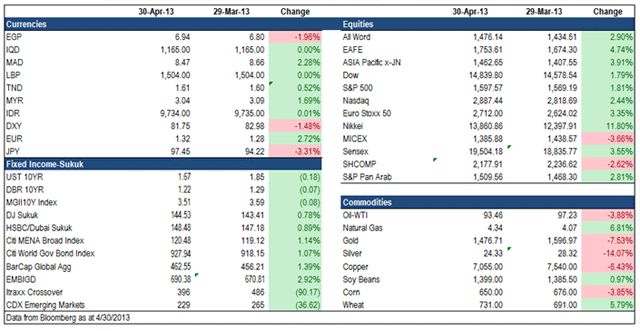
Global risk assets generally delivered strong returns in April, in part a by-product of the expectation of continued monetary easing by central banks. An aggressive policy shift by the Bank of Japan, which aimed to eliminate persistent domestic deflation, seemed to boost expectations among investors of increased flows out of Japan in search of higher yields, and drove gains for corporate and emerging-market debt while continuing to weaken the Japanese yen.
So-called "safe-haven" sovereign debt also gained, as US Treasury yields fell to their lowest level so far this year, after the country reported disappointing labor market and first-quarter gross domestic product (GDP) growth figures. In Europe, German sovereign bond yields dropped as well, with continued economic weakness in the Eurozone increasing speculation about a cut in the region's benchmark interest rate, which duly followed in early May.
Across the Middle East and North Africa (MENA) region, there was more evidence of divergence between economies. Among the stronger economies, Qatar announced plans for record expenditure over the coming fiscal year, with the country's new budget projecting substantial increases in wages and salaries, as well as development projects, many related to the 2022 FIFA World Cup.
Economic news from Saudi Arabia remained encouraging and included strengthening industrial survey data and measures aimed at facilitating the major house-building program announced in 2011. Regarding the latter, the Ministry of Finance provisioned SAR 250 billion to build half a million housing units, and plans to allocate plots of developed land to locals were also announced. In the United Arab Emirates, the ongoing recovery of the Dubai property market helped sentiment, with March seeing the 16th consecutive month of price and rental gains.
Egypt's struggles
In contrast, weak data from the Egyptian private sector underlined the negative impact of ongoing political discord and insecurity on economic activity, while also pointing to rising inflationary pressures. Egyptian finances received a boost, however, with the news that Qatar had agreed to buy an additional USD 3 billion worth of Egyptian sovereign bonds, following its USD 5 billion purchase of Egyptian debt in 2012.
This bolstering of Egypt's foreign-exchange reserves appeared to reduce the immediate risk of a sharp devaluation of the country's currency, though agreement with the International Monetary Fund (IMF) on an aid package still seemed vital for a longer-term stabilization of Egypt's finances. Importantly, Tunisia managed to achieve such an agreement with the IMF, securing preliminary approval for a USD 1.75 billion deal. The two-year precautionary credit line facility will now go to the IMF's board for final approval.
Regional fixed income markets (as measured by the Citi MENA Broad Index) continued the strong performance seen so far in 2013 with a 1.14% return in April, outperforming the Citi World Government Bond Index but marginally lagging behind the Barclays Global Aggregate Index.
For the first four months of 2013, however, the MENA index remained ahead of the Barclays index. Emerging-market bonds (as measured by the JP Morgan Emerging Markets Bonds Index Global Diversified) meaningfully outperformed both of the global indexes in April, recovering from a relatively weak first quarter.
Rating changes and bond issuance
Among corporate debt, Qatar Telecom's (Qtel) A/A-1 credit rating was placed on negative watch by ratings agency Standard and Poor's (S&P) following the Qatari company's bid to acquire a majority stake in Morocco-based Maroc Telecom. The move by S&P reaffirmed the agency's view that Qtel's international expansion could hurt its credit profile following the company's recent acquisitions in Tunisia, Kuwait and Iraq, notwithstanding the USD 1 billion Qtel raised in a bond issue in December 2012.
Apart from the increased leverage associated with the acquisitions, S&P reiterated that the increasing share of Qtel's revenues derived from countries with above-average country risk could impact the company's business risk profile.The stake in Maroc Telecom was put up for sale by French media group Vivendi and has also attracted interest from Emirates Telecommunications Corp (Etisalat).
In contrast, S&P upgraded the credit rating of Emaar Properties from BB to BB+ following an increase in the company's recurring income after its leasing and hospitality assets delivered strong performances. Another reason for the upgrade, according to the rating agency, was the successful presale of a number of new residential developments, which appeared supportive of Emaar's earnings over the medium term.
Corporate issuance was headed by Bahrain Telecommunications Company (Batelco), which launched a USD 650 million senior unsecured bond maturing in 2020, at a premium of 50 basis points to the Bahraini 2020 sovereign bond. The proceeds of the issue were earmarked as refinancing for Batelco's loan related to its acquisition of the Monaco and Islands division of Cable & Wireless Communications.
Among sukuk issues, Bahraini sovereign wealth fund Mumtalakat Holding issued Islamic bonds worth MYR 150 million in a private placement format, with a profit rate of 5.35% and maturing in 2022. In addition, Sharjah Islamic Bank issued a USD 500 million, 2.95% five-year sukuk.
Market outlook
Investors have continued to push into emerging market debt as an alternative to other lower-yielding fixed income investments, raising fears that some countries may not be able to absorb such large capital inflows. However, bond markets in many countries have deepened in recent years, while select emerging market debt offers exposure to countries with far higher growth rates than developed markets, and with public finances that are often in much better shape.
This is particularly true of Gulf Cooperation Council (GCC) countries, whose debt dynamics remain among the strongest in the world, while the outlook for hydrocarbon prices should help support expansionary fiscal policies and economic growth.
The MENA fixed income market's performance and issuance patterns so far in 2013 have been consistent with our stated expectations and with recent history, delivering competitive returns relative to other major fixed income sectors with significantly less volatility and continued growth.
We continue to believe that with the historically low levels of government bond yields in most developed markets, opportunities offered by the MENA region remain attractive, particularly on a relative value basis. The recent rally in these benchmark government bond yields has altered our tactical stance on duration from slightly overweight to neutral, but our active overweight exposure to banks and corporations from the GCC remains unaltered.
Mohieddine Kronfol is responsible for the investment process, research and performance of the Global Sukuk and MENA Fixed Income Team at Franklin Templeton Investments, where he is chief investment officer.
© Zawya 2013