The Middle East will join emerging Asia and Africa as three of the fastest growing trading regions in the world, as the global economy sees fresh new trade corridors emerge over the next four decades, forecasts Citibank.
Middle East's trade will rise exponentially over the next four decades, according to a Citibank study on trade patterns over the next few decades.
The U.S. bank estimates that world trade will rise from $37 trillion in 2010 to $122 trillion by 2030, and hit $287 trillion by 2050.
"World trade is set for both a prolonged boom and a marked transformation, according to our research," notes Willem Buiter, Citibank chief economist.
"We expect world trade (defined as the sum of bilateral exports and imports of goods and commercial services) to expand at an average rate of 6.1% per annum between 2010 and 2030, measured in constant 2010 USD, and to expand by 4.4% pa between 2030 and 2050. World trade would rise to be equivalent to 76% of world GDP by 2030 and grow more or less in line with GDP thereafter. We thus expect world trade to continue its success story of the past two decades."
Citibank argues that this boom in trade would usher in the third wave of globalisation.
The first wave came between 1870 to 1913 before the First World War, which saw major advances in global trade. The second wave hit the global economy after the Second World War which saw the rise of the United States, Germany, Japan and much of the industralised countries.
The third wave will feature fresh new faces.
Citibank expects intra-emerging market trade to overtake trade among the advanced economies (AE) by 2030 and to be of similar size to trade between AEs and EMs by 2050.
"That is quite a change. As recently as the year 2000, intra-EM trade was a bare 6% of total world trade (counting only merchandise trade, excluding services) and little more than one tenth of the level of intra-AE trade," notes Buiter in the report he co-wrote with analyst Ebrahim Rahbari.
Prospects for trade are bright across the EM world (and AE exports to EM are one of the few bright spots in the economic sphere in many AEs), but the prospects of Asia stand out.
"We expect China, already the world's largest exporter in 2010, to be the world's largest trading nation by 2015, overtaking the US. We expect Emerging Asia to become the largest region by trade in 2025, even though its share of world trade was only about half the level of Western Europe - the largest trading region today - in 2010."
China will surpass the United States as the top trading country by 2015, and India will edge past the United States by 2050 to emerge as the second largest trading country.
Middle East trading post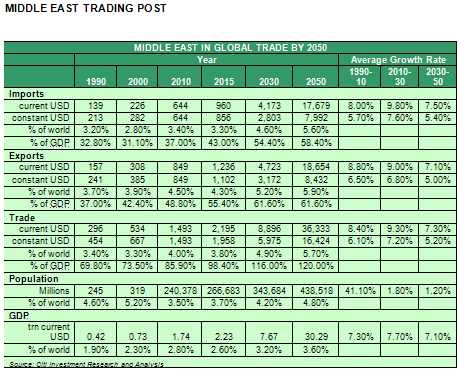
So where does the Middle East stand in all this great transformation?
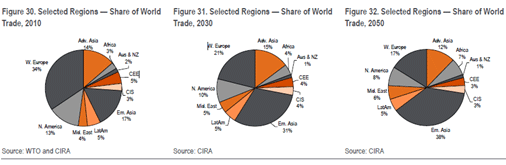
According to Citibank estimates, the Middle East contributed 4% (or $1.5 trillion - in constant US $) of global trade in 2010. By 2030, Middle East's contribution will remain constant at 5% but rise to $6-trillion in monetary terms. By 2050 that Middle East figure will rise $16.44-trillion, and account for 6% of global trade - in short, in 40 years, the Middle East's trade contribution will rise by a mere 1%, but that's deceptive a figure as the region will post an average growth of 7.2% - the third fastest growth in the world after Emerging Asia and Africa at least over the next twenty years.Africa will grow at 8.6% over the next twenty years to see its contribution of world trade rise from 3% in 2010 to 4% by 2030, and emerging Asia will be the fastest growing region in the world at 9.4%, nearly doubling its contribution from 17% in 2010 to 31% by 2030.
All three markets will slow down a bit from 2030 to 2050 but still remain the fastest growing in the world.
Emerging Asia features China, India, Indonesia, Malaysia, Pakistan, Philippines, Thailand and Vietnam and 16 others Asia countries, according to Citibank. Advanced Asia includes Hong Kong, Japan, South Korea, Singapore and Taiwan.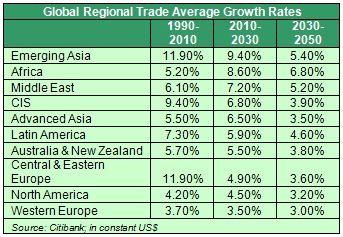
Interestingly, Western Europe will see trade flows halve from 34% in 2010 to 17% by 2050, and North America will see its trade contributions fall substantially from 13% to a mere 8%, highlighting the United States' continued deterioration as an economic powerhouse.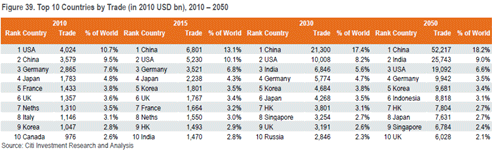
Trade corridors
New trade corridors between AEs and EMs and within EMs will come into existence and existing ones will become both deeper and wider, says Citibank.
Emerging Asia and Middle East trade will make up 4.2% of global trade by 2030 and 5.4% by 2050, as emerging Asia will constitute nearly 50% of Middle East trade.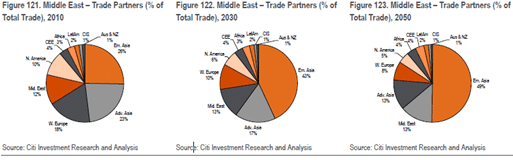
"The content of trade will also change. As industrialising EMs become richer, they will import fewer capital goods and commodities and more consumption goods and services. Exporters of non-renewable natural resources need to diversify their economies to prepare for the eventual depletion of their natural resource endowments, even if that eventuality is still some decades off.
The new trade routes have the potential to create new winners, be they products, services, cities, companies, industries or economies."
© alifarabia.com 2011