Listed Lebanese banks boast an impressive track record of growth at both the asset size and profit levels. Over the past seven years, the net earnings of Bank Audi, BLOM, and Byblos Bank grew at a CAGR of 26%, 20%, and 19% respectively, while their customer deposits and total assets grew at a CAGR of 16%, 12%, and 13%. This was coupled with a double-digit yearly growth in equity, a high liquidity and adequate solvency by international standards. Yet their present market valuations fail to reflect any of these positive indicators, adamantly dismissing a fairly solid financial performance and standing. The specter of regional and local unrest seems to be overshadowing valuation fundamentals and thus maintaining the prices of listed shares below their intrinsic values.
A review of the market cap of common equity over the past seven years for the biggest three Lebanese listed banks reveals that the market valuation ratios are today at their lowest levels for the entire period under study. The chart on the next page highlights the 7-year trend in the ratio of market cap of common equity to the trailing basic earnings, or in more common terms the P/E trailing of common equity, for each of the three banks. For accuracy and consistency, the market cap at the end of each quarter was computed based on the outstanding number of common ordinary shares (total issued less treasury shares), the outstanding number of GDRs (total issued less treasury GDRs), and their respective end-of-period prices. As at the end of August 2012, this ratio stood at 5.6, 5.1, and 6.7 respectively for Bank Audi, BLOM, and Byblos Bank, compared to double-digit figures in the 2005-2008 period.
True, growth has slowed since 2011, but that alone surely does not warrant such low multiples, most notably in light of the solid outstanding balance sheet structures of these banks - as at the end of 2011, the liquid assets in foreign currencies to deposits in foreign currencies ratio for the three banks under study averaged 80%, and their capital adequacy ratios were all above 10%.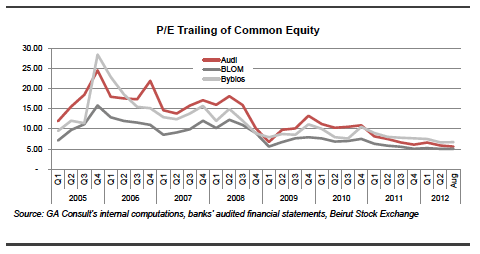
At 5.8 times, the current (simple) average P/E trailing of the three banks under study compares to average ratios of 17 times globally, 17 times in the US, 11 times in the EU, 19 times in emerging markets, and 11 times in the GCC.
The market is thus implicitly accounting for an additional risk premium in its valuation of the shares of listed Lebanese banks, which are in turn translating into lower earnings multiples. To quantify this additional risk premium, one would need to estimate the capitalization rate applicable on listed Lebanese banks and compare it to the implied cap rate corresponding to the prevailing earnings multiples.
The computation of cost of equity for a specific sector and in a specific country is not an exact science; still, a fairly well substantiated estimation of that cost for the Lebanese banking sector could shed light, at least academically, on the unjustifiable premiums that the market is commanding.
The Capital Asset Pricing Model (CAPM) is a market based model that yields the expected or required rate of return for a risky asset; according to CAPM, the cost of equity equals the risk free rate plus the country risk premium plus the equity market risk premium adjusted to the sector's Beta - i.e. the sector's correlation to a market index.
When the above formula is applied, the cost of equity would stand at about 12.2%. This is based on a risk free rate of 1.7% representing the present yield on 10-year US treasury; a country risk premium of 6%, one that is commensurate with Moody's B1 sovereign rating of Lebanon as well as Moody's specific rating of the three banks under study, a historical equity risk premium of 5.8% for mature markets, and a forward-adjusted Beta of 0.78 representing the banking sector's beta in emerging markets.
If we are to further assume a very conservative long-term growth rate of only 3% in basic earnings, significantly less than what has been achieved in the period under study, then the applicable cap rate would stand at 9.2% or the rough equivalent of an 11 times multiple, compared to a present average of 5.8 times (the cap rate equivalent of 17.2%) for the three listed banks under study. In other words, the market is presently pricing in an additional risk premium of 8% on top of the country and equity risk premiums. 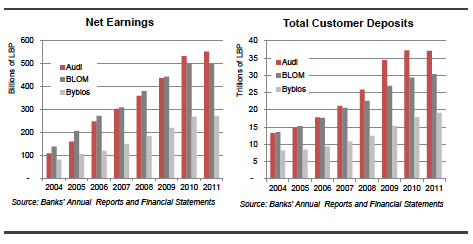
No matter what the market perception of the specific risks is, the above premium is too high and the corresponding multiples are too low. The oversubscriptions to the newly issued preferred shares over the past year by the two biggest Lebanese banks, at a time when interest rates are at historic lows and thus the potential for capital gains is limited, do not support this specific risk perception theory; neither do the prevailing liquidity and solvency ratios of listed banks.
Moreover, if we are to conservatively assume, on top of a minimal long-term 3% growth in earnings for all three banks, a potential sovereign rating downgrade to B2 by Moody's standards and a corresponding downgrade of the banking sector, and a further handsome illiquidity discount of 10% to account for the low trading volumes at the BSE, then the corresponding fair market values of the shares would still be significantly higher than their actual trading prices, namely at US$8.3, US$12.5 and US$1.9 respectively for Bank Audi, BLOM, and Byblos Bank.
Unlike demand for preferred equity, demand for common equity seems to be driven by institutional investors, notably foreign institutional investors, who for now seem to have turned their backs on the fundamentals.
The International Glossary of Business Valuation Terms defines intrinsic value as "the value that an investor considers, on the basis of an evaluation or available facts, to be the true or real value that will become the market value when other investors reach the same conclusion". Until then I am a buyer.
George Azar is founder and managing director of GA Consult, a specialized firm in the field of corporate finance. The views expressed in this article do not necessarily reflect those of Zawya.
© Zawya 2012