International oil companies continue to circle around the Kurdish region, looking at opportunities while ensuring that they do not upset the federal government in Iraq. The strategy underscores the region's potential as a hydrocarbon-rich pocket of opportunity, but the region faces resistance from the federal government which is hampering growth and keeping major international oil companies at bay.
While the major oil companies remain hamstrung, many smaller independent companies are keeping the region's economic engine humming.
Recent media reports that oil major ExxonMobil has signed a contract with the Kurdish Regional Government (KRG) to explore six oil and gas blocks in the Kurdish region of Iraq, has been met with fury in Baghdad.
The company would be the first of the major international oil companies to reach such an agreement with the KRG, according to a Dow Jones Newswire report.
Iraq Government has categorically stated that all oil contracts must be signed with the federal government and contracts with the KRG will be seen as invalid.
"We categorically deny the reports carried by some media that the deputy prime minister for energy affairs (Hussein al-Shahristani) has agreed that a U.S. firm working in the south of Iraq can sign exploration contracts with Kurdistan," said a statement released by Shahristani's office.
"The Iraqi government will deal with any company that breaks the laws in the same way that it has in past and ExxonMobil has been notified of this," the statement said, according to AFP.
ExxonMobil, along with its South Oil Company and Shell partners, produce 285,000 barrels per day from one of the country's largest oil fields, the West Qurna 1, and it will be loathe to upset the federal government given Iraq's overall energy potential. The company has not been made any statement on its reported agreement with KRG.
The move by ExxonMobil, if true, is significant as major oil companies have stayed away from Kurdistan, leaving the field to independent players.
At 112 billion of potential oil, Iraq has the fourth largest reserves in the world, although the general consensus that the actual figure may be much higher.
Iraq has 9 fields that are considered super giants (over five billion barrels) as well as 22 known giant fields (over one billion barrels). According to independent consultants, the cluster of super-giant fields of southeastern Iraq forms the largest known concentration of such fields in the world and accounts for 70 to 80 percent of the country's proven oil reserves.
An estimated 20 percent of oil reserves are in the north of Iraq, near Kirkuk, Mosul and Khanaqin. Control over rights to reserves is a source of controversy between the ethnic Kurds and other groups in the area, notes the U.S. Department of Energy.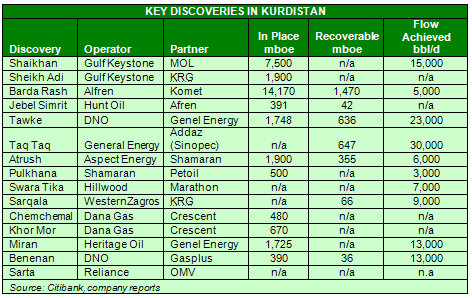
TREMENDOUS POTENTIAL, POLITICAL CHALLENGES
Regardless of the ExxonMobile news, there are tremendous opportunities in the Kurdish region of Iraq.
Taking the long view, Citibank believes the region is set for a major period of news flow and industry activity in the next few years but has, admittedly significant, political hurdles are resolved.
"Recent drilling has resulted in a number of world-class discoveries, with a success rate of 71% - highlighting the potential of the region. In the near term we expect the exploration and appraisal drilling to accelerate into 2012, both on existing discoveries and frontier licences. We expect the industry to drill 25+ E&A wells over the next 15 months, targeting regions 50bn barrel resource potential," notes Citibank.
The bank thinks the region can emerge as a low-cost energy hub - a major prize given that much of global conventional oil has been developed and oil majors are drilling deeper and more expensively to extract fossil fuel.
"The operators have indicated average F&D costs of $3-4/bbl, and operating costs of $4-6/bbl for a typical development. We calculate an IRR of c.35% and breakeven of c.$36/bbl for a generic oil project in Kurdistan," says Citibank. "However, the Kurdistan PSC [production sharing agreement] terms are yet to be ratified and we see the risk that these terms could be tightened."
The purported ExxonMobil deal brings to the forefront the challenges of operating in the region without the blessings of the federal government.
The KRG has developed its own Oil and Gas Law, separate from the federal legislation, and claim to be far more favourable to investment.
No agreement has been reached between the Iraqi central government and the KRG on the Iraqi Oil and Gas Law, which will provide a solid regulatory and legal framework for the Iraqi oil and gas industry.
"The Iraqi central government has questioned the validity of the Kurdistan PSCs, which appear to offer better economics than the Iraqi service contracts in the south. In addition, Kurdistan oil contractors are not receiving full payment for their oil exports from the regional government. Both issues are unlikely to be resolved until an Iraqi Oil and Gas Law is ratified, in our view. While some progress has been made with both sides resuming talks for the first time since 2007, there is no visibility on the timing of this legislation," says Citibank.
KURDISH STABILITY
In a volatile neighbourhood, the autonomous Kurdish region bills itself as a safe and stable area ready for business. With 4 million people in a region the size of the Netherlands, the region has been successful as marketing itself as a gateway to Iraq.
According to some estimates the Kurdish region has a per capita of around $4,500, higher than Iraq, and has strong trade ties with Turkey, UAE, Lebanon and Iran.
"Since Iraq's liberation, the investment licenses granted by the Investment Board of the Kurdistan Regional Government for projects in housing, banking, industry, tourism, education, agriculture, communications, and health service have amounted to nearly $16 billion," said KRG Prime Minister Barham Salih at a conference in Washington last week.
The main issue facing Iraq's nascent political order is power sharing in an inclusive government, notes Salih. The real debate has begun on decentralization and federalism.
"This debate transcends the usual Kurd-Arab perspectives. For the first time, Arabs, whether Sunni from Anbar or Salahadin provinces, or Shiites from Basra, are calling for the creation of federal regions with powers similar to those of Kurdistan... This will be the ultimate test for Iraqi leadership, especially at this time when the American troops are to leave by end of year," he said in his speech.
ATTRACTING INTEREST
The KRG's charm offensive is working. The UAE is looking to invest $6-billion in the Kurdish region by 2013, Sheikh Lubna Al-Qassimi, the UAE Minister of Foreign Trade told the Kurdistan Investment 2011 report, published by the regional government.
Close to 1,170 foreign companies are registered in the region, with 60% from Turkey, which is ironic given that the Kurds and Turkish have a long history of distrust and enmity.
That appears to be changing as Turkey has been positioning itself in the region with bilateral trade exceeding $6-billion in 2010. Four Turkish energy companies - Genel Energy, Petoil, Petroquest and Dogan Energy already operate in the region.
Overall, the Kurdistan region's investment board says there are currently 290 active projects, generating almost $14 billion. A quarter of these projects are foreign direct investment from Arab countries, the EU and the United States.
All of these developments are underpinned by a strong hydrocarbons sector.
Dr Ashti Hawrami, KRG's Minister of Natural Resources, notes the region has signed 43 production-sharing contracts with 40 companies. The oil companies - which are mostly smaller, independent firms, have committed to $10-billion investment in energy sector, according to the Minister.
"We have reached the point that we can implement plans quickly to export 100,000 barrels of oil per day (bpd), rising to 150,000 bpd by the end of 2011," the minister told the Investing publication.
"By 2014, Kurdistan will be able to export at least one million barrels per day. That is a reasonable production level to expect from the reserves that we anticipate in Kurdistan. There have been eight significant oil finds. We estimate the potential oil reserves at around 45 million barrels per day. All this means a large increase in revenues for Iraq as a whole, given that the country is currently producing just over two million barrels of oil per day.
Citibank does not believe the region can meet the ambitious production target of 1 million barrels of oil per day. "We believe is a challenging target given the lack of clarity around the Oil and Gas Law and limited infrastructure in the region. Further delays to the Oil and Gas Law will delay the significant investment into development and transport infrastructure, in our opinion," says the bank.
The Kurdistan region also has sizable gas reserves of three to six trillion cubic metres, which it plans to export to Turkey and Europe, once its own domestic needs are met.
DISAGREEMENT ON OIL SHARING LAW
But all these developments face tremendous hurdles due to the stalemate with the federal government.
"We have wasted four years arguing, moving one step forward and taking two steps back - it was all very frustrating. As a result Iraq has lost billions from exports from the Kurdish region," says Hawrami, that the KRG has supported Prime Minister Noor Al Maliki on the conditions that he will find a breakthrough for this key issue.
But there has been some progress as both sides are reported to have agreed to a temporary revenue sharing mechanism for Kurdistan oil exports. This temporary oral agreement implied a 50:50 split of revenues from Kurdish exports between Kurdistan and the central government in the absence of a permanent petroleum law.
Even as the parties discuss the Oil and Gas law and Federal Revenue Sharing Law, the KRG wants the federal government to end its practice of blacklisting companies that operate in Kuridstan.
"That really was a wrong policy adopted by the oil ministry and in Baghdad, and it was very harmful to Iraq," Hawrami said in the Investment report.
These issues are unlikely to be resolved soon. The Iraqi central government and the KRG remain in a legislative gridlock on the validity of the PSCs signed directly between the international oil companies and the KRG.
"Matters are further exacerbated by a lack of fundamental petroleum law in the country. Discussions on the Oil and Gas Law have been ongoing since 2007, and we expect them to continue into 2012. However, we have no visibility when these issues will be resolved," notes Citibank.
CONCLUSION
The reported agreement between ExxonMobil and KRG may not pan out given Baghdad's opposition, but it highlights the interest of oil majors and also the challenges involved.
Regardless, the KRG needs to be commended for persevering and creating an economic and political oasis despite being dealt a poor hand by history and being displaced, ravaged, pillaged and slaughtered for decades by various regional players.
To their credit, the Kurdistan region has emerged as yet another pocket of opportunity in the Middle East that offers tremendous potential. But it remains mired in political gridlock due to deep-seated regional and national rivalries.
The relationship between the KRG and the central government continues to remain difficult. "The two major issues of contention are the oil contracts (and distribution of revenues) and the Kurdish-populated territories adjoining the boundaries of the Iraqi Kurdistan region," says Citibank. "We believe that the resolutions of these two issues are closely linked, which may lead to a prolonged dispute that could significantly delay the
plans of the international oil companies operating in the region."
© alifarabia.com 2011