The Gulf states will need to create 3.3 million jobs over the next ten years, but programmes like Natiqat won't work, says Al Masah Capital.
The Gulf states will need to create 3.3 million jobs over the next ten years, meanwhile the MENA region will need to create 30.7 million jobs by 2020, according to Al Masah Capital.
Unemployment in the Middle East stands at 10.3% and North Africa at 9.8%. While that may seem comparable or even favourable to some OECD countries - (U.S. 9.1% unemployment, Spain 21.3%), joblessness in MENA is a structural problem.
"The unemployment rate among the youth in the MENA is high - one in every four youths living in this region is unemployed. The youth unemployment rate in the Middle East and North Africa stands at 25.1% and 9.8% respectively," says Al Masah Capital.
Clearly, much of the dismay and resentment that drove the raging Arab Spring was led by the unemployed or underemployed youth and led to the dismantling of least two regimes.
Regimes that have been left standing are quaking in their boots. Regional countries have stepped up their efforts to create jobs for the youth.
Saudi Arabia has earmarked $40-billion for education and training in the new budget, from its earlier allocations of $36.7-billion in 2010 and $32.5-billion in 2009.
"The logic is simple, if you keep the population busy, they won't have time to take to the streets. However, the actions so far, especially in Saudi and Egypt, are cosmetic at best," says Al Masah.
The Dubai-based financial institution does not expect the wholesale removal of expatriate force with a national labour force to work.
"The current actions taken by Saudi Arabia seem cosmetic. Actions such as the Nitaqat program and capping of expat residency (expected in Kuwait) are not long-term solutions for the problem of unemployment in the MENA region. Restricting employment for expatriates, if done aggressively, could prove detrimental to the region's economy."
Nitaqat Programme categorizes private companies in Saudi Arabia under various bands. Establishments with high rates of Saudization have been placed under the Excellent/Green band and granted most privileges in visa requests and operations for non-Saudis. Companies with a lesser number of Saudi employees are classified under the Yellow and Red bands. These companies have been given a period of three months (until 10 September 2011) to comply with the policy before restrictions come into effect, Al Masah notes.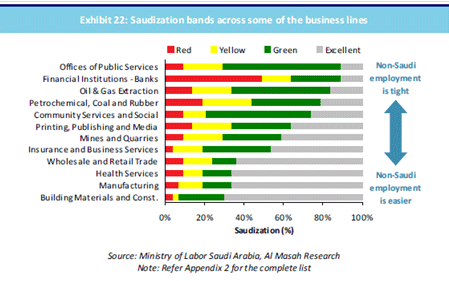
According to the Saudi Arabia's Labour Minister Adel Faqih, as many as 40% of the private sector firms in KSA fall under the last two bands (Yellow and Red) and could be forced out of business if they fail to comply with the new rules within the given time frame, says Al Masah.
This puts tremendous pressure on the private sector at a time when they have just recovered from the global financial crisis and regional lethargy.
Past experience with these policies also does not bode well for future success. Saudization has been placed for decades but has met with little success.
According to the Ministry of Economy and Planning, the rate of Saudization was 47.9% in 2009, below the target of 51.5% in the Eighth Development Plan. The target rate in the Ninth Development Plan has been lowered to 53.6% for 2014 from the earlier 60.4%, notes Al Masah.
Emotional Issue
The issue of employment for nationals is an emotional one, not just for the local population that feels it should have the first right of refusal to jobs, to expatriates who bring their carefully crafted expertise and skills to the region.
In an earlier report Citibank had suggested that Saudi Arabia should take the hit and overhaul the job market by pushing ahead with its Nitaqat programme.
Serious imbalances have been building in the country over decades and that requires urgent attention: only 40% of Saudis of working age are in employment, 43% of 20-24-year-olds are officially unemployed, 51% of Saudis are below the age of 21, expat workers make up 90% of the private sector work force, says Citi.
"While the emphasis in the past has been on creating new jobs for Saudis through diversification efforts, we believe it is a constructive step forward to re-emphasize at the same time the back-filling of jobs currently held by expats."
These steps are crucial for Gulf states like Saudi Arabia, which are facing a ticking unemployment time bomb, even though it would hurt their economies in the immediate term.
The 'ticking time' bomb is an apt description.
"As many as 75.5 million people in the region would be in the 20-30 age group by 2020," says Al Masah. "Considering an employment rate of 65% among the youth and exit of 18.3 million from the working age group, 30.7 million people in the region would need new jobs. Creating jobs for these new entrants would be a challenging task for MENA countries.
So, Al Masah's solution to defuse the 'ticking bomb'?
Push to pursue higher education: The governments in the region have focused on investments in primary and secondary schooling until now. The focus would now have to be broadened to include higher education facilities.
Align to the needs of the job market: MENA produces more graduates in humanities and social sciences than in science and technology. The current educational system fails to impart the right skills and hence should be reformed taking into consideration the market requirements.
Encourage interactive teaching models: The current education system in MENA places little emphasis on group work, problem solving and interactive teaching methods. Governments need to take steps to improve the method of imparting knowledge in the region. They should also look at updating the curriculum and improving teacher training programs.
Al Masah cites the example of Singapore as a model, which started with very few resources but focused on higher education ands reinvented itself as a knowledge-based economy.
While such a model could work for places like the UAE and Qatar, countries like Iran, Iraq, Saudi Arabia and Egypt have different sets of problems, and they need a combination of higher education, technical and skills-based education to meet the rising demands for their expanding populations.
"We believe sustained efforts built around five key points could solve the region's unemployment problem to a large extent: (1) Support self-employment/entrepreneurship, (2) Encourage investments from the private sector, (3) Give greater emphasis on education, (4) Nationalization, and (5) Diversification."
While it is unlikely that the regional authorities will disagree with these recommendations, the fires of diversification and entrepreneurship have been stoked many times before - perhaps the Arab Spring can ignite it once again.
© alifarabia.com 2011