In a toss-up between strategy and culture in a company, as the key drivers of corporate governance, "culture eats strategy for breakfast", according to Dr Adnan Al Soufi, CEO of Saudi Arabia-based SEDCO Holding, who was speaking at the first Hawkamah Corporate Governance Forum on May 22.
The forum was the Dubai-based Hawkamah's first such initiative to examine how companies can effectively implement corporate governance and, more particularly, the role of the chief financial officer in this effort.
Having himself established seven boards, and recruited 49 people, for seven subsidiaries when he started working for the company in 2010, Al Soufi said: "A good board is always critical - it's the most important thing that drives performance. Having good oversight is always the best thing," he said in conversation with Leonardo Peklar, CEO at Hawkamah Institute for Corporate Governance. "We have a history of recruiting globally-minded board members in the Holding that are of great value to us, and we use that effectively," he said.
SEDCO is owned by the Bin Mahfouz family; one of Saudi Arabia's largest banking families. The culture and attitude of the family, Al Soufi said, facilitated his task. The family, he said, "are really truly responsible businessmen," whose culture is "open and exposed. Listening is an important skill and competence is [also] important. I was glad to see the family had these competencies." 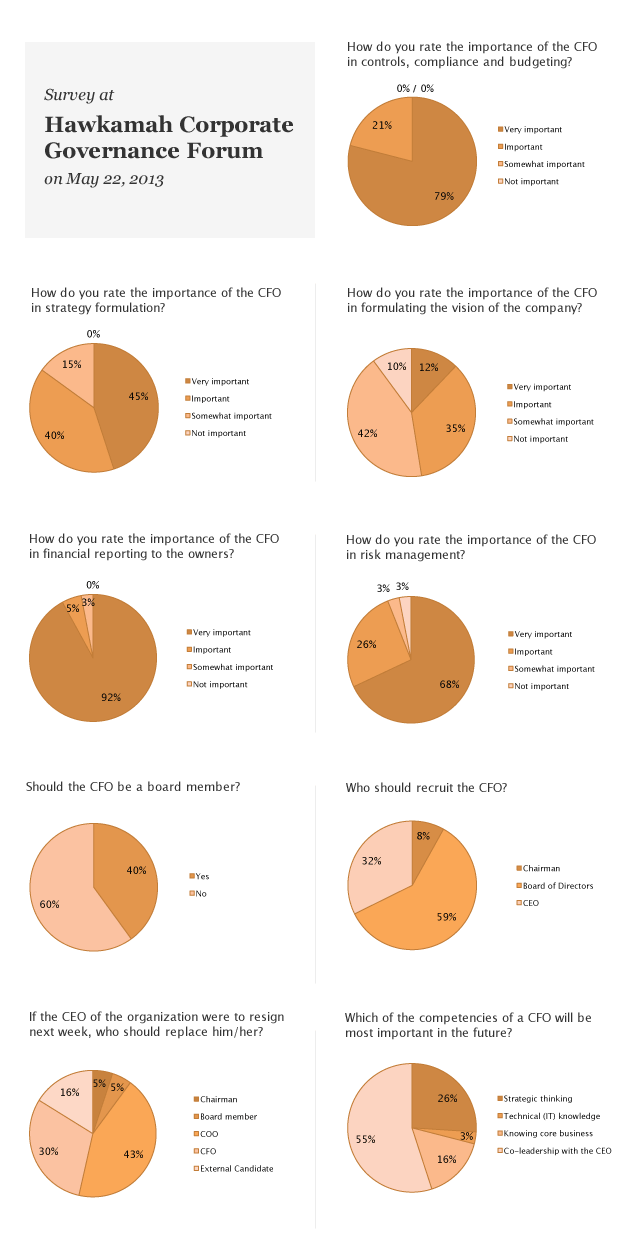
Board-centered governance
The challenges of installing board-centered governance into the group were building the boards' teams, Al Soufi said. While having strategy reviews was useful, the open communication and dialogue between him and the family proved very important.
This company "culture" as fifth dimension to a business comprises three aspects, he said. "When I look at a company I look at three things that drive success: One, what is leadership - having great leaders. The second is strategy - does the company have a good strategy? And third (which matters a lot) is the culture, the way people do things, whether it's the board or top management."
Al Soufi then asked the audience which they considered most important - strategy or culture. The audience overwhelmingly voted for culture.
"Culture eats strategy for breakfast," he said, "The way things are done, how risk management is handled, can people have an open debate, when should they blow the whistle, etc. These should be immediately detected by the organization, so they have a system of checks and balances - and governance is all about having a system of checks and balances in place."
Role and qualities of the CFO
A good chief financial officer (CFO) doesn't need to be a financial expert, but does need three core qualities, Frank Dangeard, board member of Telenor, Symantec and Credit Agricole-CIB, said during a panel discussion.
"The CFO needs to be a good manager to manage a large team of experts; have very good judgment... and be right on the orders of magnitude; and be capable of inspiring trust because of the number of stakeholders that he is involved with. As a shareholder, a board member, and a CEO, I need to trust him," Dangeard said.
Co-panelist Asim Al Abbasi, CFO, Economic Zones World (EZW), had his own take: "Post-2008, the environment has changed a lot. There is much more reliance on what the CFO stands for in terms of what they look at. Prior to 2008, in FTSE 100 companies, less than 40% of CEOs or managing directors were from a financial background; but today it's more than 51%. Now, more than 80% of board members come from a financial background, so in the eyes of shareholders and investors there is some merit to coming from a financial background," he said.
Dangeard and Al Abbasi were joined by Rajesh Pareek, CFO, Dubai International Financial Centre (DIFC), and Ricky Thirion, vice president and group treasurer, Etihad Airways, during the panel discussion, which was moderated by Francois de Montaudouin, founder of Orbite Middle East FZE.
"The landscape of the CFO has changed significantly. Today's CFO needs to deal with the abnormal, and this is on a daily basis," Pareek added to the conversation. The CFO joined DIFC in 2010 and was tasked with a role of refinancing the sukuk, which included dealing with rating agencies and educating the board and CEO on what needed to be done for the company.
"What comes out of all of this after the crisis is that the CFO needs to step up and make the organization aware that life is not normal. It took me a significant amount of time to get that trust and get that education instilled. We did a very successful refinancing and after that I think it's changed a lot in the organization, it's created a lot of discipline. We have a syndicated facility now and I think the organization has matured and my role has become more relevant after the refinancing," he said.
Evaluating risk
Thirion of Etihad Airways added that the perception of "what the CFO is" was not properly evaluated until after 2007. "You've seen the financials that have taken place for the kind of projects; they were all financed at prices that today people cannot imagine. Subsequent to 2007, after the crisis, the pricing of risk has become more realistic. So what has this done to the CFO's role?" he said.
Post-2008, he said, people started evaluating risk in a more educated manner; and so the CFO's role became much more important. The CFO plays his role even prior to 2008 in a similar fashion but in a market on a good run "people don't listen to the voice that comes from within the company", he said.
"Four years prior to the crisis everybody looked at an opportunity and then they just jumped at it. The last four years of the crisis has also taught them what not to do. I think today in a scenario of what not to do, the CFO's role has become much more critical and important."
This has meant companies starting to take the governance position "quite seriously", Thirion said. A company will now ask questions where they would not have before, and post-2008 there's a "shift in how the CFO is being seen in the organization".
Audience vote
The interactive session also invited the audience of CFOs, CEOs, and dignitaries to vote on a number of questions. The first question was: "How do you rate the importance of the CFO in controls, compliance and budgeting?" After a short electronic vote, 79% responded "very important", 21% responded to "important" and no votes were cast for "somewhat important" or "not important". The second question asked the audience to vote on the importance of the CFO in strategy formulation. Later during the forum, the audience was asked to evaluate the importance of a CFO in financial reporting to a company's owners.
The discussion then moved to focus on the requirements for board KPIs (key performance indicators). For Al Soufi, a board should set its own KPIs, meet and discuss what its role will be in the coming three years, set an agenda, and deal with priorities, "some of which are related to the performance of the company and the performance of the CEO," he said, which should be incorporated into the board KPIs.
"There is wide recognition now that boards must evaluate themselves - otherwise, how are they going to be evaluated?" he asked. While shareholders provide a perspective, a board should provide a perspective on themselves, so self-evaluation for a board is necessary, "plus a combination of training and independent evaluation," he said.
The Hawkamah Institute for Corporate Governance will be hosting regular forums. The next will be held on June 24, 2013, and will focus on Subsidiary Governance. The forum was held at the Securities and Commodities Authority.
Zawya 2013