Sentiment has turned negative in South Africa. The continent's largest economy is reeling after dismal new figures revealed a lackluster first quarter.
The economy grew by a paltry 0.9% in the first three months of the year, compared to 2.1% in the fourth quarter, according to data from Statistics South Africa.
The main drivers of economic activity were the mining and quarrying industry and finance, real estate and business services (each contributing 0.7 of a percentage point). General government services (0.3 of a percentage point), wholesale, retail and motor trade and catering and accommodation industry and the transport, storage and communication industry grew 0.2%.
"Negative contributions by other industries included the manufacturing industry (-1.2%), the agriculture, forestry and fishing industry and the electricity, gas and water industry (each contributing -0.1 of a percentage point)," Statistics South Africa said.
The South African rand (ZAR) fell 11% on the news, trading at ZAR 10 to the USD for the first time in five years. The rand has declined nearly 17% in the first five months of the year and is at its weakest since 2009.
"We remain structurally bearish on the rand given the negative stagflationary macro backdrop," said Matthew Sharratt, analyst at Bank of America Merrill Lynch. "We see particular risks over Q2 and Q3 as the potential for labor unrest and/or electricity supply shortages would likely amplify already negative market sentiment toward South Africa's fundamentals."
South Africa's Standard Bank revised its GDP forecast for the year from 2.5% to 2.3%, and also cuts its 2014 forecast from 3.5% to 3.2% on concerns about weakening macroeconomic fundamentals.
CURRENCY RISKS
"The main risk to GDP growth in 2013 is the currency, said Thabi Leoka and Nomvuyo Guma, analysts at Standard Bank. "The weakness in the currency is likely to negate any disinflationary benefit from falling commodity prices. The volatile currency will increase imported commodities and the pass-through effect could result in higher PPI (purchasing power index) and CPI (consumer price index) prints. A weaker rand also restricts the MPC (monetary policy committee) from cutting rates as a measure to support slow growth."
Standard Bank notes that while other emerging market currencies have also taken a hit, the South African rand has been the hardest hit, especially as the South African Reserve Bank (SARB) has been reluctant to intervene with rate cuts to support the currency.
The bank expects ZAR to average around 9.35 compared to the USD by the end of 2013.
"We believe that consumers will have to tighten their belts again as we may be in the eye of the storm. While we are of the view that the next rate move will be a 50 bps cut in Q1:14, we believe that the chance of an earlier cut is high," the analysts noted.
MINING PROBLEMS
Then there are the country's mining problems. Wildcat labor strikes and labor cuts in the mining sector by major global players have hurt the country's GDP. Meanwhile, Glencore Xstrata PLC is reporting disruption in three of its mines in the country.
The sector accounts for 6% of South Africa's direct GDP and 60% of its exports, but has suffered because of crippling strikes and labor unrest which gripped the country last year. The Labor Ministry estimates close to 17 million of working hours were lost last year due to strikes.
It seems that mining sector's woes will only multiply. The global commodity sector including copper, gold and silver is in the midst of contraction. As a result, most global mining companies are slowing down in South Africa, as part of a global retrenchment.
Angola American Platinum, for example, recently decided to cut 6,000 jobs in the country, as part of the cost-cutting exercise.
HIGHEST COSTS
To add to its woes, South Africa is facing competition from other upstart African states that are luring companies with better deals, less labor tensions and greater economic environment.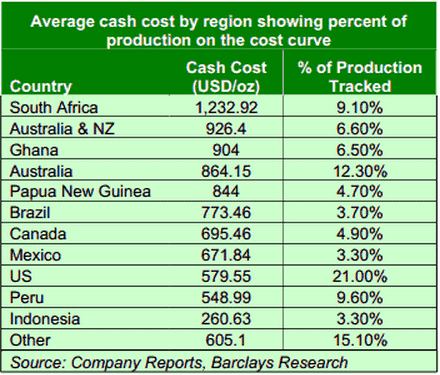
A Barclays survey finds South Africa has the highest cash cost among gold-mining regions in the first quarter.
"South Africa remained the highest-cost region in Q1 13, with the cash costs of the vast majority of its production well above the average (50%) cash costs, and largely concentrated around marginal (90%) cash costs," wrote Christopher Louney, analyst at Barclays Capital.
"Although we expect much of any future upward pressure on cash costs to come from labor-related supply disruptions in 2013, the overall cost base is also likely to rise," Louney said, adding that the wage increases are expected to rise 8% year-on-year after wage negotiations in June.
Rising expenditures will leave little room for profits especially at a time when gold prices are falling.
"We believe that the base of gold cash costs is set to rise and that scope for greater upside risk in the coming quarters lies in potential labor-related supply disruptions in South Africa."
President Jacob Zuma has urged "calm in the mining sector", but the external mining environment and the country's own inability to tackle the problem could see South African economy slide this year and the next, even as their regional counterparts post blistering growth.
© alifarabia.com 2013