12 November 2008
Developing countries, located on different continents, will play a crucial role in balancing global oil demand in 2009, a financial and commodities market research institution has said in a recent report. Oil demand will significantly subside in developed economies in 2009 the report predicted.
Merrill Lynch, in its recent analysis on global energy demands, said the Middle East and the emerging economies of 'Chindia' (China and India) are few of the resilient regions where hydrocarbon requirement will continue to grow, albeit at a slower pace in spite of the recession.
"Asian oil demand has been slightly more resilient, thanks to more robust economic performance in China and India relative to rest of the world," Merrill Lynch said.
The report titled "A race to the bottom of petroleum product demand" gives a gloomy picture of oil demand in 2009 and cautions that the "demand for petroleum products has declined simultaneously across al major consuming nations in the recent months, in line with a broad based deterioration in economic activity."
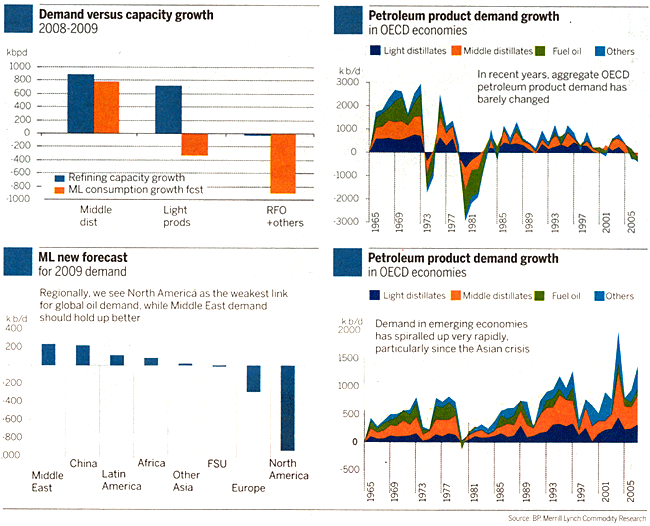
While the demand for oil will grow by 250,000 barrels a day in the Middle East, about 200,000 barrels a day in China, 100,000 barrels a day in Latin America and about 80,000 barrels a day in Africa, the demand will subside by about 300,000 barrels a day in Europe and about 950,000 barrels a day in North America.
The report asserts that emerging markets matter more than OECD economies for global oil trade.
"Looking forward, a set of leading indicators point to significant weakness ahead, suggesting that oil demand should continue to contract going into 2009. In this context, certain geographical regions and certain petroleum products will be more affected than others by the economic downturn. Regionally, we expect North America to remain the softest spot for global oil demand, while demand in the Middle East should remain afloat," Merrill Lynch said.
The report said the global slowdown has had a varied impact on the demand for different petroleum distillates. "By product, the global crack demand for residual fuel and other petroleum derivatives, such as coke, lubricants or LPGs, will likely contract significantly, with gasoline demand also falling. In contrast, we see no reduction in middle distillate demand the next year," it added.
Lynch said a contraction in air travel and a substantial decline in container traffic has put "downward pressure" on gas oil, jet and naphtha cracks (petroleum distillates).
"The reduction in passenger and freight transportation, along with a marked downturn in petrochemical and other industrial activity across the world, has put tremendous downward pressure on petroleum product cracks. In particular, petrol and naphtha crack spreads to crude oil have weakened substantially, but spreads in other products such as jet fuel and diesel have halved from their peaks," it said.
Merrill Lynch had recently changed the oil price forecast for 2009 and said a decline in demand could force down oil prices to $ 50 barrel, almost a third of the historical high of $ 147 a barrel in July 2008. Standard Chartered and PFC energy have predicted oil prices at $ 85 a barrel and $ 90 a barrel respectively the next year.
Petrol demand to weaken
Demand for petrol, the end distillate that's used to power road vehicles, will plummet significantly in North America and Europe, Lynch said. Capacity expansion of refineries across the world will, now in fact, contribute to a global surplus of refined petroleum products, it added. "Leading the global demand decline, the United States has experienced an average contraction of 7.1 per cent, or 1.5 million bpd YoY in petroleum product demand in the last three years," it said. Lynch said the expected decline in demand for gasoline in Europe is due to a "substitution away from petrol cars and out of oil-fired power generation."
Data published in the report showed that while the refining capacity of light products (which includes petrol) grew by 700 barrels a day in 2008, its demand declined by 350,000 barrels a day. In case of middle distillates, the refining capacity is expected to grow by about 900,000 barrels a day by the end of 2009 where as growth in demand is forecasted to be considerably lower, the data showed.
Developing countries, located on different continents, will play a crucial role in balancing global oil demand in 2009, a financial and commodities market research institution has said in a recent report. Oil demand will significantly subside in developed economies in 2009 the report predicted.
Merrill Lynch, in its recent analysis on global energy demands, said the Middle East and the emerging economies of 'Chindia' (China and India) are few of the resilient regions where hydrocarbon requirement will continue to grow, albeit at a slower pace in spite of the recession.
"Asian oil demand has been slightly more resilient, thanks to more robust economic performance in China and India relative to rest of the world," Merrill Lynch said.
The report titled "A race to the bottom of petroleum product demand" gives a gloomy picture of oil demand in 2009 and cautions that the "demand for petroleum products has declined simultaneously across al major consuming nations in the recent months, in line with a broad based deterioration in economic activity."
While the demand for oil will grow by 250,000 barrels a day in the Middle East, about 200,000 barrels a day in China, 100,000 barrels a day in Latin America and about 80,000 barrels a day in Africa, the demand will subside by about 300,000 barrels a day in Europe and about 950,000 barrels a day in North America.
The report asserts that emerging markets matter more than OECD economies for global oil trade.
"Looking forward, a set of leading indicators point to significant weakness ahead, suggesting that oil demand should continue to contract going into 2009. In this context, certain geographical regions and certain petroleum products will be more affected than others by the economic downturn. Regionally, we expect North America to remain the softest spot for global oil demand, while demand in the Middle East should remain afloat," Merrill Lynch said.
The report said the global slowdown has had a varied impact on the demand for different petroleum distillates. "By product, the global crack demand for residual fuel and other petroleum derivatives, such as coke, lubricants or LPGs, will likely contract significantly, with gasoline demand also falling. In contrast, we see no reduction in middle distillate demand the next year," it added.
Lynch said a contraction in air travel and a substantial decline in container traffic has put "downward pressure" on gas oil, jet and naphtha cracks (petroleum distillates).
"The reduction in passenger and freight transportation, along with a marked downturn in petrochemical and other industrial activity across the world, has put tremendous downward pressure on petroleum product cracks. In particular, petrol and naphtha crack spreads to crude oil have weakened substantially, but spreads in other products such as jet fuel and diesel have halved from their peaks," it said.
Merrill Lynch had recently changed the oil price forecast for 2009 and said a decline in demand could force down oil prices to $ 50 barrel, almost a third of the historical high of $ 147 a barrel in July 2008. Standard Chartered and PFC energy have predicted oil prices at $ 85 a barrel and $ 90 a barrel respectively the next year.
Petrol demand to weaken
Demand for petrol, the end distillate that's used to power road vehicles, will plummet significantly in North America and Europe, Lynch said. Capacity expansion of refineries across the world will, now in fact, contribute to a global surplus of refined petroleum products, it added. "Leading the global demand decline, the United States has experienced an average contraction of 7.1 per cent, or 1.5 million bpd YoY in petroleum product demand in the last three years," it said. Lynch said the expected decline in demand for gasoline in Europe is due to a "substitution away from petrol cars and out of oil-fired power generation."
Data published in the report showed that while the refining capacity of light products (which includes petrol) grew by 700 barrels a day in 2008, its demand declined by 350,000 barrels a day. In case of middle distillates, the refining capacity is expected to grow by about 900,000 barrels a day by the end of 2009 where as growth in demand is forecasted to be considerably lower, the data showed.
By Shashank Shekhar
Emirates Business 24/7 2008