Many investors and strategists are heralding 2013 as the year of 'the great rotation' - the shifting of assets from fixed income (primarily bonds) into equities. There are several reasons for the expected rotation, but one key driver is the low return on bonds.
If the rotation starts to take hold, it will certainly be beneficial for the global equity markets. By extension, the rotation is also likely to be positive for Middle East and North Africa (MENA) equities, especially in the Saudi equity market, which is the largest in the region and has recently lagged behind some MENA indices.
The decline in interest rates on bonds was triggered by concerted action of major central banks designed to boost economic growth. This has pushed interest rates to such a low level that they are becoming increasingly unattractive for many investors.
The graph below shows the significant decline in the interest rates as depicted by the three-month Saudi interbank offered rate (SIBOR), which fell from 4.9% per annum (pa) in 2007 to just under 0.9% pa in 2012.
This diminished the returns to the bond investors significantly.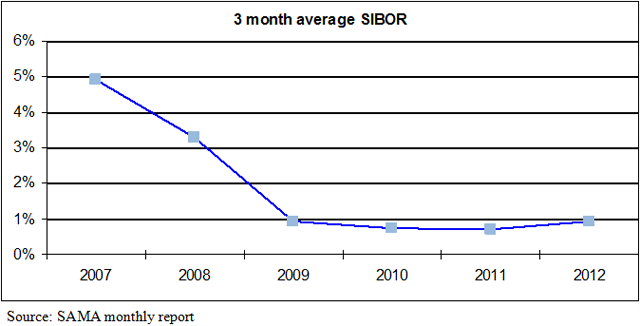
As interest rates fall, investors continued to pile into bonds. This trend became noticeable as more and more investors seek the safety of high quality bonds amid the unstable economic environment.
In theory, declining interest rates should have helped increase the value of equities. Typically, the lower the risk-free rate, the higher the value of a company (assuming all other factors were constant). However, low interest rates have had a relatively modest impact on equity values. Basically, investors shunned equities as they were unwilling to take risk even though the returns were attractive.
The following graph shows that in 2007 the SIBOR rate was at 4.9% pa, while Saudi equities were offering dividend yields of 4.4%. Since then, SIBOR rates have declined to under 1%, while dividends have remained relatively attractive at above 3% as of the end of 2012.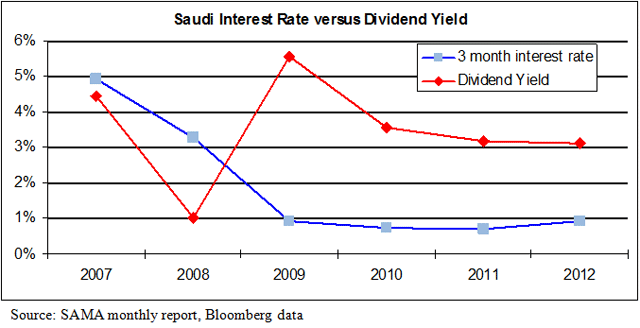
Taming investors' fears
With the improving economic outlook for 2013, along with central banks worldwide stimulating their respective economies, investors are beginning to feel more confident about investing in riskier assets such as equities. One indicator of the growing risk appetite of investors is the increasing fund flows into the emerging markets.
In Saudi Arabia, the domestic money market funds' share was 70% (versus 30% in Saudi equity funds) at the end of 2012, compared with 39% in 2007. Admittedly, some of the decline in equity allocation was due to the Saudi market declines in 2007. Nonetheless, a portion of the increase in money market fund assets versus equities can be attributed to investors' preference for safety.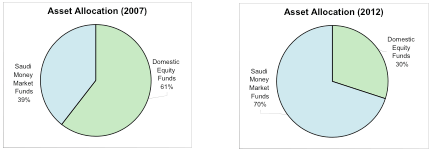
On the other hand, many analysts and investors, who argue that on a global scale there is no clear indication that equity allocations are significantly underweight at present, have challenged the rationale for the 'great rotation'.
In addition, they point out that the increased inflow into bond markets during the last few years has been driven by cash-like assets (e.g. money market) rather than equities. Rotation or not, investment decisions should be based on the fundamentals of a company.
In the MENA region, given its size and macroeconomic position, Saudi Arabia stands out. According to a recent Zawya report, Saudi Arabia accounts for 38% of the assets managed in the MENA mutual fund industry.
On the economic front, Saudi Arabia registered a 6.8% GDP growth in 2012 and the uptrend looks set to continue. Large government development projects, a young and growing population, and a strong government fiscal position is supporting the strong macroeconomic picture of the country.
The foreign reserves of Saudi Arabia have reached SAR 2,449 billion as of January 2013, which is 2.8 times the 2012 estimated total government expenditure. The government certainly has the financial resources to continue on the path of growth and development by focusing resources on the key sectors of the economy.
The largest allocation in the 2013 Saudi budget was for education (SAR 204 billion), followed by health and social affairs (SAR 100 billion) and infrastructure and transport (SAR 65 billion).
Saudi equities, especially domestically driven listed companies, are expected to continue to benefit from robust macroeconomic conditions. In addition, the valuation levels also appear to be reasonable.
The last five-year average of the Saudi stock market's trailing price-to-earnings (PE) ratio is 14 times, while at the end of 2012, the bourse was trading at PE of 13 times, which is at a discount. If we look at the longer-term returns, Tadawul All Shares Index has appreciated by 10.4% p.a. over the last 10 years, which is comparable to emerging market equity returns.
As long as the market is trading at a reasonable valuation level, investors who are comfortable to take risks could look to invest for the long-term without trying to time the market.
Najmul Hasnain is head of Morgan Stanley Investment Management department in Saudi Arabia and a portfolio manager for the Saudi equity fund. He has 20 years of asset management, investment banking and equity research experience.
Disclaimer:
The views and opinions expressed herein are of Najmul Hasnain and are based on matters as they exist as of the date of preparation and not as of any future date, and will not be updated or otherwise revised to reflect information that subsequently becomes available or circumstances existing, or changes occurring, after the date hereof.
This is not a product of Morgan Stanley's Research Department and should not be regarded as a research recommendation. The information contained herein has not been prepared in accordance with legal requirements designed to promote the independence of investment research and is not subject to any prohibition on dealing ahead of the dissemination of investment research
Any index referred to herein is the intellectual property (including registered trademarks) of the applicable licensor. Any product based on an index is in no way sponsored, endorsed, sold or promoted by the applicable licensor and it shall not have any liability with respect thereto.
Zawya 2013