Norway's Statoil and BG Group's decision to invest in a liquefaction natural gas project in Tanzania adds yet another competitor in the crowded LNG space.
"Results from the Jodari-1 test [offshore Tanzania] have greatly improved our understanding of the sub-surface, reducing uncertainty as we progress our options for commercializing the resource through a potential liquefied natural gas export project and our domestic market obligations," BG Group Chief Executive Chris Finlayson said in a statement on March 18, 2013.
The news comes less than a week after China National Petroleum Corp. took a 20% stake in Italian giant Eni's natural gas assets in Mozambique, which are also ripe for LNG developments.
Prospects of LNG exports in African and other parts of the world come at a time when Middle East LNG exports are flat.
"Global LNG supply dropped for the first time in 20 years on limited new capacity additions, supply disruption in the Middle East and North Africa region and declines in Indonesian exports," said Neil Beveridge, an analyst at Bernstein research.
"With only one project starting up (Australia's Pluto LNG project) last year plus declining output from Yemen (-1.5 mtpa, down 24.7%), Algeria (-1.4 mtpa) and Egypt (-1 mtpa) on geopolitical unrest and declining Indonesian cargoes (-3.3 mtpa), global LNG supply contracted for the first time," said Beveridge. "We expect LNG markets will remain tight through 2013."
Even Qatar, the world's biggest LNG exporter, is losing its grip.
The country led the world in terms of new LNG production, cranking up an addition 2 mpta of natural gas in 2012, but output is expected to remain flat in the future, especially as production has reached 100% of capacity and no new LNG projects are planned in the near future.
Qatar also recently saw its title as the world's top LNG exporter to Japan snatched away by Australia.
Japan is the world's biggest importer of LNG and is expected to be a major natural gas customer in the future as well, and often pays the highest price for its LNG imports.
Australia exported 15.9 million tons of LNG to the Asian country, exceeding Qatar's 15.7 million tons last year.
The trajectory is only going to get worse for Qatar as Australia is set to emerge as the world's biggest LNG exporter sometime by 2017 if all its projects go according to plan.
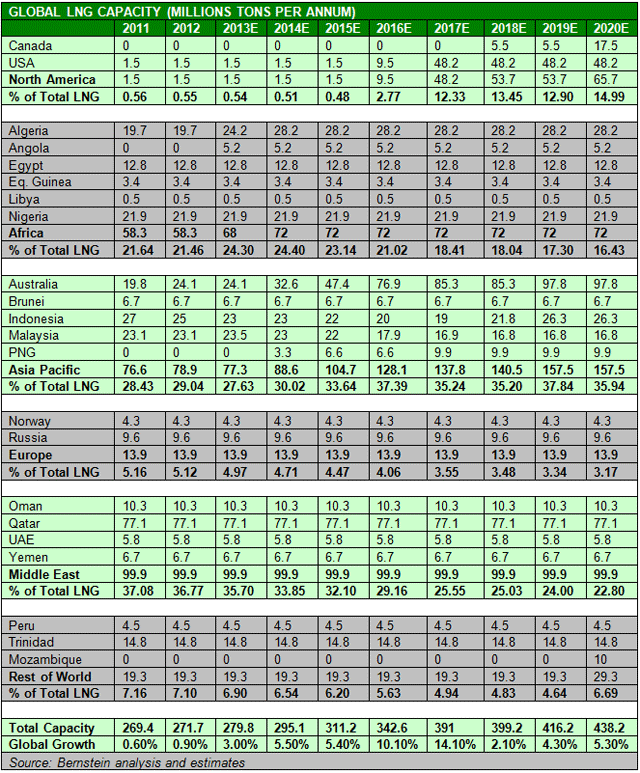
While Australia's LNG production is set to more than quadruple from 24.1 mtpa in 2012 to 97.8 mtpa by 2020, Qatar will remain flat from its current production volumes of 77.1 mtpa.
US enters gas arena
And while Australia is stealing market share from Qatar and other Middle East exporters in Asia, other gas producers are eyeing European markets.
The United States' shale gas boom could allow the country to export 48.2 mtpa by 2020, compared to a negligible 1.5 mtpa this year, according to estimates.
"While there is considerable excitement over new LNG hubs in the US, Canada and Mozambique, there are risks. As yet - it is unclear how much LNG the US will permit to be exported," said Beveridge. "While we expect 50 mtpa by 2020 (c. 10% of domestic supply) this is uncertain."
American LNG export permits are typically granted by the US Department of Energy to a nation that has a free trade agreement (FTA) with the US, but there is great pressure by the oil and gas companies to expand exports to other countries as well as in Asia and Europe.
"The proposed projects are predominately located on the Gulf Coast, but also include proposed facilities on the East and West Coasts," said Ernst & Young in a report.
The United States has a huge advantage as many of the LNG facilities are located in the Gulf Coast where the energy infrastructure is strong giving it considerable edge over other LNG producers such as Tanzania, Mozambique, Angola and Nigeria.
"These brownfield exports projects would likely enjoy significant cost advantages from the existing in-place infrastructure, in comparison with greenfield projects, without such infrastructure already in place," said Ernst & Young in a report.
Eastern Africa wants slice of LNG pie
Meanwhile, Eastern Africa poses another major threat to Middle East dominance in LNG.
"The discovered base [in Africa] could theoretically support exports of up to 70 mtpa [almost as much as Qatar's production] but since the exploration phase is far from over, that estimate could easily rise to 100 mtpa," notes E&Y.
Around 110 trillion cubic of gas in place has been explored in Mozambique, principally by separates consortium led by Andarko Petroleum (Rovuma Arae 1) and Eni and China National Petroleum Corp. (Rovuma Area 4).
Tanzania could join Mozambique's rank, diminishing Middle East's influence on LNG even further.
With Qatar in the midst of a self-imposed moratorium on new gas production, any new development will take place well beyond 2020.
In short, the Middle East will have to be content with seeing their combined LNG production to remain flat and their contribution to global LNG output fall from 36.77% in 2012 to below 23% by 2020.
For a region that sits on some of the world's biggest natural gas reserves, it's decline as an LNG powerhouse is primarily due to the political crisis in places like Egypt, Algeria and Yemen.
© alifarabia.com 2013