15 May 2008
The country's cement shortage is expected to ease by the end of this year thanks to additional supplies from greenfield and expansion projects.
According to the UAE cement report by Abu Dhabi-based Prime Holding, the balance of supply and demand is expected to result in a net cement surplus for the region, beginning this year, removing the cement production bottleneck that has plagued the industry for the past three years.
The study obtained by Emirates Business said current production expansions under way across the region are expected to be mostly complete by 2010.
Following the UAE's supply shortage which was aggravated by the construction frenzy in Dubai that began in 2003 significant public and private investments were channelled into increasing cement production capacity.
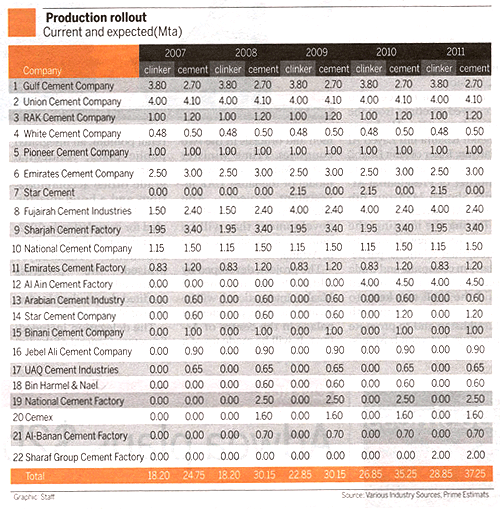
The largest expansions included Union Cement Company's tripling of production capacity to 4mta of clinker and 4.1mta of cement and Gulf Cement's increase in clinker production capacity to 3.6mta from 1.3mta.
The continued shortage across the domestic cement market combined with rising prices and seemingly attractive margins has continued to encourage new entrants, both local and multinationals, to join the production arena in an attempt to acquire a share of the growing market.
The largest of these additions will take place at the greenfield production factory of National Cement in Abu Dhabi - which will produce 2.5mta of which Swiss Holcim owns 25 per cent, and at the 1.6mta newly built factory owned by Cemex.
Another 0.6mta of additional supply will join production capacity, from Star Cement Factory in Abu Dhabi in 2009, while 2010 will witness an addition of 4.5mta by Arkan Building Materials followed by 2mta in 2011 by Sharaf Group Cement Factory in Fujairah.
Based on these figures, the report forecast the total supply of local cement to hit 37.25mta by 2011 reflecting 11.6 per cent annual growth between 2007 and 2011.
Meanwhile, clinker production is expected to continue reflecting a shortage, despite increasing from a current 18.2mta to 28.85mta over the same period.
According to industry sources, cement imports to the UAE stood at 1.7mta and 2.96mta in 2006 and 2007, respectively, as the country faced local supply shortages with existing cement capacities unable to meet the heightened construction sector demand. However, with new capacity rolling out over the coming few years, it is expected the mismatch between supply and demand will ease going forward.
"Our assumptions have yielded an increase in cement demand to 20.6mta by the end of 2008 expanding over our forecast horizon to culminate at 32.2mta, illustrating a 16 per cent annual growth," said the report, which assumed utilisation rates will remain at 90 per cent nationwide. Assumption risks, however, lie in any unforeseen delays in commissioning of new production facilities, which would negatively affect supply assumptions. A resulting market deficit under this scenario is expected to be filled through imports or an increase in local producers' utilisation rates.
On the demand side, assumption risks centre around any unforeseen construction activity, or slowdown, and the threat of buyer substitution in favour of cheaper imports.
"With regards to the latter, we would expect local producers to respond with a reduction in utilisation rates to below our average forecasted 90 per cent, as has proven the case in the past," it said.
Prime Holding said it continued to remain bullish on the region's construction sector and expected existing mega projects, as well as new announcements, to absorb the bulk of new production coming on stream over the coming two years.
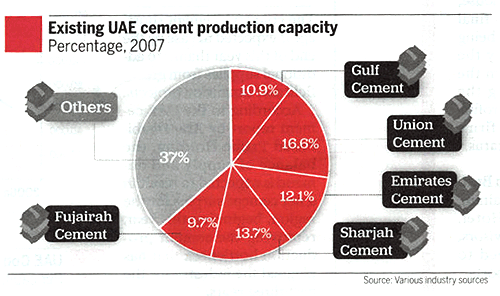
The UAE's 15 cement factories represent the total production capacity of the country. Ten out of the 15 companies are fully integrated facilities producing clinker and cement, while the other five are comprised solely of cement grinding capacities, with the required clinker purchased externally from either local or international markets. The total cement production capacity of the 15 producers stood at 24.75mta of cement and 18.20mta of clinker last year.
Ras Al Khaimah alone has a production capacity of 12.5mta - representing 50.5 per cent of aggregate UAE production - due to its rich limestone resources. RAK-based Union Cement is the largest producer, sporting a capacity of 4.1mta of cement and 4mta of clinker.
Union Cement, along with the other four major producers, have a production capacity of 63 per cent of the aggregate total, equivalent to 15.25mta. Production capacities at the other 10 remaining cement plants are fragmented varying between 0.6mta for companies like Arabian Cement and Star Cement to 1.5mta in the case of National Cement.
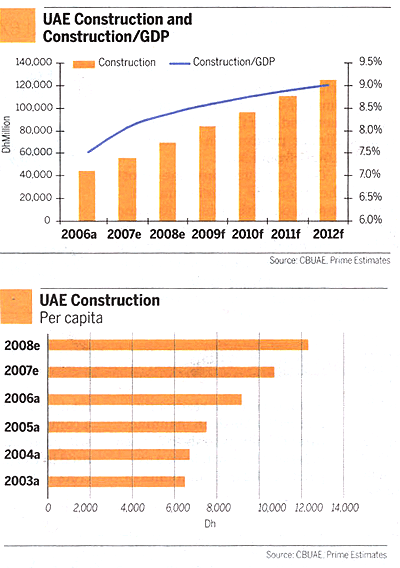
Total cement consumption in the UAE was registered at 16.2mta in 2006 and 18.2mta in 2007, equivalent to 8.7 per cent and 8.8 per cent of the total construction value, while assuming average prices of Dh245 per tonne and Dh280 per tonne, in both years, respectively.
"Our numbers are also founded on conservative estimates with regard to utilisation rates of 75 per cent in 2006 and 80 per cent in 2007," said Prime Holding.
For 2008, the report estimated cement as a proportion of total construction to remain at 8.7 per cent, on the back of continued upward pressure on pricing. It said cement consumption in the UAE is a direct function of domestic construction activity, with export activity being minimal, limited largely to various cement blends including oil-well cement, slag or power-crete.
The lack of export capacity, the study found, was due to the ongoing shortage in the local cement market and relatively high domestic production costs. In comparison to neighbouring markets of Saudi Arabia, Iran and Egypt, costs in the UAE would render break-even selling prices on the international market largely uncompetitive. With regard to demand, the report said cement consumption was driven by the domestic construction sector, with projects under bidding or in the construction phase estimated at $1.2 trillion (Dh4.4trn). And demand was expected to increase to about 80mta by 2010, illustrating an 8.9 per cent annual growth.
Enjoying the combined effects of rising energy prices and low interest rates, the UAE has witnessed its GDP expand at an unprecedented 21.4 per cent for the 2004 to 2007 period. Striving to diversify its economy to hedge against any undesirable fluctuations generated by oil price volatility, the UAE construction sector has played a pivotal role in driving non-hydrocarbon economic growth, estimated to have contributed 8.1 per cent of aggregate GDP in 2007.
The value of UAE-based residential, commercial, services and hospitality construction related projects is estimated at $444 billion over the coming decade.
The country's cement shortage is expected to ease by the end of this year thanks to additional supplies from greenfield and expansion projects.
According to the UAE cement report by Abu Dhabi-based Prime Holding, the balance of supply and demand is expected to result in a net cement surplus for the region, beginning this year, removing the cement production bottleneck that has plagued the industry for the past three years.
The study obtained by Emirates Business said current production expansions under way across the region are expected to be mostly complete by 2010.
Following the UAE's supply shortage which was aggravated by the construction frenzy in Dubai that began in 2003 significant public and private investments were channelled into increasing cement production capacity.
The largest expansions included Union Cement Company's tripling of production capacity to 4mta of clinker and 4.1mta of cement and Gulf Cement's increase in clinker production capacity to 3.6mta from 1.3mta.
The continued shortage across the domestic cement market combined with rising prices and seemingly attractive margins has continued to encourage new entrants, both local and multinationals, to join the production arena in an attempt to acquire a share of the growing market.
The largest of these additions will take place at the greenfield production factory of National Cement in Abu Dhabi - which will produce 2.5mta of which Swiss Holcim owns 25 per cent, and at the 1.6mta newly built factory owned by Cemex.
Another 0.6mta of additional supply will join production capacity, from Star Cement Factory in Abu Dhabi in 2009, while 2010 will witness an addition of 4.5mta by Arkan Building Materials followed by 2mta in 2011 by Sharaf Group Cement Factory in Fujairah.
Based on these figures, the report forecast the total supply of local cement to hit 37.25mta by 2011 reflecting 11.6 per cent annual growth between 2007 and 2011.
Meanwhile, clinker production is expected to continue reflecting a shortage, despite increasing from a current 18.2mta to 28.85mta over the same period.
According to industry sources, cement imports to the UAE stood at 1.7mta and 2.96mta in 2006 and 2007, respectively, as the country faced local supply shortages with existing cement capacities unable to meet the heightened construction sector demand. However, with new capacity rolling out over the coming few years, it is expected the mismatch between supply and demand will ease going forward.
"Our assumptions have yielded an increase in cement demand to 20.6mta by the end of 2008 expanding over our forecast horizon to culminate at 32.2mta, illustrating a 16 per cent annual growth," said the report, which assumed utilisation rates will remain at 90 per cent nationwide. Assumption risks, however, lie in any unforeseen delays in commissioning of new production facilities, which would negatively affect supply assumptions. A resulting market deficit under this scenario is expected to be filled through imports or an increase in local producers' utilisation rates.
On the demand side, assumption risks centre around any unforeseen construction activity, or slowdown, and the threat of buyer substitution in favour of cheaper imports.
"With regards to the latter, we would expect local producers to respond with a reduction in utilisation rates to below our average forecasted 90 per cent, as has proven the case in the past," it said.
Prime Holding said it continued to remain bullish on the region's construction sector and expected existing mega projects, as well as new announcements, to absorb the bulk of new production coming on stream over the coming two years.
The UAE's 15 cement factories represent the total production capacity of the country. Ten out of the 15 companies are fully integrated facilities producing clinker and cement, while the other five are comprised solely of cement grinding capacities, with the required clinker purchased externally from either local or international markets. The total cement production capacity of the 15 producers stood at 24.75mta of cement and 18.20mta of clinker last year.
Ras Al Khaimah alone has a production capacity of 12.5mta - representing 50.5 per cent of aggregate UAE production - due to its rich limestone resources. RAK-based Union Cement is the largest producer, sporting a capacity of 4.1mta of cement and 4mta of clinker.
Union Cement, along with the other four major producers, have a production capacity of 63 per cent of the aggregate total, equivalent to 15.25mta. Production capacities at the other 10 remaining cement plants are fragmented varying between 0.6mta for companies like Arabian Cement and Star Cement to 1.5mta in the case of National Cement.
Total cement consumption in the UAE was registered at 16.2mta in 2006 and 18.2mta in 2007, equivalent to 8.7 per cent and 8.8 per cent of the total construction value, while assuming average prices of Dh245 per tonne and Dh280 per tonne, in both years, respectively.
"Our numbers are also founded on conservative estimates with regard to utilisation rates of 75 per cent in 2006 and 80 per cent in 2007," said Prime Holding.
For 2008, the report estimated cement as a proportion of total construction to remain at 8.7 per cent, on the back of continued upward pressure on pricing. It said cement consumption in the UAE is a direct function of domestic construction activity, with export activity being minimal, limited largely to various cement blends including oil-well cement, slag or power-crete.
The lack of export capacity, the study found, was due to the ongoing shortage in the local cement market and relatively high domestic production costs. In comparison to neighbouring markets of Saudi Arabia, Iran and Egypt, costs in the UAE would render break-even selling prices on the international market largely uncompetitive. With regard to demand, the report said cement consumption was driven by the domestic construction sector, with projects under bidding or in the construction phase estimated at $1.2 trillion (Dh4.4trn). And demand was expected to increase to about 80mta by 2010, illustrating an 8.9 per cent annual growth.
Enjoying the combined effects of rising energy prices and low interest rates, the UAE has witnessed its GDP expand at an unprecedented 21.4 per cent for the 2004 to 2007 period. Striving to diversify its economy to hedge against any undesirable fluctuations generated by oil price volatility, the UAE construction sector has played a pivotal role in driving non-hydrocarbon economic growth, estimated to have contributed 8.1 per cent of aggregate GDP in 2007.
The value of UAE-based residential, commercial, services and hospitality construction related projects is estimated at $444 billion over the coming decade.
By Karen Remo-Listana
Emirates Business 24/7 2008