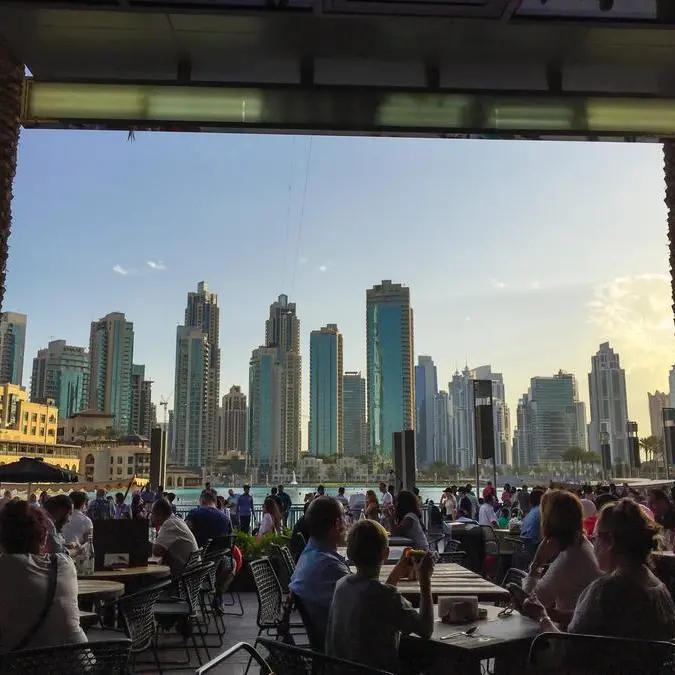
Riyadh's skyline is being transformed as new businesses flock to the city on the back of strong economic growth. But are fears of oversupply in the commercial market justified?
Riyadh's skyline has changed much in recent years. Strong economic growth, coupled with an emphasis on developing new commercial clusters across the country, has triggered several substantial commercial real estate developments in the city, some of the largest of which will come on to the market in 2012.
According to industry experts, this is likely to present a problem. Even with the prospect of serious oil windfalls filling the kingdom's coffers and with it the promise of further economic expansion, bringing large amounts of office inventory onto the market almost simultaneously presents a downside risk to a market which has not been immune to global economic effects.
"The commercial market in general [in Saudi Arabia] suffers from oversupply and is forecast to undergo limited growth in the short-to-medium term," the business analysis and market intelligence service Business Monitor International (BMI) warned in a recent kingdom-wide market overview.
BMI noted that the country's real estate market had recovered in 2010 after a period of instability due to the global financial downturn in 2009.
"Nevertheless, recent data shows that the real estate market in the second half of 2011 was not immune to the market volatility experienced worldwide," it said.
Commercial property adviser CB Richard Ellis echoed the sentiment.
"The sheer volume of space entering the market would seem to present a significant challenge for this sector," it said in its latest KSA MarketView report.
Meanwhile in a report on the third quarter of 2011, global real estate services firm JonesLangLasalle was moved to state: "With over one million square metres of high quality space being added to a market inventory of only three million sq m, there is some concern that the office market will crash after 2012."
On the capital's northern outskirts, some of the culprits of the cautiously pessimistic forecasts are taking shape.
In scale, ambition and vision the projects are highly impressive. Due to enter the market at about the same time at the end of this year, they also threaten to flood the city with premium 'Class A' office stock.
The $1.65 billion, 776,000 square metre Information Technology Communications Complex (ITCC) is being earmarked as the centrepiece of an emerging corridor for technology-focused businesses, a 'smart city' the kingdom hopes will be a magnet for future investments in a diversified economy.
However, the ITCC pales in comparison with the King Abdullah Financial District (KAFD), a $10 billion project touted as Riyadh's future commercial heart, an area of real estate which authorities one day envisage hosting a GCC Central Bank.
While the prospect of such a bank seems a long way off at present, KFAD is very much a reality, and will eventually have about 60 buildings linked by air conditioned skywalks, an urban environment quite unlike any other in the country.
But will the success of both projects - which will enter a rarefied property bracket currently occupied by the highly successful Kingdom Tower and Faisaliah Centre - ultimately depend upon broad macroeconomic drivers?
"The growth in the supply of prime space in Riyadh is taking place in the context of a depressed global economy in which international firms, including banks are seeking to cut overheads including staff and accommodation costs," CBRE says. "Only the most bullish firms, with the deepest pockets, are seeking expensive expansion space in the short term," it adds.
Conversely JLL - which in its Q3 2011 report stated that the vacancy rate in Riyadh's traffic-congested Central Business District (CBD) had fallen in the period to 16 per cent and that rents were bottoming out - also points out that "the recent leasing success of Riyadh Business Gate (a commercial complex also in north of the city) shows there is strong demand for this kind of product."
It continues "demand is strong in the Riyadh office market, from the government, the multinational sector and also from Saudi conglomerates and contractors," and expects a "substantial migration" of employment from the traditional business districts in Olaya, Malaz and Bathaa to the ITCC and FAFD projects going forward.
"With annual take up in Riyadh running at an impressive 200,000 sq m, these projects will certainly fill up - it is only a question of how long it will take," the Company notes.
JLL suggests that the impact of the scale of supply of the ITCC and KAFD projects could be mitigated by the fact that they are being developed by the same Company - Rayadah Investment Company (RIC), the property investment arm of Saudi Arabia's Public Pension Agency.
"This should restore some balance to the landlord-tenant equation on these projects at least, even if the vacancy rate is high. With no property taxes and low energy costs, the carrying costs of vacant space are quite low," it says.
Some experts believe currently supply-demand dynamics in Riyadh will lead some companies to upgrade their office space, though JLL warns such a strategy could come at a cost.
"Tenants will be able to trade up from the existing stock, but they may need to consider paying rental rates similar to those in Abu Dhabi and Dubai to take advantage of these new projects."
CBRE notes a dichotomy between pricing and occupancy rates between Local and International Class A office space in the city. While prime space in international Class A buildings such as Faisaliah and Kingdom Tower command rents exceeding SR2,000 per square metre per annum, 'Local' Class A rates are between SR1,200 and SR1,400 per sq m per annum.
Government initiatives intended to create thousands of white collar jobs for Saudi nationals - some 60,000 jobs are being created in the government sector alone - could also trickle down to the private sector, with a positive knock-on on commercial real estate.
Furthermore, with a promising long-term economic prognosis for the kingdom - provided oil prices remain high - Riyadh's new commercial heart could be beating strongly soon.
© The Gulf 2012