Lebanon's Riad Salameh is ranked as one of the world's best central bankers. But which Mideast bank governor fares worse than Ben Bernanke and Jean-Claude Trichet? Surprising answer!
Lebanon's Riad Salameh emerged as one of the top central bankers in the world, receiving an A grade from Global Financing magazine, and beating the likes of Ben Bernanke, Chairman of the U.S. Federal Reserve and Jean Claude Trichet, the European Central Bank chief.
Salameh was the only Middle East banker to receive an A rating, apart from Israel's Stanley Fischer (who also briefly emerged as an unlikely candidate to head the International Monetary Fund after Dominique-Strauss Kahn resigned).
The 'Central Banker Report Card' feature, published annually by Global Finance since 1994, grades Central Bank Governors of 36 key countries (and the ECB) on an 'A' to 'F' scale for success in areas such as inflation control, economic growth goals, currency stability and interest rate management. ('A' represents an excellent performance down through 'F' for outright failure.)
The Banque du Liban's Salameh can be credited for his admirable prudence during the global financial crisis, and his continued measured oversight despite tough economic conditions elsewhere in the region.
In a country wracked with constant changes and instability, Salameh has held the position of Governor since 1993 and saw his six-year term extended once again in July.
The Lebanese banking sector reported satisfactory activity growth over the first half of 2011 despite the long-lasting domestic political stalemate and the emerging regional turmoil, says Beirut-based Blombank.
"The first half of 2011 rise in bank lending is likewise underpinned by banks' strong financial flexibility and high financial standing, Indeed, Lebanese banks benefit from a solid and stable deposit base constituting the major source of funding," the bank noted.
The rate of inflation in Lebanon in the first half of the year stood at 6% on surging commodity and food crisis, a per cent higher than 2010.
Other Middle East central bankers included in the survey where Saudi Arabia's Mohammed Al-Jasser and Bahrain's Rasheed Mohammed Al Maraj, Qatar's Abdullah Saud Al-Thani and Kuwait's Sheikh Salem AbdulAziz Al-Sabah. Notably absent were the central bank governors of the UAE and Egypt.
Saudi Arabia's Al-Jasser earned a B+ this year, an improvement over the B grade he received last year from the publication. Clearly, keeping inflation under control despite high oil prices and a major stimulus programme factored in the grade.
Al-Jasser's biggest challenge is the deteriorating U.S. dollar and how it affects the dollar peg, interest rates and foreign currency reserves.
"The exchange rate peg means that interest rates in the Kingdom are closely linked to those in the US, notes Saudi-based Jadwa. "It is conventional wisdom that the downgrade should cost a government in terms of higher interest rates on its bonds, perhaps as much as 100 basis points (1 percentage point) over time, as investors demand higher compensation for the risk they are taking. However, prices of US government debt have risen in the last few days."
Meanwhile, Bahrain Al Maraj was awarded a B-. Bahrain, once seen as one of the most progressive economies in the region with an outstanding regulatory environment, has fallen foul of global investors after its crackdown over its citizens earlier in the year which eroded investor confidence.
The country's economy has suffered - indeed contracted. Meanwhile, the central bank did not help its reputation by expecting a 3 to 5% growth this year when all other estimates showed a contraction or anaemic growth.
Bank of America Merrill Lynch expects the economy to contract 2.2%. The economy shrank 1.4% in the first quarter of the year and credit ratings agencies downgraded the country due to insufficient financial resources at its disposal.
Another key reason for the poor grade could be Al-Maraj's criticism of Moody's for downgrading the country's sovereign credit rating to Baa1 from A3. However, the governor failed to offer substantive defence of the country's monetary affairs in the face of severe economic disruption during the domestic protests.
Read: Al Maraj's interview with Zawya Dow Jones here:
Local reports show that four financial institutions left Bahrain in 2011, although it seems two of these had long-planned a move away and the other two were merely functions from within banks (that are still in Bahrain), that have moved to Singapore, notes real estate consultant CB Richard Ellis. There are more than 400 financial institutions based in the country.
However, the worst performing central banker in the region according to Global Finance was Qatar's Al-Thani. The grade is in sharp contrast to the rest of the Qatari economy which has earned accolades for its resilience and robustness. Qatar's inflation rate was 1.9% in July, hardly a figure that induces a rap on the knuckles to a central banker. The IMF expects growth of nearly 11% in 2011 in the country. Al-Thani must also be upset that he is below Ben Bernanke, who manages the monetary levers of one of the world's most indebted nations.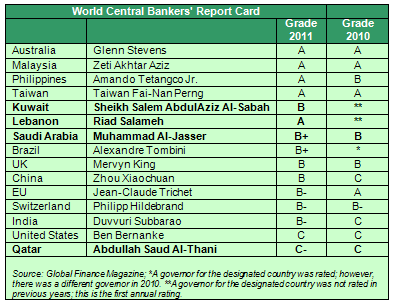
© alifarabia.com 2011