As Armenia's president Serzh Sargsyan once again prepared to take a presidential oath on a 7th century Bible on April 9, protestors spilled on to capital Yerevan's Liberty Square to rage against the election results, Arab Spring style.
But the independent Organization for Security and Co-operation in Europe (OSCE) believes the presidential elections were "generally well-administered" compared to previous ones, angering opposition groups who think the Western world should "stop legitimizing fraudulent elections" in the country.
Shrugging off the criticism, president Sargsyan focused on economy as a key priority for the country in an inaugural address marking his second term as head of state.
"For the forthcoming five years, I consider our nation's economic development the number one priority," he told the national assembly, adding that a whole array of problems that Armenia is facing is in this very plane.
"Let me highlight three main ones: emigration, unemployment, and poverty. The solutions for these problems are to be found on the same field. Efficient economy that is on the rise, this is the formula to our success."
Despite the political dissent, Armenia's economy grew 5.6% last year, and the Asian Development Bank forecast growth of 5.5% in 2013, and 6% in 2014.
"With the outcome of the February 2013 presidential elections signaling the maintenance of current policies, continued but more moderate growth is expected in 2013 and 2014," the bank wrote in a recent report. "Growth could be slower if external risks, including a further slowdown of growth in the Russian Federation and possible recession in the euro area, materialize."
Getting a fiscal grip
Other key concerns include a drop in gross fixed capital formation - a key macroeconomic indicator - which fell 4.2% last year as public and private sector investments waned.
However, inflation was also kept under control from 7.7% in 2011 to 2.6% last year, as food prices abated.
"Fiscal policy was generally tight, aimed at gradually shrinking the deficit without derailing economic growth," said the ADB. "As expenditures rose less than planned, the budget deficit narrowed to 1.5% in 2012, less than the programmed 2.6%."
The country is ranked remarkably high on World Bank's Doing Business list and is considered the 32nd easiest place in the world to conduct business.
Armenia scores especially high in registering property (4th globally), starting a business (11th) and protecting investors (25th). However, it fares poorly in enforcing contracts (91st), trading across borders (107th) and taxes (108th).
"It is critical to make a definitive breakthrough in the strengthening of the business environment," the European Bank for Reconstruction and Development said. "The many recent reforms have to be implemented in letter and spirit, and the review of regulations should continue to ensure any unnecessary obstacles are eliminated."
More also needs to be done to facilitate domestic and international trade. Improvement of the transportation and communications infrastructure would aid development of export-oriented sectors and reduce the high implicit transaction costs.
Cool to Russia
Armenia is also looking to move away from its traditional alliance with Russia, and move closer to the European Union.
President Sargsyan has been cool to the idea of a Russian-led customs union bloc and has focused more of his efforts on negotiating a so-called deep and comprehensive free trade agreement (DCFTA) with the European Union and as a member of the wider European Neighborhood Policy.
Indeed, the EU has categorically stated that a Russian customs union will be "incompatible" with Armenia's efforts to seal a DCFTA with Brussels.
The EU recently commended the country for making "very good progress" in the negotiations and allowing visa-free entry to EU citizens. In turn Armenia has been rewarded with increased financial assistance of EUR 15 million.
A European Union report also gave Armenia a good grade in achieving political reforms.
"Armenia acted on some of the key recommendations. It prepared a roadmap to improve the electoral process, adopted a National Human Rights Strategy and took some measures to fight corruption, reform the judiciary and public administration and advance sector reforms and regulatory approximation to the EU acquis [rules]."
The EU's effort to embrace Armenia is an attempt to loosen Russia's grip on Yerevan, and president Sargsyan seems happy to oblige, especially after the EU's support of the disputed elections.
Closer ties with the EU will also come in handy as the government faces significant services payments on external debt of USD 423 million this year.
"This sum will pose a major drain on financial resources, equal to 15% of the value of exported goods and services, and could put pressure on the overall balance of payments," said the ADB.
"The government's share of this debt service is USD 225 million, which will equal 10% of government revenues in 2013, though this burden is projected to ease thereafter."
The EU has increased its financial assistance to the country, from EUR 98.4 million during 2007-2010 to EUR 157 million during 2011-2013.
A deepening relationship with the EU may also push Armenia to pursue greater political reforms and appease some of the opposition groups in the country who remain deeply unhappy with those in charge.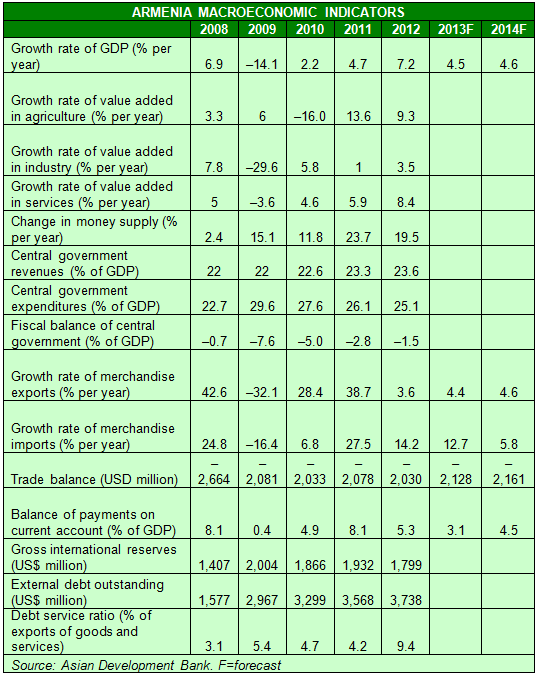
© alifarabia.com 2013