Africa needs to invest USD 93 billion each year to meet its infrastructure needs, but the continent suffers from a financing shortfall of USD 48 billion.
Of these projects, Africa needs financing of nearly USD 68 billion over the next seven years for its most critical infrastructure, and a total of USD 360 billion by 2040 to build projects focused on transportation, electricity, water and communications sector, according to the Program for Infrastructure Development in Africa (PIDA).
"Home to some of the world's fastest growing economies, Africa is at a critical threshold as it positions herself as the world's leading 'resource frontier'... This will drive demand for infrastructure, which is already one of the continent's greatest challenges to sustainable development," said Gilbert Mbesherubusa, vice-president for infrastructure, private sector and regional integration at the African Development Bank.
"However, Africa's need is not just for an adequate, efficient and viable infrastructure stock, but for transformational infrastructure that will spur Africa to the next level of development and reposition the continent as a recognized player in the global economy."
But public sector investment is constrained by rising costs, and shrinking government spends and budgets that are inadequate to meet their targets.
"While infrastructure demand is growing, public infrastructure financing has become more difficult to obtain," the World Economic Forum and the Boston Consulting Group said in a recent report.
"Public budgets are strained; as a result of the global financial crisis and, more recently, the Eurozone sovereign debt crisis, the budgets of major donors that have traditionally supported aid flows to Africa are under pressure, making official development assistance increasingly uncertain and likely to decline."
Africa has 200 million people below the ages of 15-24 and that number is set to rise. Africa's billion-people population, which represents 15% of the global population, is expected to make up 30% of the world, as Africa grows faster than other regions.
Private sector participation
The infrastructure bonanza presents tremendous opportunities for the private sector and foreign companies to secure new contracts and to export technology, skills and innovation to the continent.
Africa's infrastructure needs are enormous, according to some recent statistics:
- The World Economic Forum and Boston Consulting Group estimates energy consumption will likely increase from 590 terawatt-hours (TWh) in 2010 to more than 3,100 TWh in 2040, at an annual growth rate of 6%.
- Port throughput in Africa is expected to rise from 265 million tons in 2009 to more than two billion tons in 2040.
- The amount of water withdrawn from African water systems is expected to rise from 265 cubic kilometers in 2005 to between 400 and 550 km³ in 2040.
- Information and communications technology (ICT) demand is projected to increase by a factor of 20 by 2018. To keep pace, the 2009 bandwidth of 300 gigabits per second will need to grow to about 6,000 gigabits per second.
Many sovereign governments are seeking to tap global financial markets to fund the rising infrastructure needs. Around 11 Sub-Saharan countries have issued sovereign bonds, with Ghana (in 2007), Senegal (2011) and Zambia (2012) issuing bonds especially focused on funding the energy and transportation sectors.
But the International Monetary Fund says that while sovereign bond issuances can raise international players' access to Africa, "sometimes corporate governance structures and debt monitoring capacity may not be in place to contain macroeconomic and structural vulnerabilities arising from increased private sector and parastatal external debt and currency risk exposure."
"Both the Asian crisis and the financial turmoil in Europe are reminders of the drawbacks of excessive private foreign debt."
Pitching Africa to investors
Some regional governments have created a conducive business environment for the private sector, which is desperately looking for yield in frontier markets.
"Despite these strong economic fundamentals, Africa continues to be seen as having structural obstacles to private infrastructure investments," said WEF in its report.
"Concerns include a lack of clear legislation and enforcement of commercial law, a sometimes low degree of transparency - particularly with regard to procurement - and a mixed track record in the implementation of public-private partnerships (PPPs)."
Within these layers of challenges and obstacles is the critical need for Africa to seek private sector involvement.
Multilateral agencies such the African Union Commission (AUC), in partnership with the United Nations Economic Commission for Africa (UNECA), the African Development Bank (AfDB) and the NEPAD Planning and Coordinating Agency have created PIDA to focus on some key areas, and encourage the private sector and international investors to participate in building Africa.
Its key targets include raising electricity access to 70% of the people by 2030 from the current levels of 39%, boosting transport and trade connections between various regional countries and ensuring food security and access to water.
Here are the key projects and programs PIDA aims to complete by 2020, which offer the private sector plenty of opportunities to participate in the growth of Africa: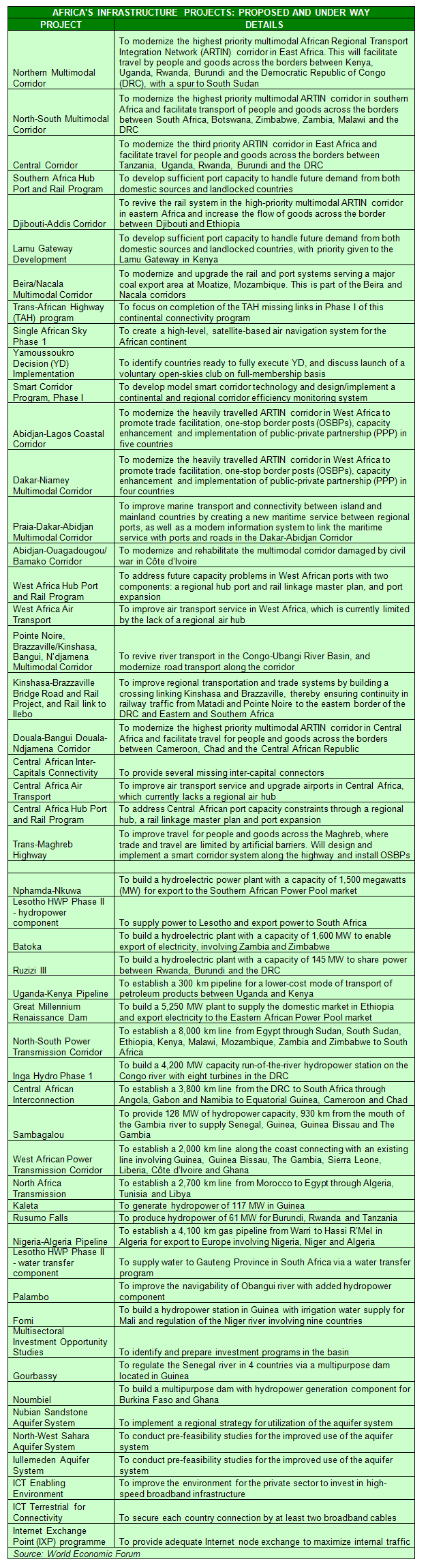
© alifarabia.com 2013