In the eyes of the International Monetary Fund, the greatest risk facing Qatar is a worsening of global liquidity and financing conditions.
Individual banks, especially those that rely on large wholesale funding might face liquidity pressures and either have to resort to the central bank for dollar funding or deleverage, warns the IMF, apart from in foreign reserves of the central bank and lower valuation of Qatar's external assets portfolio.
"Nevertheless, risks to banking stability appear much lower now after three rounds of bank capitalization and asset restructuring since 2008," concedes the Fund. Qatar tapped the market with a USD5 billion sovereign bond issuance at favourable yields in November.
"Even so, the drying up of foreign funding channels could hinder the prospects of other borrowers by increasing the cost, and thereby affecting the infrastructure investment plans and non-hydrocarbon growth. Spillovers through financial channels could impact Qatar's valuation of external portfolios and reduce the value of its foreign assets."
Of course, an escalation of tensions between Iran and the U.S. which would impact all the Gulf states' energy exports, is the other big worry for Qatar and the global energy markets.
Beyond that, the IMF is hard pressed to find areas of concern for the country with the world's third largest proven gas reserves, double-digit growth over the past few years and only 1.7 million people to take care of.
In an era where sovereign solvency is to be cherished, Qatar is practically rolling in it. Indeed the economy has grown five-fold since 2000.
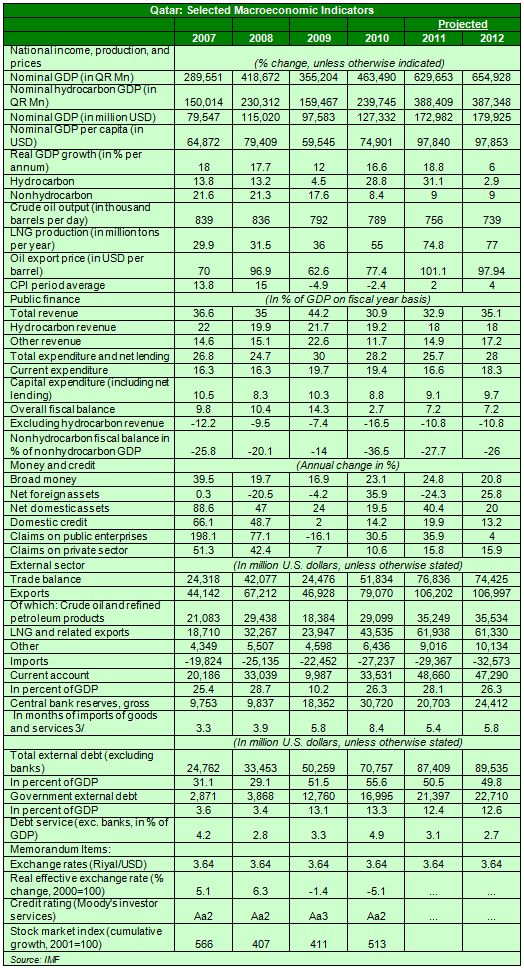
While the U.S. lost its triple-A status and the EU's sovereign debt crisis exploded, Qatar's economy grew by 19% in 2011, two percentage points higher than 2010 - not a bad performance coming straight out of the world's biggest financial crisis since the Great Depression.
But as the country's LNG production stabilises after years of acceleration, the economy is expected to slow down, relatively speaking.
Large infrastructure investment and increased production in the manufacturing sector will maintain real non-hydrocarbon GDP growth at 9%. Average headline CPI inflation is forecast to rise 4% in 2012.
Meanwhile, the fiscal balance is still projected to record a surplus of over 7%, and the external balance is projected to post a surplus of USD47 billion.
MISSING THE GOAL
The IMF does not expect Qatar to meet its target of reducing fiscal dependency on the hydrocarbon sector by 2020.
To be fair, nobody really expected the country to finance its budget from non-hydrocarbon revenues and returns from the Qatar Investment Authority (QIA), within the next 11 years, but the IMF contends that recent increases in expenditures make it an unlikely development.
The recent increases in current expenditures, and the large public sector salary and pension increase for Qataris announced in September, in particular, led to an expansionary fiscal stance in 2011/12, and set back the narrowing of the deficit by 3-4 percentage points of GDP, says the IMF.
"According to staff's calculation, the non-hydrocarbon revenue would cover about 63% of the total expenditure by 2016/17, implying the need for more effort by the authorities to achieve their target. Given the authorities' objective and for building buffers for shocks, staff encourages the authorities to save more, especially during booms."
Still, the effort is commendable as the government hopes to roll out USD100-billion of development over the next few years in non-energy development and for the FIFA World Cup it will host in 2022.
Indeed, capital expenditures will be a major driving force of the non-hydrocarbon economy. Major new infrastructure projects include the airport, the new port, railroad, roads, tunnels, sewage and land reclamation that will keep banks with lending opportunities and construction and engineering companies interested in the country.
But achieving credit growth without overheating the economy will be Qatar's main challenge.
Credit is already expanding at a fast clip, driven by the public sector, and real estate. Continued growth in the non-hydrocarbon sector and implementation of infrastructure related projects will provide additional demand for credit, says the IMF.
"Against this backdrop, the IMF cautioned that banks and the QCB need to ensure that the overall credit quality does not weaken, particularly in the real estate sector in view of the prevailing excess supply, and the precarious global economic outlook."
Indeed, if the government rolls out its huge expansionary programme smoothly, it could generate 30,000 white-collar jobs from its new airport facilities alone, which would - in turn - generate demand for services such as healthcare, education, retail and entertainment and housing as the knowledge workers will bring their families.
In short, the economy is expected to fare quite well thanks to a stable LNG income combined with an expansionary capital expenditure.
But that's just the tip of the iceberg. Here are the other key highlights from the IMF report:
1 The share of hydrocarbon revenues that go directly to the QIA has risen from 24% to 33% between 2004 and 2011, and it is projected to stabilize at around 30% of total cash flow.
2 The share of hydrocarbon revenues in total revenues has been on a declining
trend -- with high volatility -- but still made up over 60% of total revenues in 2010.
3 Qatar's revenue make-up is different from the oil rich Gulf countries which are completely beholden to the volatility of oil prices. Qatar's gas revenues are stable and locked in thanks to long-term LNG contracts.
4 The government's 2011 salary hike of USD1.6-billion has led to a 5% increase in total expenditure.
5 Qatar's breakeven oil price is USD40 - considerably lower than its Gulf peers (Bahrain's breakeven oil price is USD100 and Saudi Arabia around USD80-88).
6 The IMF warns that increase in public sector wages, the convergence of supply and demand in real estate, and possible overheating from large public investment could see headline inflation rise to 5% in the medium term.
7 Financial contagion risks includes increase in cost to public enterprises and banks that have announced intention to issue international bonds. Reduction in wealth due to fall in equity values in Qatar Stock Exchange is another financial risk.
8 The Qatari riyal is overvalued compared to the American dollar, but if the authorities want to balance their budget with non-hydrocarbon revenues, they must save more, the IMF recommends.
9 The Qatari Government has informed the IMF that it will maintain capital expenditure at 40% of total expenditure. It expects to generate revenues from corporate taxes, broadening of the tax base, non-renewal of tax holidays, and the introduction of the withholding tax. The value added tax (VAT) is another option currently being mulled by all Gulf states.
10 The government plans to launch a single financial regulatory regime in early 2012. They are also addressing issues related to Islamic banking to adapt to the new regulatory regime.
11 "Qatar's real estate market segments would help banks assess risks better and also enable the QCB to take informed pre-emptive regulatory measures to preserve financial stability," says the IMF. "Additionally, staff encouraged the Qatari authorities to develop a corporate governance code for real estate developers that would contribute to the prevention of excessive risk-taking in the sector."
12 The banking system has the ability to withstand credit and market risks. Nevertheless, staff underscores the need to monitor individual banks for stress, given the interlinkages in the financial system. Further, individual banks' foreign currency liquidity conditions need to be monitored and the QCB should stand ready to relieve potential pressures.
CONCLUSION
All things considered, it's good to be Qatar right now. While the IMF focused solely on the country's economic prospects, it is important to consider its political outlook.
Qatar has emerged as a champion for the downtrodden Arab citizens, encouraging Egyptians, Libyans Yemenis and Syrians to break the shackles and seek freedom - but has fallen short of extending the same privilege to its own citizens. At the moment, though, the average Qatari citizen is not complaining.
However, Qatar raised a few eyebrows when it participated militarily in the Libyan civil war instead of just funding from the sidelines. While this has raised the country's profile, it could also expose the country to retaliation and a target by groups that disapprove of its interventionist policy.
But so far Qatar has deftly manoeuvred its way in the region's political minefield. Given its past exploits, most would bet on Qatar finding a way out of any political quagmire.
© alifarabia.com 2012