15 January 2012
A year after HSBC released its 2050 report which estimated that Egypt would surpass Saudi Arabia as the largest economy in the Middle East, the bank has dug deeper in its crystal ball-gazing research.
The first report limited its forecast to the world's 30 largest economies by 2050 - but has now expanded it to 100 nations and includes more Middle East nations.
And like the first edition of the report, there are a few surprises.
The report makes for some fascinating reading and the underlying theme is that the economies we currently call "emerging" are going to power global growth over the next four decades, says HSBC.
"We identify 26 fast-growth countries. They share a very low level of development but have made great progress in improving fundamentals," says HSBC, which identifies 'fast growth' above 5%.
"As they open themselves to the technology available elsewhere, they should enjoy many years of 'copy and paste' growth ahead. Besides China, India, the Philippines and Malaysia, this category includes Bangladesh, the central Asian countries of Uzbekistan, Kazakhstan and Turkmenistan, Peru and Ecuador in Latin America, and Egypt and Jordan in the Middle East."
ALSO READ: Egypt Will Surpass Saudi Economy By 2050: HSBC
GROWTH PATTERNS
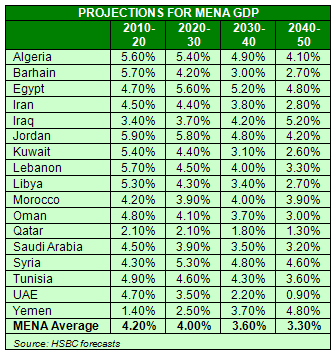
Disappointingly for the Middle East, only Egypt and Jordan are expected to be in the category of fastest growing nations till 2050.
Saudi Arabia, Iran, Kuwait, Morocco, Libya, Syria and Tunisia, Lebanon, Oman, Iraq and Bahrain are among the next batch of countries that are expected to have growth of between 3 to 5%.
The UAE and Qatar are among the batch of countries that are expected to be 'stable' - or less than 3%, which may come as a disappointment, but the bank admits that their growth is under estimated, especially for some of the smaller oil rich nations with fluid populations.
Overall, the Middle East economies are expected to post an average growth of 4.20% to 3.30% over the next 40 years, which is much lower than the 5.8% to 4.3% of the Asia economies, and even lower than Central and South American growth averages.
Africa will be the fastest growing region, of course starting from much a lower base, averaging around 5.3% to 4.6% over the next four decades.
The developed countries will average around 2% throughout the forecast countries, the bank forecasts.
"The West is not getting poorer, but high levels of income per capita and weak demographics will limit growth," says HSBC. "It is the small-population, ageing economies in Europe that are the big relative losers, seeing the biggest moves down the table."
IT'S ALL ABOUT THE DEMOGRAPHICS
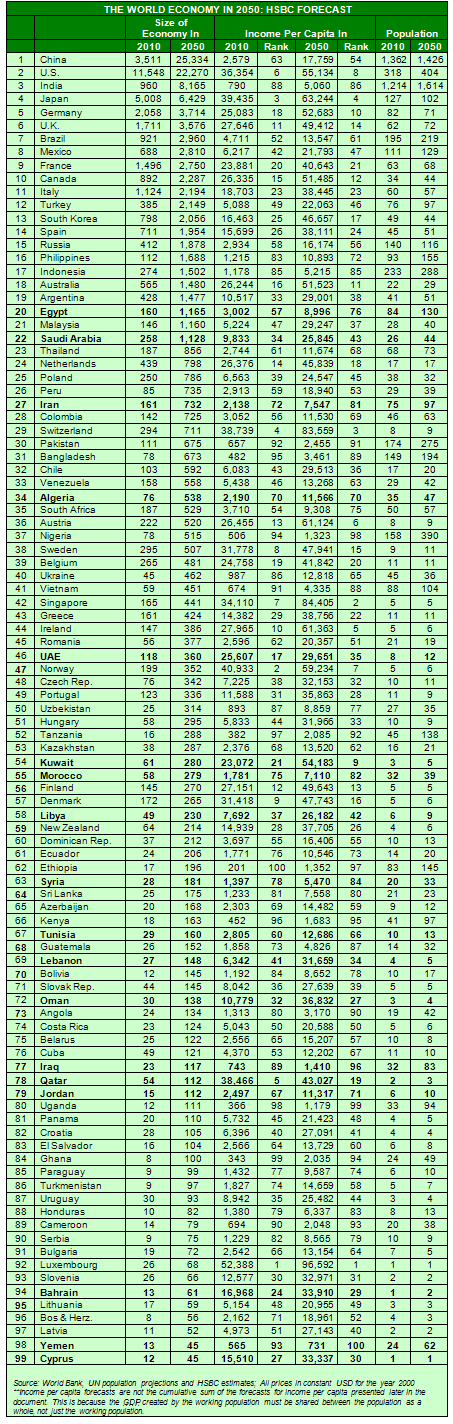
Population dynamics have much to do with growth over the next few decades. The five fastest growing economies in the world - China, India, Philippines, Egypt and Malaysia - all have one thing in common, exceptionally large and/or fast-growing populations.
The bank says economy with large populations will benefit at the expense of slow or small population basis.
"In 2050 there will be almost as many people in Nigeria as in the United States, and Ethiopia will have twice as many people as projected in the UK or Germany. The population of many African countries will double. Pakistan will have the sixth-largest population in the world. Even if some of these countries remain relatively poor on a per-capita basis, they could see a dramatic increase in the size of their economies thanks to population growth."
MISLEADING ESTIMATES?
HSBC says the current upheavals in MENA are a direct result of rising population growth, poor educations and job prospects coupled with a lack of democracy.
A major problem forecasting for most Middle East, and especially Gulf states, is the immigration flows, which can be volatile.
"Nevertheless, the model does conform to our high expectations for long-term growth in Egypt and Saudi Arabia, despite some of the near-term challenges. Similarly, the outlook looks extremely robust for Bahrain, Jordan and the United Arab Emirates," says the bank.
However, some of HSBC's other Middle forecasts are hard to swallow. It is tough to imagine that Algeria will be a bigger economy than the UAE and Kuwait by 2050.
Or countries with less energy resources such as Morocco, Syria, Tunisia and Lebanon will fare better than energy-rich Iraq and Qatar over the next 40 years - given the world's rosy forecast for oil prices over the next few decades.
Another key country that sticks out as a sore thumb is Libya. The country has virtually no political and social infrastructure to speak of today and even by HSBC's population-biased metrics will have a mere 9 million population by 2050. Yet it is placed higher than Lebanon, Oman, Iraq, Qatar and Jordan in the list.
HSBC's arguments are also a bit unsatisfactory: "Being highly endowed with oil has managed to ensure that income per capita in many of these nations is already very high," says the bank.
"This model will therefore penalise certain countries since it cannot explain the current level of income per capita with the variables it considers. So we need to take forecasts for economies such as Qatar with some pinch of salt. These economies may continue to grow at a rapid pace, despite any weakness in the fundamentals for which our model is accounting," the bank notes, adding that there are lots of caveats to bear in mind with regards to how its model might not accurately capture the outlook for parts of the Middle East.
But clearly this source of wealth, and the ability to spread it fairly across the population, is a major source of contention now and will continue to be in the future, says the HSBC.
While, there might be some disagreements regarding HSBC's estimates, they are broadly in line with Citibank's own 2050 forecast, which places Saudi Arabia and Egypt and Iran among the largest Middle East economies of the future.
Goldman Sachs' Next Eleven (N-11) also include Egypt and Iran, but yet again, the UAE and Qatar fail to make the cut.
Also Read: Saudi Arabia 6th Richest Economy by 2050: Citibank
Regional Dynamos
A year after HSBC released its 2050 report which estimated that Egypt would surpass Saudi Arabia as the largest economy in the Middle East, the bank has dug deeper in its crystal ball-gazing research.
The first report limited its forecast to the world's 30 largest economies by 2050 - but has now expanded it to 100 nations and includes more Middle East nations.
And like the first edition of the report, there are a few surprises.
The report makes for some fascinating reading and the underlying theme is that the economies we currently call "emerging" are going to power global growth over the next four decades, says HSBC.
"We identify 26 fast-growth countries. They share a very low level of development but have made great progress in improving fundamentals," says HSBC, which identifies 'fast growth' above 5%.
"As they open themselves to the technology available elsewhere, they should enjoy many years of 'copy and paste' growth ahead. Besides China, India, the Philippines and Malaysia, this category includes Bangladesh, the central Asian countries of Uzbekistan, Kazakhstan and Turkmenistan, Peru and Ecuador in Latin America, and Egypt and Jordan in the Middle East."
ALSO READ: Egypt Will Surpass Saudi Economy By 2050: HSBC
GROWTH PATTERNS
Disappointingly for the Middle East, only Egypt and Jordan are expected to be in the category of fastest growing nations till 2050.
Saudi Arabia, Iran, Kuwait, Morocco, Libya, Syria and Tunisia, Lebanon, Oman, Iraq and Bahrain are among the next batch of countries that are expected to have growth of between 3 to 5%.
The UAE and Qatar are among the batch of countries that are expected to be 'stable' - or less than 3%, which may come as a disappointment, but the bank admits that their growth is under estimated, especially for some of the smaller oil rich nations with fluid populations.
Overall, the Middle East economies are expected to post an average growth of 4.20% to 3.30% over the next 40 years, which is much lower than the 5.8% to 4.3% of the Asia economies, and even lower than Central and South American growth averages.
Africa will be the fastest growing region, of course starting from much a lower base, averaging around 5.3% to 4.6% over the next four decades.
The developed countries will average around 2% throughout the forecast countries, the bank forecasts.
"The West is not getting poorer, but high levels of income per capita and weak demographics will limit growth," says HSBC. "It is the small-population, ageing economies in Europe that are the big relative losers, seeing the biggest moves down the table."
IT'S ALL ABOUT THE DEMOGRAPHICS
Population dynamics have much to do with growth over the next few decades. The five fastest growing economies in the world - China, India, Philippines, Egypt and Malaysia - all have one thing in common, exceptionally large and/or fast-growing populations.
The bank says economy with large populations will benefit at the expense of slow or small population basis.
"In 2050 there will be almost as many people in Nigeria as in the United States, and Ethiopia will have twice as many people as projected in the UK or Germany. The population of many African countries will double. Pakistan will have the sixth-largest population in the world. Even if some of these countries remain relatively poor on a per-capita basis, they could see a dramatic increase in the size of their economies thanks to population growth."
MISLEADING ESTIMATES?
HSBC says the current upheavals in MENA are a direct result of rising population growth, poor educations and job prospects coupled with a lack of democracy.
A major problem forecasting for most Middle East, and especially Gulf states, is the immigration flows, which can be volatile.
"Nevertheless, the model does conform to our high expectations for long-term growth in Egypt and Saudi Arabia, despite some of the near-term challenges. Similarly, the outlook looks extremely robust for Bahrain, Jordan and the United Arab Emirates," says the bank.
However, some of HSBC's other Middle forecasts are hard to swallow. It is tough to imagine that Algeria will be a bigger economy than the UAE and Kuwait by 2050.
Or countries with less energy resources such as Morocco, Syria, Tunisia and Lebanon will fare better than energy-rich Iraq and Qatar over the next 40 years - given the world's rosy forecast for oil prices over the next few decades.
Another key country that sticks out as a sore thumb is Libya. The country has virtually no political and social infrastructure to speak of today and even by HSBC's population-biased metrics will have a mere 9 million population by 2050. Yet it is placed higher than Lebanon, Oman, Iraq, Qatar and Jordan in the list.
HSBC's arguments are also a bit unsatisfactory: "Being highly endowed with oil has managed to ensure that income per capita in many of these nations is already very high," says the bank.
"This model will therefore penalise certain countries since it cannot explain the current level of income per capita with the variables it considers. So we need to take forecasts for economies such as Qatar with some pinch of salt. These economies may continue to grow at a rapid pace, despite any weakness in the fundamentals for which our model is accounting," the bank notes, adding that there are lots of caveats to bear in mind with regards to how its model might not accurately capture the outlook for parts of the Middle East.
But clearly this source of wealth, and the ability to spread it fairly across the population, is a major source of contention now and will continue to be in the future, says the HSBC.
While, there might be some disagreements regarding HSBC's estimates, they are broadly in line with Citibank's own 2050 forecast, which places Saudi Arabia and Egypt and Iran among the largest Middle East economies of the future.
Goldman Sachs' Next Eleven (N-11) also include Egypt and Iran, but yet again, the UAE and Qatar fail to make the cut.
Also Read: Saudi Arabia 6th Richest Economy by 2050: Citibank
Regional Dynamos
© alifarabia.com 2012