The government of Saudi Arabia will spend more than SAR 300 billion (USD 80 billion) until 2020 on increasing power generation capacity and developing power distribution networks, with 30% to 40% of the power sector being allocated to private sector participation, as the kingdom struggles to meet rapidly growing demand.
Actual power generation capacity in the largest Arab economy reached 49,138 MW by the end of 2010, having risen at a 10-year compounded annual growth rate of 6.7%, according a report by National Commercial Bank.
Overall consumption and peak load demand, however, grew at 10-year CAGRs of 6.4% and 7.7%, respectively, amounting to 212,263 GW and 45,661 MW.
The kingdom has allocated more than SAR 55 billion only for 2012 to build power stations and transmission and distribution projects in many parts of the country.
According to the Zawya Projects Monitor, power generation, distribution and transmission related projects valued at more than USD 41.42 billion are currently under way in Saudi Arabia.
Increasing demand
The Saudi Electricity Company (SEC) currently has 729 power generation units installed at 71 stations with a total capacity of 40,697 MW at the end of 2010. Over the 10 years from 2000, SEC added 20,157 MW to its capacity, or an average of 2,015.7 MW per year.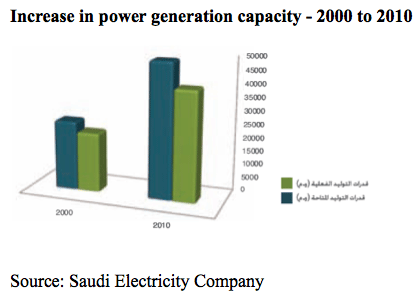
However, consumption of electricity has been increasing at the rate of 6% per year. According to a 2011 Economist Intelligence Unit report, each Saudi resident uses 7,700 KW per year, compared to the global average of 2,500 KW.
Economist Dr. Fahd Bin Gomaa, a member of the International Association for Energy Economics, says Saudi Arabia's production still lags demand. "The demand for electricity in Saudi increases by 9% per year and it's expected to reach 120 GW in 2032. This would require increasing production to 30 GW by year 2020 alone, at a cost of SAR 300 billion."
The kingdom's ministry of water and electricity, on the other hand, expects power demand to increase 4.5% per year until 2032, as the population will grow by 50% by that year. The ministry says generation capacity needs to increase to 75,000 MW.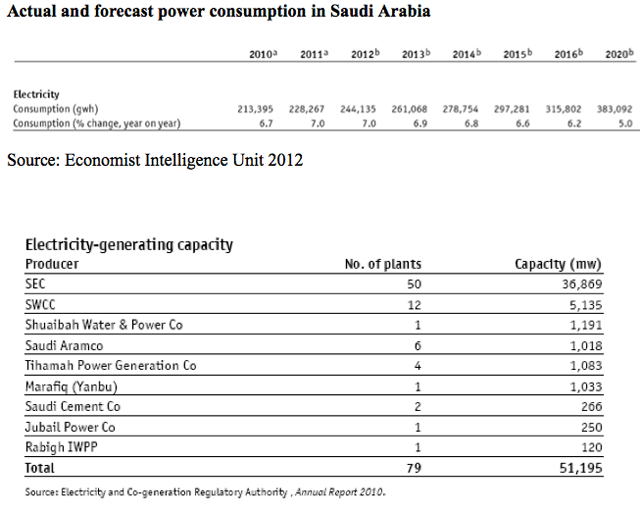
Of the SAR 300 billion that the Saudi government is seeking to invest in the power sector, 30% to 40% has been allocated for private sector investors from inside and outside the kingdom to develop, fund and operate the projects as independent producers.
Abdallah Alhassen, the Saudi minister of water and electricity, indicated last year that the financial commitment necessary for water and electricity projects exceeds SAR 500 billion for the next 10 years. A large chunk of this will need to come from the private sector, he said, including domestic and foreign entities on a build, own and operate basis.
Some independent private sector projects are already being implemented. These produce two million cubic meters of water and about 5,000 MW of electricity.
© Zawya 2012