In the first part of the 2012 regional economic prospects, a look at oil-rich countries' efforts to manage their citizens' expectations, economic slowdown and regional and domestic political upheavals in the New Year.
The year 2011 was probably the most unexpected for the Middle East in decades with not just the magnitude of changes unravelling in the region, but also the sheer number of those cataclysmic changes.
While the Middle East is no stranger to unrest and conflict, often these disturbances are limited to a few nations - never before was the entire swathe of the Middle East - from Tunis to Tehran - shaken to its very core in one singular year.
Each and every analyst and observer was taken aback by the significant, life-altering events that changed the lives of millions of people in the Middle East.
No analyst conjuring up scenarios in 2010 for the year 2011 predicted even in an 'Extreme Case Scenario' that Egypt's Hosni Mubarak, Libya's Moammer Gaddhafi and Tunisia's Ben Ali will be swept away by waves of popular dissent.
Yet here we are on the eve of 2012, with all those momentous changes coming to pass - and more.
2011 was the defining year for Arab Awakening, and will reverberate in ways direct and indirect across the region for years, if not decades.
The paths chosen, especially by Tunisians, Egyptians, Libyans, Yemeni, Palestinians, Bahrainis and Syrians could well lead to more conflict but also, hopefully more opportunities for a new generation of Arabs.
Regardless, it will not be easy. The year 2012 is expected to be a continuation of the struggle that started with Mohammed Bouzzazi in Tunisia whose act of self-sacrifice on the eve of 2011 ushered in the Arab Spring. The region will have to weather many more seasons, before it can find true peace, democracy and economic prosperity. But it's a journey well begun.
Like 2011, 2012 will be the year of fire-fighting across the region. Saudis will be looking to douse Iran's ying with its own brand of yang, ensuring that protests in Bahrain does not get out of hand or even spill on to its eastern province, and succession issues don't come to the fore again for some time.
Egypt's Supreme Council of Armed Forces (SCAF) will look to counter the political rise of Muslim Brotherhood and the Salafist movement and Syrian government will not rest until it has either rooted out protests or is rooted out - either way it does not appear to be a peaceful transition.
PART 1: OIL ECONOMIES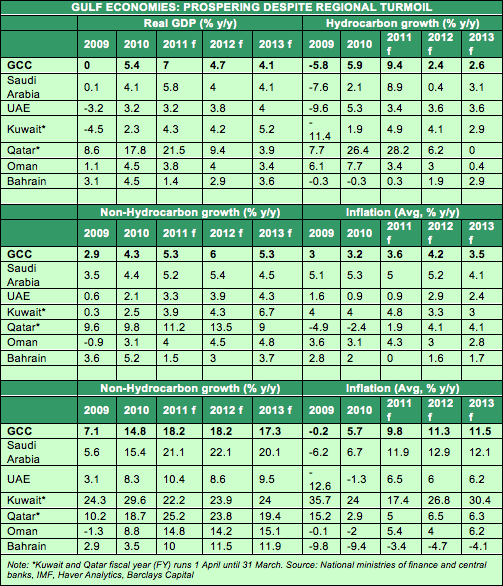
As always, Arab world's economic performance is best gauged by dividing them into oil and non-oil economies. In the first part of the series, we will examine oil-exporting nations.
In the Gulf, higher oil prices and production levels should help lift the budget revenues from hydrocarbon exports from USD554 billion in 2010 to USD793 billion in 2011 and then decline to USD725 billion in 2012, according to the Institute of International Finance (IIF).
This surge in revenues far exceeds the increases in government spending and underlies the widening of the consolidated fiscal surplus from 3.2% of GDP in 2010 to 8.1% in 2011, before narrowing to 2.1% of GDP under the assumption of lower oil prices of USD97/b in 2012 (compared with USD109/b in 2011). The combined external current account surplus is projected to rise from USD170 billion in 2010 to USD322 billion in 2011, but then decline to USD225 billion in 2012.
Gross foreign assets of the GCC are projected to rise to about USD1.9 trillion (against foreign liabilities of USD0.4 trillion), according to the IIF estimates.
Gulf economies which grew 7% despite global and regional turmoil will not see a similar growth rate next year, says Samba analyst Keith Savard who co-wrote the GCC Outlook 2012 report.
"While sustained fiscal stimulus will continue to bolster non-oil sectors, a weaker global environment and reduced contribution from oil sectors will see growth dip to 3.7% in 2012," says Samba.
Still, years of $100 oil prices have left Gulf states in the pink of economic health.
"Although government spending has risen sharply and oil prices are expected to decline, GCC states (except Bahrain) are still projected to run healthy fiscal and current account surpluses in 2012. That said, fiscal positions are now more vulnerable to oil price movements. The average budget break-even price for the GCC as a whole is estimated to have risen to $70/b."
Other analysts such as Deutsche Bank put that figure much higher to $100 and Apicorp estimates it to be around $88.
The Arab Spring movements in the broader Middle East and Africa (MENA) region; unrest in Bahrain, and to a much lesser degree Oman, have focused the minds of GCC leaders, notes Samba.
"Their immediate response has been to accelerate measures aimed at addressing unemployment and social issues in the region, primarily through an increase in state employment and spending on social issues, housing and infrastructure," says Samba.
These additional spending commitments are substantial and come on top of already expansionary fiscal policies. Cumulatively, government spending in GCC states has risen by between 30-60% since the onset of the global crisis in 2008.
Also read: The impact of EU Crisis On Middle East States
BAHRAIN: MOST VULNERABLE
Bahrain is expected to be the most vulnerable Gulf state in 2012 as protests by Shiaas continue despite a government clampdown.
The IIF expects Bahrain's real GDP to rise 3.3% in 2012 after rising a mere 2.2% in 2011.
Economics though is the least of Bahrain's worries as Saudi Arabia is expected to bail it out in the event of an economic crisis. Bahrain is also due to receive USD10-billion as part of a USD20-billion Gulf fund announced by its GCC allies in the aftermath of the unrest in Manama.
Bahraini Government's biggest concern will be to find a political solution and reconciliation with its Shia majority population. The lessons from Egypt, Libya and Tunisia show that while the regimes in these countries fell even though their economies were posting significant GDP growth.
Clearly, economic growth is no antidote against popular unrest.
"Political and social unrest has damaged Bahrain's reputation as a safe, stable, financial hub. While the widespread protests which erupted earlier in the year have been brought to an end, many issues remain unresolved and this is dampening investor confidence," notes Samba.
There is hope yet. The Bahrain government has welcomed the findings of the Independent Commission of Inquiry, which explicitly condemned several Bahraini public entities for abuse of human rights. Such positive steps notwithstanding, but Barclays Bank expects the tension between opposition groups and government to remain through to the first quarter of 2012.
KUWAIT: COULD POLITICAL UNREST ESCALATE?
Kuwait's deteriorating political environment could be a cause for concern in the New Year. The storming of the parliament by protestors led to the ouster of yet another Kuwaiti government and is a sign of great political dissatisfaction, despite its apparent riches.
Kuwait's Emir Sheikh Sabah al-Ahmad Al-Sabah has sworn in a new cabinet with only minor changes to the government that resigned in November over allegations of corruption - it is Kuwait's eight cabinet since 2006.
The political malaise is delaying structural changes to the economy, including much needed investments in non-oil sectors.
"Lingering strains in the financial sector, mainly reflecting problems in investment companies, continue to hamper non-oil growth which remains muted," says Samba.
"In addition, hopes have faded for the rapid implementation of the four-year development plan launched last year as political tensions have resurfaced, and capital spending has stalled. As a result, it seems likely that non-oil sector growth will stall at around 3 percent next year."
Luckily for Kuwait, GDP is still expected to hit 4.4% on the back of record oil production, but as global crude demand eases in the year, that figure will scale back to 3.1%.
OMAN: DODGING A BULLET
Oman managed its economy well despite severe domestic disturbance earlier in the year.
"The unrest and protests experienced earlier in the year have ceased, although lingering discontent over high unemployment rates and demands for political reform remain," says Samba. "The authorities have responded by increasing public sector jobs, raising salaries and pensions, and spending more on social sectors and infrastructure."
The Saudi bank expects the Omani to see growth decline to 3.5% in 2012 from 4.0% in 2011.
Oman should be able to finance its increased expenditure commitments relatively comfortably.
"The jump in oil prices this year is expected to push the fiscal surplus up to 10% of GDP, although this is projected to drop back to 7.5% in 2012 as prices recede. Meanwhile, public debt remains low at less than 10% of GDP. The current account will similarly remain in surplus through 2011-12, and inflation will be contained, helped in large part by policies restricting price increases," says Samba.
QATAR: THRIVING IN A CRISIS
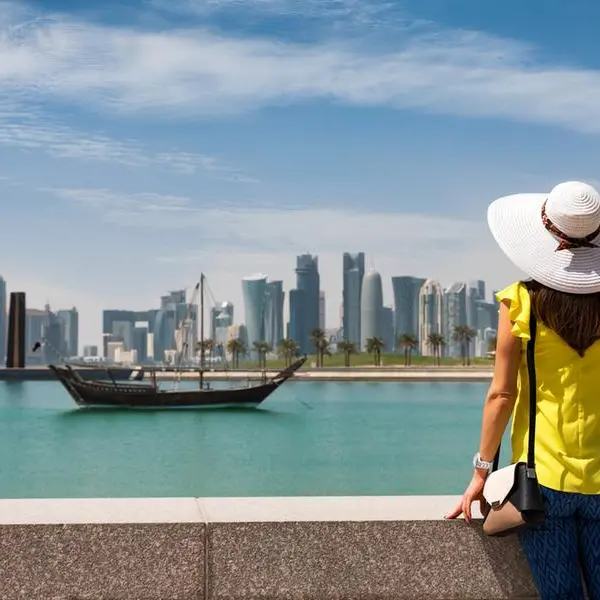
Qatar had a great 2011. At the forefront of the conflict in Libya, helping ignite the Arab spring in Tunisia and Egypt through its Al Jazeera channel and being tough on Syria, Qatar has flexed its political muscle and stepped out of the shadows of other regional political powers such as Saudi Arabia and Iran this year.
Its confidence has much to do with its economic prosperity.
Qatar is expected to be the fastest-growing economy in the region in 2011, driven by about a 30% increase in LNG production while crude oil production remains flat. But the moratorium on new LNG production capacity until 2015 will slow overall growth sharply to 5.3% in 2012, as compared with 18.0% in 2011.
"But the continued large increases in public spending on infrastructure and wages will maintain non-hydrocarbon growth of around 8%," says an IIF report.
"The sharp increase in public wages and pensions, ranging from 50% to 120%, combined with the rise in spending on infrastructure, is projected to narrow the fiscal surplus from 3.2% of GDP in fiscal year 2010/11 to 0.4% in fiscal year 2011/12. The further decline in rents has helped to keep the 12-month inflation rate below 2%."
SAUDI ARABIA: ECONOMIC WINDFALL, POLITICAL HEADACHES
Economically speaking, Saudi Arabia had a pretty good year.
Overall growth is expected at 5.8% this year, driven by a substantial increase in crude oil production and government spending. For the whole of 2011, non-hydrocarbon real GDP is expected to grow by 4.8%. We expect private sector activity to moderate in the second half of this year and in 2012, according to IIF estimates.
Saudi Arabia's GDP is set to hit USD572-billion in 2011 from USD435-billion in 2010, and ease back to USD565 billion in 2012.
Oil production is expected to increase by only 2% (from 9.3 mbd in 2011 to 9.4 mbd in 2012).
"This will bring our forecast for real GDP growth down from 5.8% in 2011 to 3.7% in 2012. We expect oil production to decline modestly towards the end of this year as global demand for oil weakens due to worsening economic conditions in the U.S. and Europe, and as prospects for the return of some exports from Libya improve. Crude oil production was 9.8 mbd in August then declined to 9.4 mbd in September according to official sources," says the IIF.
But that's just half the story.
Saudi Arabia found itself at the opposite end of the Arab Spring in 2011. It started with Saudi Arabia providing shelter to ousted Tunisian dictator Zine El Abidine Ben Ali who fled Tunis after his position became untenable in the country he had ruled for close to 24 years.
But other dominoes started falling. Saudi Arabia and its Gulf allies fretted after the U.S. Government decided to support protestors at Tahrir Square rather than Egyptian strongman Hosni Mubarak.
Another regional Gulf ally had fallen.
Unrest started to brew closer to home as Bahrain and Yemen, and to a lesser extent Oman, erupted. Saudi Shias in the eastern province of the country also looked to rise in sympathy with their Bahraini counterparts, but that movement never gained any momentum.
The Kingdom was quick to launch two spending programmes one after the other to the tune of $130-billion to build housing, create jobs and raise salaries in a successful preemptive bid to quash any dissent in the country.
Saudi Arabia also used every tool in its arsenal to manage the worrying situation: using military force in Bahrain, pledging funds for both Manama and Muscat, and using its diplomatic skills to find a political solution in Yemen.
Perhaps Saudi Arabia can look with its some satisfaction at the departure of Libyan dictator Moammer Gaddhafi. The hatred between the governments of the two countries is legendary, although the Saudis would have preferred a quieter departure for Qaddhafi rather than his brutal death that was caught on mobile phones and went viral on Youtube.
Meanwhile, King Abdullah felt compelled to chide the Syrian President Bashar Al Assad for unleashing violence against his own people, earning the ire of both Damascus and its chief ally in Iran.
In the midst of this turmoil was the incredible revelation that U.S. and Mexican authorities had uncovered a plot by Iranian spies to assassinate the Saudi ambassador to Washington.
In 2011, Saudi Arabia, which prefers to operate behind closed doors, was compelled to raise its own profile, using its political, diplomatic, military and economic influence in the region in a very overt manner.
Its decision to keep pumping oil near production capacity also soothed global economy nerves and ensured that crude prices didn't spiral out of control.
But the death of 82-year-old Crown Prince Sultan bin Abdul-Aziz Al Saudi, brought into sharp focus Saudi's own succession issues at a time when the region was looking up to the Kingdom as a rock of stability.
While the 87-year-old King Abdullah was quick to promote the 78-year-old Interior Minister Prince Nayef bin Abdul Aziz Al Saud as the Crown Prince, it has highlighted the future of Saudi leadership and that of the Al Saud dynasty given the abundance of choices and rivalries within the extended family.
The year 2012 will continue to bring greater headaches for the Saudis as tensions with Iran could escalate. The Bahraini, Yemeni and Syrian issues also remain largely unresolved and oil demand will ease in 2012 with the return of Libyan oil and ramping up of Iraqi crude.
Saudi Arabia has also not managed to crack its unemployment problem, and with so many external and domestic issues, it will be yet another busy year for the Kingdom and especially the new Crown Prince.
UAE: DUBAI DEBT RISKS TO RETURN IN 2012
This year saw the return of the classic UAE business model: it emerged as a safe haven, benefiting from regional troubles and its excellent infrastructure giving tourists and businesses and expatriates a sense of comfort in the regional shamal.
It helped that Abu Dhabi kept pumping oil to keep the economic engine humming. The country's non-hydrocarbon growth is projected to remain around 3% in 2012 despite a more difficult external environment. In addition, UAE banks are now in a stronger position than in 2008 to withstand another global downturn that could stem from the European debt crisis.
"The real estate market in the UAE appears to have bottomed out, and significant progress has been made in corporate restructuring and in governance," says the IIF.
However, question marks surrounding Dubai debt have come to the fore once again.
Ratings agency Moody's has raised concern about renewed medium-term pressures on Dubai entities when the refinanced obligations become due, and about the emirate potentially needing further financial support.
Moody's has also assessed Dubai's exposure to liabilities emanating from state-owned corporates as amounting to around USD33.7 billion. In total, Moody's has identified USD101.5 billion of debt linked to the Dubai government and its state-owned non-financial corporations.
Moody's says that Dubai Holding Commercial Operations Group, Jebel Ali Free Zone and DIFC Investments LLC, which together hold around US$3.8 billion of debt maturing in 2012, continue to face refinancing risks.
But the overall economy has deleveraged considerably with greater effort at cost control, especially in Abu Dhabi, which should place it in an excellent position to prosper should global economic sentiment improve.
"Progress in structural reforms over the next few years (mostly in the legal and regulatory environment), the strengthening of federal institutions, and the enhancement of transparency and governance in the corporate sector could accelerate the pace of economic growth to over 4% in the medium term."
IRAQ: US DEPARTURE - A BLESSING OR A CURSE?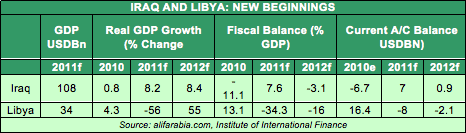
The departure of American forces from Iraqi soil by the end of 2011 will usher in a new chapter in Iraq. All eyes will be on how Nour Al Maliki's government faces up to the security challenges, reconcile issues with various provinces including the independent-minded Kurdistan region and ensure that the country does not plunge into chaos.
Iraq's real GDP stood at 8.2% in 2011, a figure which is expected to rise by 8.4% in 2012 - the highest in the region, according to IIF estimates.
Also read: Iraq: The New Iran?
The International Energy Agency notes that Iraqi oil expansion plans in the medium-term are moving apace, with capacity now forecast to increase by 2.33 million bpd to 38.1 million bpd by 2016. Iraq accounts for 80% of the increased capacity among OPEC nations over the next five years.
The agency has revised Iraq's crude oil production capacity upwards to more than double to 1.87 mb/d in 2010, to 4.36 mb/d on average by 2016.
"Downside risks remain, with the end-2011 withdrawal of US troops uppermost on the list and fears of escalating instability as insurgency bombing increases. IOCs also report that continued bureaucratic, logistical and operational constraints are posing significant challenges and delays to project work, which we have already largely built into our forecast," says the IEA.
LIBYA: CAN LIBYANS COME TOGETHER?
Libyan leader Moumar Gaddhafi met a bloody end, but left a country with few institutions and structures to build a nation. Libyans now face formidable challenges in defining the core elements of a new political system.
"Assuming a smooth political transition beyond the regime change, Libya's medium-term prospects for sustainable, high economic growth should be good," says the IIF.
The country's large foreign assets (which are estimated to have declined from US$150-billion before the war to $110 billion now, more than triple the projected GDP for 2011) and oil wealth will help to attract foreign investment and expertise to restore oil production and rebuild the economy.
"Following the sharp contraction in output in 2011 (estimated at 54%), real GDP is projected to rebound sharply in 2012 and subsequent years, largely due to the gradual recovery of oil production and spending on infrastructure."
With oil prices expected to remain reasonably high barring a global catastrophe, oil economies are expected to fare than their oil-consuming partners. But that does not mean that they are expecting a carefree 2012.
© alifarabia.com 2011