Middle East markets had a phenomenal February. Find out which stocks performed outstandingly well, and which failed to get investors enthused.
February was the month when Middle East markets roared back to life.
Dubai, often the laggard among Middle East markets over the past few years, was the region's best performing market in February, rising 23.1% during February, leaving even the fast-improving Egypt behind which rose 16.5%.
Saudi Arabia, easily the region's largest market in terms of market capitalisation, also impressed with an astonishing 10.2% improvement during the month.
In sharp contrast to last year when virtually all the regional stock markets - except for Qatar - were in the red, this year all the markets are firmly in the black.
"GCC markets have largely mimicked the performance of global equities, with investors taking a favorable view on stocks in the early part of the year, as valuations appear attractive," Gulf Investment Corporation analysts said in a note.
Equity markets reacted positively and the Euro rallied against its peers, as the EU and IMF agreed to a second bailout for indebted Greece worth EUR 130bn. And while the world worries about an oil price spike, this development is deemed good news in the Gulf states.
The markets also appear to shrug of tensions between Israel and Iran for the moment, and have risen after years of languishing at attractive levels.
On the whole, GCC markets surpassed global equities on returns during February. The S&P GCC index posted gains of 7.59% while the MSCI World Index rose 4.66% for the month. Within the region, all markets were in the black as investor sentiment has remained positive since the start of 2012, notes GIC.
Dubai Financial Market, which was at a seven-year low rose on the back of real estate, services and investment sectors. GIC expects the rally to continue in the near future, especially as the emirate's credit situation improves.
For example Drydocks World LLC, a unit of state-controlled Dubai World, said it expects to present on March 8 the terms to restructure its debt under a USD2.2-billion syndicated facility.
Drydocks World aims to complete the restructuring by July and said: "it is confident that it will receive the support of a majority of its syndicated lenders to the terms of its debt restructuring."
Abu Dhabi also tracked Dubai with financial services and real estate sectors rising in tandem with their sister exchange across the road.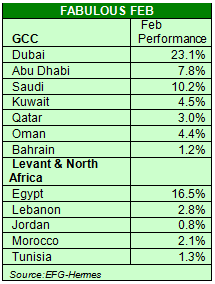
NCB Capital is also bullish on the regional and especially Saudi markets.
"The global rally in stock markets supported Saudi's Tadawul All Share Index (TASI) to breach levels unseen since September 2008.... Investors in the Saudi market overcame systematic risks and coupled with strong corporate earnings at SAR95 billion, 22% gain Y/Y, for 2011," said NCB in a note.
And this rally appears to have legs as the volumes have risen exponentially. Daily traded volumes recorded SAR12.2 bn on February 25, the most lucrative session since July 2008, according to NCB.
"Moving forward into 2012, daily traded volumes averaged SAR7 bn in comparison to last year's SAR3.6 billion over the same period," notes NCB. The suppressed prices of stocks during 2011 and 2010 resulted in an opportunity to gain on undervalued stocks as the market's price to earnings ratio (PE) reached 12.29 in 2011. The elevated level of trading raised the PE level to 12.9 which still represents an attractive market by historical levels and global standards. The market is still on a strong trajectory and by breaching the 7,000 level, 7,250 seems very plausible."
Kuwait Stock Exchange, which has been dragged by investment and real estate companies for the past few years also saw a jump of 4.5% during February as investors were buoyed by the completion of election in the country.
Qatar, which has been the pick of most analysts, lagged other markets, but was still up 3% during the month. Oman fared even better, with a sterling 4.4% improvement.
Only Bahrain, which is the weakest Gulf economy and faces significant political struggles, managed a 1.2% recovery.
"With oil prices remaining elevated thanks to the geopolitical tensions in the region, the short- term outlook for the GCC equity markets seems appealing," says GIC. "Supported by the strength in oil prices, long-term projects that were put on hold by governments seem to be back on the cards."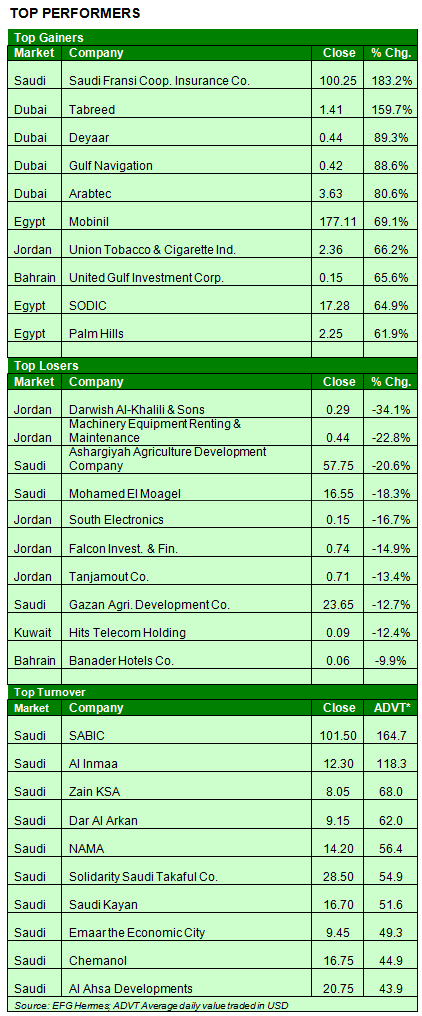
The region's top performing stock was Saudi Fransi Cooperative Insurance Company, which rose a staggering 183.2% during the month, according to EG-Hemes data. The company had seen a 141% growth in customer base in the first six months of 2011 and is benefiting from the all-round insurance growth in the Kingdom led by the health insurance segment.
Dubai's Tabreed was the only other stock to post triple-figure growth in the region, according to EFG-Hermes data.
The company, also known as the National Central Cooling Company, has tracked the sagging fortunes of the UAE's real estate sector, but its operations have picked up on the back of Dubai Metro's expansion.
The company posted a 34% net profit last year on the back of new plants and customer connections. Last year the company completed its recapitalization programme last year and put in a place a capital structure to enable the company to settle its 2006 sukuk in full upon maturity.
Dubai's Deyaar, the troubled real estate developer which felt the full force of Dubai's real estate downturn, swung to a profit last year.
The company saw a AED37.7 million net profit in 2011, compared to a loss of AED2.87-billion in 2010. The company aims to deliver 1,000 units this year.
All this good news influenced its share price, which rose to 44 UAE fils - an 89.3% rise in February.
Gulf Navigation also rose 88.6%, as investors took another look at 'fil' stocks.
"Retail investors are increasingly speculating on penny stocks. Stocks with a share price below AED1 on 31 Dec 2011 have risen the most year-to-date and have the highest turnover/market cap ratio," write EFG-Hermes analysts Fahd Iqbal and Simon Kitchen.
"This is followed by stocks with a price of AED1-2, while stocks with a price above AED2 have trailed. In our view, retail-favoured penny stocks (mostly small caps) are at risk of a sharp correction once momentum subsides. Large-cap stocks are therefore more likely to hold on to gains made thus far in the face of any profit-taking."
Finishing off the five best performing stocks was Dubai stalwart Arabtec, which rose 80.6%, according to EFG-Hermes data.
Construction star Arabtec has been an investor darling but was dragged down by the overall negative sentiment in Dubai's real estate industry. But the company has persevered and secured contracts in Saudi Arabia, India, Kuwait and Egypt, among others.
WORST PERFORMING STOCKS
Not all stock were lifted by the rising tide. Jordan's Darwish Al-Khalili & Sons fell 34.1% during the month of February. The Amman-based company is focused on trade, marketing, import, and export of electronic appliances.
In June last year, LG Electronics severed ties with Darwish Khalilil & Sons unit Middle East Complex for Engineering Electronics and Heavy Industries, on the ground that it owed it USD7-million, according to Jordan Times.
In fact, Jordan which was the worst performing stock market in the region, saw five stocks in the biggest losers in February.
CONSOLIDATION, NOT CORRECTION
EFG Hermes expects the UAE rally to continue albeit with interruptions.
"Dubai is up 31% YTD, versus 10% for Abu Dhabi and 9% for the Hermes MENA Index," said EFG-Hermes analysts. "Signs are emerging that the Dubai rally is losing steam, with investor attention switching to low quality, small-cap stocks. However, with trading activity having recovered substantially, we expect Dubai to consolidate close to current levels rather than correct sharply, as per the previous three rallies in Dubai, bringing the market down by only 5-10%."
Dubai could get a further boost as the debt restructuring works itself out and Dubai companies are not expected to default.
"We do not expect a default from any Dubai GRE; the successful repayment of the DIFC Investments and JAFZA sukuks should help propel the Dubai markets higher," said EFG analysts Iqbal and Kitchen. "Market sentiment should also be supported by ongoing strength in tourism and trade, as well as some improvements in selective segments of residential real estate."
CONCLUSION
The regional markets have come back to life and it is likely there may be protracted periods of consolidation before markets move further forward.
But at least there is trading activity and the virtuous cycle of more trade and more market participants could also encourage new listings.
Despite the regional overhang of a war (what else is new), the fundamentals are ripe for some healthy returns for investors.
Alifarabia.com does not own any of the above mentioned stocks, nor intends to buy any of the equities in the foreseeable future.
© alifarabia.com 2012