The historic events of 2011 slowed launch activity of mutual funds in the MENA region, from more than 60 in 2010 to 52 in 2011. This was evident in conventional fund launches - from 42 in 2010 to 34 in 2011- while Islamic fund launches decreased only slightly from 19 to 18.
More than half of the funds launched in 2011 were of the equity asset class, traditionally the most common one. Compared to two exchange-traded funds launched in 2010, only one ETF was launched in 2011, emphasizing the slow progress of this nascent product in the region.
Surprisingly, Tunisia witnessed the maximum activity despite the political turmoil as 12 of the launched funds were focused on this North African country. In second place came Egypt, another location of high turbulence in 2011, with 10 of the launched funds focused on Egypt. 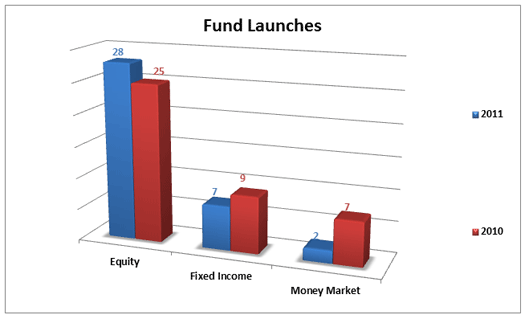
Source: Zawya Funds Monitor
The largest number of regionally domiciled funds continues to be in Saudi Arabia, with 239 as of Q3 2011. Saudi Arabia also has the largest Islamic asset management industry in the world. On the other hand, Jordan has the smallest number of locally domiciled funds at three.
According to MENA ETF Landscape, a research report by Zawya, there were 10 ETFs that invest at least 50% of their assets in the MENA region as of Q3-2011. In Q4-2011, the HSBC Amanah Saudi 20 Exchange Traded Fund joined the list.
Comparing returns made between the end of 2010 and the end of 2011, the conventional equity asset class witnessed the Qatar-focused Qatar Gate Fund (Q) as the top performer, with around 7% y-o-y returns. The second and fourth top performers were also focused on Qatar, a sign of a strong progress in the performance of the Qatari conventional equity market.
In the Islamic equity asset class, the Tunisian MAC Al Houda FCP came in first with around 18% y-o-y returns. In the fixed income asset class, the Lebanese Beirut Opportunities Fund outperformed its peers, recording around 8% returns. The second, third, and fifth top performers were also focused on Lebanon. In the sukuk asset class, a strong correlation between geographic diversification and performance was suggested as the top five performers had diverse exposure to countries in the GCC and MENA, and the GCC-focused Tharawat Sukuk Fund led its peers with around 6% return.
The economy is most often assumed to be the agent with the most impact on the asset management industry, and investors shy away from mutual funds in countries experiencing economic downturns. But to what extent do equity funds actually reflect the country's economy? According to GCC Equity Funds and Economic Fundamentals, a research report by Zawya, Bahrain witnessed the greatest correlation, 79%, between the performance of its equity funds and its economy while Saudi Arabia witnessed the least correlation, at a negative 60%, between 2006 and 2010.
Starting at USD 68.025 million at the end of the fourth quarter of 2010, the gross AUM of regionally domiciled funds shrank to USD 62.653 million at the end of the third quarter of 2011-- a 7.9% decrease. The bulk of this decrease was witnessed in Saudi Arabia as the gross AUM dropped from USD 25.22 million as of Q4-2010 to USD 22.79 million as of Q3-2011. In Egypt, gross AUM dropped from USD 9.498 million as of Q4-2010 to USD 7.582 million as of Q3-2011. Bahrain, Jordan, Kuwait, Oman, Qatar, and UAE also witnessed a decrease in gross AUM of domiciled funds while a few countries such as Tunisia, Morocco and Lebanon witnessed an increase in gross AUM from Q4-2010 to Q3-2011.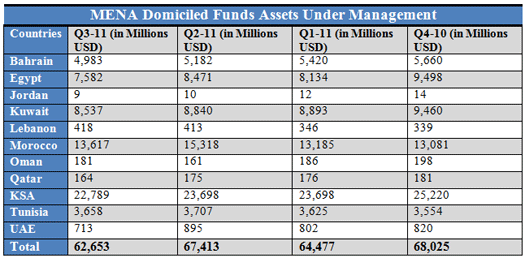
Source: Zawya Funds Monitor
The first few months of 2011 gave investors plenty to worry about, and they responded by pulling out cash from mutual funds in the MENA region. Overall, regional funds registered outflows of over USD 3 billion between Q4-2010 and Q1-2011, mainly because of massive redemptions from Saudi Arabia and Egypt.
While trade finance and money market funds witnessed the largest outflows during this period, fixed income and balanced funds recorded some inflow. A swift recovery in investor sentiment was witnessed during the second quarter of 2011 as overall USD 518 million fund inflows were registered between Q1-2011 and Q2-2011. The largest inflows went to Moroccan funds, followed by Saudi Arabian funds while the largest outflows were witnessed in GCC funds followed by Kuwaiti funds.
Among the asset classes, the fixed-income funds witnessed the largest inflow while the equity funds recorded the largest outflow, suggesting that at least some of the money exiting equity funds sought safety in fixed-income funds.
The Zawya Funds Ranking as of Q2-2011 consisted of 16 conventional and six Islamic fund categories, a total of 22 categories. Among the top-ranked funds in the conventional categories were: Markaz Arabian Fund in the MENA Equity conventional category, Gulf Gate Fund in the GCC Equity conventional category, Al Arabi Saudi Equity Fund in the Saudi Arabia Equity conventional category, Al Mal UAE Equity Fund in the UAE Equity conventional category and Arab African International Bank Investment Fund in the Egypt Equity conventional category.
Top-ranked funds in the Islamic categories included Jadwa GCC Equity Fund in the GCC Equity Islamic category, Falcom Saudi Equity Fund in the Saudi Arabia Equity Islamic category, Sanabel Fund in the Egypt Equity Islamic category and Tharwa Islamic Fund in the Kuwait Equity Islamic category.
The region has experienced some hurdles and pessimistic sentiment in the past year but has emerged unscathed with promising prospects ahead. The investment culture in the region is still not very robust, and there is a need for improvement in fund regulatory structures.
However, key developments give hope to fund managers and investors alike. Saudi Arabia is planning to open Tadawul, the Saudi stock exchange, to foreign investors in order to increase their otherwise limited access to the market. The UAE's Securities and Commodities Authority has published several draft regulations with regards to fund management and market-making, attracting investors and revitalizing the market.
Top News
A difficult ride for MENA funds in 1H2011
Asset managers urge unified rules for Middle East
Retail asset management industry in nascent state
Middle East still attractive for international asset management industry
For comprehensive coverage on MENA funds, please visit Zawya's Funds Monitor.
© Zawya 2012