Riyadh and Jeddah had a stellar 2010-2011, clocking the second and third highest growth rates in the world according to The Brookings Institution's 2011 Global MetroMonitor.
Their performance was only bettered by the Chinese economic engine Shanghai, which saw its income rise nearly 10% during the 2010-11 period.
Riyadh posted a 7.8% rise in income and 6.3% growth in employment to emerge as the second fastest growing metropolitan in the world.
Jeddah fared extremely well too, registering a 7% rise in income and 5.5% in employment to claim a distinguished third place.
The performance of the two Middle East cities is even more commendable given the unrest in the region last year. Of course, both cities were buoyed by high oil prices and the economic stimulus announced by the Saudi Government as a direct response to the Arab Spring revolution exploding across the region.
Riyadh, which previously ranked 17th in the survey, saw a great jump partially because of growth in local markets, business and finance and manufacturing according to The Brooking Institution's data, which tracks 200 of the largest cities across the world.
"This 2011 Global MetroMonitor identifies large metropolitan areas that led or lagged on economic growth from 2010 to 2011, the latest year of a still-volatile period for the global economy," said the report. "It further explains how and why metropolitan performance shifted in 2011 versus previous years, and identifies metro areas that have fully recovered from the great recession, those still in recovery mode, and those that continued to lose ground last year."

ABU DHABI IS RICHEST MIDEAST METRO
While Abu Dhabi did not grow as quickly, the city emerged as the fourth richest in the world with income per capita of USD63,859. Only Hartford in the U.S., Oslo in Norway and San Jose, also in the U.S. fared better than the UAE capital.
However, the UAE city ranked 128th among 200 metros, with income growth of a mere 0.5% and employment growth of 1.0 during the period. It's quite a fall for a city that was once the 14th fastest-growing in previous rankings.
Dubai fared better than Abu Dhabi, coming 114th in the ranking. The emirate saw its income decline by 2.7% during the period but employment rose 3.0%.
The big surprise was Kuwait City, which was head and shoulders above the UAE cities, with a respectable 44th place. Kuwait's capital city saw a 2% improvement in income and 2.8% change in employment, which is interesting given that the country was in a political paralysis for much of 2011 and its' financial services and real estate sectors remain problematic.
The tiny gas giant Qatar's capital city Doha was conspicuously absent from the list.
CASABLANCA SURPRISE
An even bigger surprise was Casablanca which ranked 18th in the world, with a robust 3.3% income growth and 3.8% growth in employment.
Unlike its North African neighbours, the Morocco Government escaped much of the wrath of its citizens with some timely political and economic reforms and an election that saw real change in the country.
Casablanca is though no stranger to high rankings in this survey, having emerged 19th in previous years' rankings - but this is its best effort thus far.
EGYPTIAN CITIES LANGUISH AT THE BOTTOM
Cairo and Alexandria - Egypt's two representative cities - fared poorly in this year's survey. In fact, Cairo was ranked 188th in the overall ranking, with a 0.5% decline in income and 0.3% decline in employment.
It also emerged last among the 200 metros in terms of income per capita with USD1,989, worse even then Alexandria which had per capita income of USD2,248.
Egypt's troubles over the past year are well-documented but clearly once we look past its short-term troubles, the potential is there. Cairo's highest ranking in previous Brookings' surveys was an impressive 12th, and there is no reason to think the city can't scale those lofty heights after a period of uncertainty which may prevail for a while.
For now, however, both Cairo and Alexandria are in the midst of a 'full recession', a fate they share with Athens, Dublin, Seville, Naples, Lisbon, Valencia, Sacramento, Kansas City, San Francisco Hiroshima - not bad company.
Also Read: Rise Of Egypt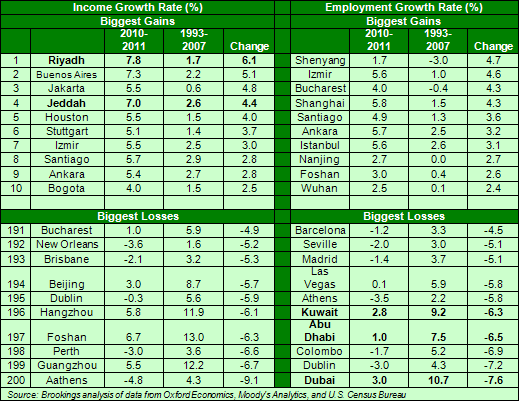
GLOBAL OUTLOOK FOR METROS
Most of the 200 metro areas are in high-income countries, with only a little over a one-fifth in developing countries, according to the survey.
While the metro economies in developing countries represented only 14% of the GDP of all 200 metro areas in 2011, they have gained quickly on developed metro areas during the last few years.
The great recession accelerated the shift of economic growth toward metro areas in developing countries. From 1993 to 2007, the 42 metro economies in developing countries added 2.5% to the GDP of the entire sample, but then added another 2.2% in just the four years from 2007 to 2011, says The Brookings Institution.
"The 200 largest metropolitan economies are a diverse lot, both in terms of sheer size and relative wealth. Even though Tokyo's GDP shrank by about 3% from 2007 to 2011, it still possesses the largest metropolitan economy in the world, valued at roughly USD1.3 trillion, in 2005 dollars. New York has the world's second-largest metro economy -- equal in size to that of the nation of south Korea," said the Institution's report.
"The other largest metro economies are located in Western Europe (London, Paris, Köln-Düsseldorf), Asia (Osaka, Seoul), and the United States (Chicago, Los Angeles, Washington, D.C.). These 10 metro areas represent 27% of the combined GDP of the world's 200 largest metro economies.
"In contrast, eight of the ten largest metro areas by population are found in developing countries, and include three in china (Chongqing, Shanghai, Beijing), two others in Asia (Jakarta, Mumbai), two in Latin America (Mexico City and São Paolo), and one in Africa (Cairo). Together, those 10 metro areas house about
one-quarter of the combined population of the 200 metro areas."
OTHER KEY HIGHLIGHTS
* According to the report, 90% of the fastest-growing metropolitan economies among the 200 largest worldwide were outside of North America and Western Europe. In sharp contrast, 95% of the slowest growing were in OECD nations, including Japan.
* Most metropolitan areas were key engines of growth, beating national averages in both income and employment generation.
* Less than one-half of the 200 metro areas surpassed their pre-recession levels of employment and/ or income by 2011, the report notes.
"While nearly all developing Asia-Pacific and Latin American metro areas achieved new highs in both income and employment in 2011, only one North American metro area did so. Most metro areas also posted slower employment and income growth rates in 2010-2011 than they did over the long-run, pre-recession period from 1993 to 2007," the report notes.
* Metro areas specializing in commodities and business and financial services within their countries exhibited the strongest performance - which explains the rise of Riyadh and Jeddah.
By contrast, metro areas with high concentrations of local/non-market services (education, health care, administrative services, government) or construction registered only sluggish growth last year - which explains Abu Dhabi and Dubai.
Manufacturing accounted for the largest share of output growth in 59 metro areas from 2010 to 2011, including many in which it does not rank as the largest industry.
Also Read: 100 Biggest Economies By 2050
© alifarabia.com 2012