The latest Central Bank of Bahrain statistics confirm that Bahrain's financial services sector suffered during the domestic unrest that began last year as did the rest of the economy in the Kingdom. While the impact has been limited for the most part, the instability in Bahrain has coincided with a wider global financial services sector retrenchment, which could translate into a further scaling down of financial services by global players in the Kingdom.
Bahrain has been in the news for all the wrong reasons over the past 12 months. Domestic unrest has led to political stalemate and the economy has suffered as the majority Shia population sought greater fairness, freedom and opportunities from the Al Khalifa regime that rules the country.
The Bahrain Independent Commission of Inquiry (BICI) has reported that 35 people were killed during the unrest, including five security personnel, and five detainees who were tortured to death while in custody - hundreds were also injured.
While the political struggles were matched by an iron-fisted government response, analysts have been worrying about the country's financial services sector, which had been meticulously built by the government over the past 40 years.Bahrain takes tremendous pride in its financial services sector and was widely regarded as the original banking hub in the region, until it was displaced by Dubai.
For years, Bahrain had enjoyed a great reputation as a strong financial services regulator and home to many offshore funds, mutual funds, investment vehicles and international banks. But last year, that reputation was placed in doubt and there were rumours of banks leaving the troubled country, and funds moving away.
A comparison between the latest Central Bank of Bahrain (CBB) newsletter with the one issued in December 2010, highlights the impact on the financial sector, and while many areas appear to be hit, there has not been a massive exodus of institutions leaving the country - not yet any way.
The total number of financial institutions operating in the Kingdom has remained the same in 12 months times - 412. But dig a little deeper and the extent of activities in the country's financial services sector come to light.
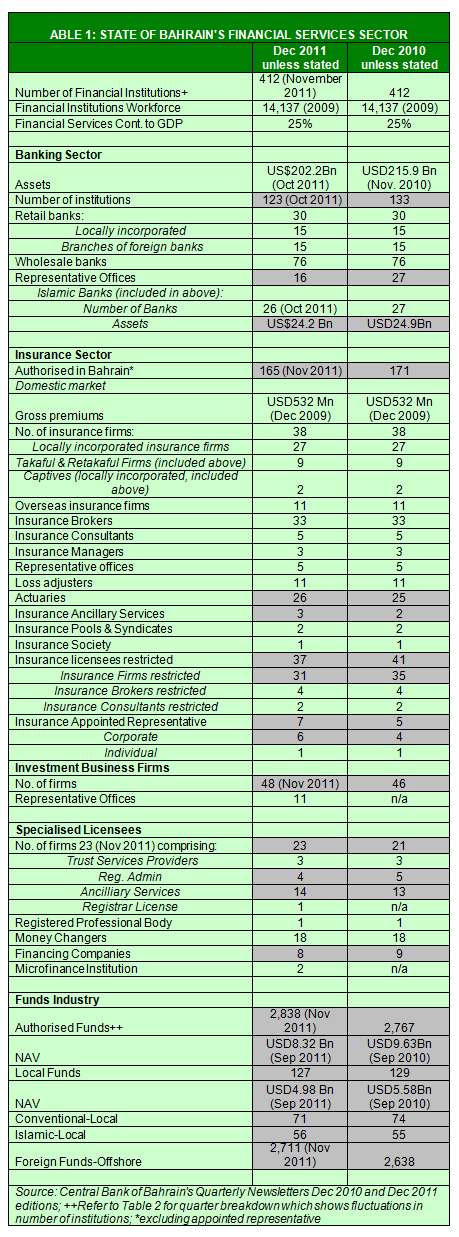
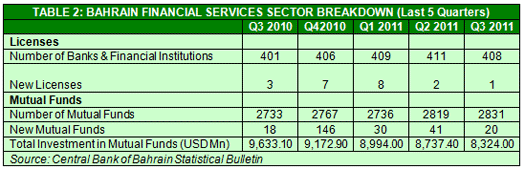
While the number of banks and financial institutions stood at 412 by November 2011, CBB's statistics show the number stood at 408 by the third quarter of 2011, compared to 411 in the second quarter of the same year - suggesting at least three financial institutions left the country. During the first three quarters of 2011, CBB also issued 11 new licenses.
The number of banks operating in the Kingdom fell from 133 in December 2010 to 123 banks - primarily in the number of representative offices which fell from 27 to 16, according to CBB data.
Bahrain also appears to have lost four new investment business licenses during the year. The CBB' statistics show 48 investment business firms by November 2011, but the bank had earlier reported that there were 52 IB firms by June 2011, which included two new licenses during the year.
The sub-sector reported total assets under management of USD9.93 billion as at 30 June 2011, an increase of 31.6% over the same time last year. Investments as principal totalled USD285.6 million, an increase of 5.4% from USD270.9 million reported for 30 June 2010.
"In difficult times faced by the global economy, this sector has shown resilience and remains profitable," said Mr. Abdul Rahman Al Baker, Executive Director, Financial Institutions Supervision, at the CBB.
According to media reports, a few international banks are expected to move completely or partially out of the country, and the situation could get worse given the wider global downturn which has compelled many banks to lay off workers and downsize their operations.
Real estate consultancy Cluttons said in a report it is aware of number of companies who either closed or delayed opening or expansion plans in the Kingdom during 2011. "Whether this can be solely attributed to the civil unrest or marginal trading is unsure," says the report.
There is a danger that Bahrain's vulnerable state could push many global financial institutions to move out as part of a wider cost-cutting measure. That would be a significant below given that 400 financial institutions are present in the country, employing 14,000 people, including a little over 9,000 Bahrainis.
However, companies continue to eye Bahrain as a hub. The State Life Insurance Corporation of Pakistan, for example, said last month that it will enter Bahrain over the next six months.
The CBB is also trying to play to its strength, by improving its financial laws and regulations.
The regulator is revising the Collective Investment laws and has opened the proceedings for consultation, and is expected to be finalized and issued by the end of the first quarter of 2012. It expands the current regulations to include re-organization of the rules and chapters, and adds new chapters addressing areas like corporate governance requirements, and duties and responsibilities of relevant parties.
"We foresee that the re-organisation of the CIU Module would certainly provide users more comfort when navigating through the rules," said Mr. Mohammed Ayman Al Tajer, Director, Financial Institutions Supervision, at the CBB, according to the latest newsletter.
The CBB is also looking to develop rules for microfinancing and a Bahrain bourse rule book is also on the way to improve transparency for brokers, listing companies and the legal community.
More significantly, the Central Bank of Bahrain successfully raised USD750 million, seven-year sukuk on behalf of the Bahraini government, albeit at 450bps over mid swaps to yield 6.273%, according to Zawya Sukuk Monitor. The issue was oversubscribed USD1.8-billion from 115 investors.
"Bahrain's return to the sukuk market through a longer dated issue is part of our desire to create a yield curve in the international sukuk market in the same way that we have done in our domestic market," said Shaikh Salman bin Isa Al Khalifa, Executive Director, Banking Operations, at the CBB in a statement.
"The strong demand from new as well as existing international investors is a confirmation of investor confidence in our credit, particularly in view of the volatile market backdrop."
Also Read: Bahrain's Lost Political Decade
NOT AS BAD, BUT MAY GET WORSE
While the CBB statistics show that the country has seen funds outflows and some financial institutions leave the country, it has not been as catastrophic yet.
Fitch Ratings says that while Bahrain has been the worst affected economy in the Gulf on account of the Arab revolutions, the impact to the banking sector has been limited.
Manama-based Securities & Investment Corporation (SICO) notes that Bahrain's third quarter real GDP grew 2.3% year-on-year to USD 3.5-billion, led by growth in the oil and gas sector, as well as in the country's 'core' sectors.
"The financial sector continues to be impacted by bad assets write-down and the inability of a few of the local-based wholesale banks to refinance their existing short-term debt," says SICO. Hence the declining total banking sector assets (-10.6% year-to-date) has partly contributed to the relatively low 1.5% year-to-date financial sector growth."
The sector, however, saw a healthy 2.8% year-on-year growth in the third quarter with net profits of listed banks increasing by 6.7% during the same period, according to SICO.
Retail banks, which have a direct impact on local money supply, however, continue to enjoy high liquidity. Retail banking assets and deposits grew 5.3% year-on-year and 7.5% year-on-year respectively in 3Q11. Lending, on the other hand, grew by a strong 8.8% during the same period. Although the growth rate is decelerating since the start of this year, liquidity indicators continue to grow at elevated levels.
ECONOMIC RECOVERY
Bank of America Merrill Lynch estimates the 2011 and 2012 Bahraini budgets breakeven oil prices at US$112 per barrel and US$108 per barrel respectively (up from the US$99/bbl it had estimated for the January 2011 version of the budgets).
"On a cash basis, the 2010 fiscal balance was -5.3% of GDP and, on our house forecasts for oil prices (US$108/bbl in 2011 and US$114/bbl in 2012), the 2011 fiscal balances should be around -1.3% and 1.6% of GDP respectively," said BAML in a recent report. "This nevertheless assumes a full spending of the appropriations (capital expenditures may have been impacted by the unrest, while delay in the adoption of the budget would result in flat-lining 2010 expenditure)."
The Institute of International Finance estimates a reasonable 3.3% growth for Bahrain in 2012, from 2.2% in 2011.
Other data shows the economy lost BD550 million, - or USD1.5 billion - a significant amount for the USD26-billion economy.
CONCLUSION
Bahrain is not out of the woods yet, and there is no indication that the government has resolved any of the thorny issues with the opposition.
In fact 2012 started with Bahrain security firing tear gas and beating protestors with iron bars leaving dozens injured, human rights activists and the opposition claimed. The Bahrain news agency said it was responding to a 'group of saboteurs' on an illegal march.
With such a difference in the interpretation of events, it appears that the political disagreements will get worse before they are resolved. Amidst this gloomy backdrop, with the safer shores of Dubai, Abu Dhabi, Doha and Riyadh beckoning, Manama's unique selling points of great regulation and clustering of financial institutions seems less convincing by the day.
© alifarabia.com 2012