USD 50 billion for the Development of the Electricity and Oil Sectors - Financial and Administrative Corruption Hinders Investments
The electricity sector accounts for the largest share of the Government and foreign investments, as the Iraqi Government had allocated 45% of its budget, amounting to USD 112 billion, until 2014, for the development of the electricity and oil sectors at USD 50 billion. Iraq is driving private companies to cover the State's deficit in the electricity sector, with the continued power cuts in many regions of Iraq, up to 16 hours in several regions. Some attribute this problem to the administrative and financial corruption that hinders all investments in Iraq. The electricity was accused of concluding fictitious contracts that exceeded USD 1 billion, which led to the dismissal of the Minister of Electricity last August.
Current Consumption
Iraq Investment Authority estimates the volume of investments in electricity, in order to meet the requirements of Iraq, at more than USD 13 billion until the end of 2011. A report issued by the Central Organization for Statistics and Information Technology of Iraq, indicated the size of the overall consumption of electricity in Iraq, by the end of 2010, as follows:
- The amount of produced electricity was of 48.9 million Megawatt hours in 2010, compared to 46.1 million in 2009, with an increase of 6.2%.
- The revenues achieved in the electricity sector amounted to IQD 2.60 billion in 2010, compared to IQD 1.94 billion in 2009, with an increase of 33.8%.
- The value of supplies in the electricity sector amounted to IQD 2.84 billion in 2010, compared to IQD 3.15 billion in 2009, with a decrease of 10.1%.
- The amount of electricity sold to consumers was of 18.2 million Megawatt hours in 2010, compared to 18.1 million in 2009, with an increase of 0.55%.
- The value of benefits offered to the operators amounted to IQD 79.7 billion in 2010, compared to IQD 70.2 billion in 2009, with an increase of 9.3%.
According to a report published by the Iraqi Ministry of Electricity on its website, the power production of the Ministry is of around 5,500 kW, while the actual needs exceed 10,000 kW, which leads to power cuts up to 20 hours most of the times. Meanwhile, the international reports affirm that Iraq lost USD 250 billion, as a result of the administrative and financial corruption during the past six years. Perhaps the most famous corruption was the one that led to the dismissal of the Minister of Electricity last August, after he concluded contracts valued at more than USD 1.7 billion with fictitious companies, for the production of electricity.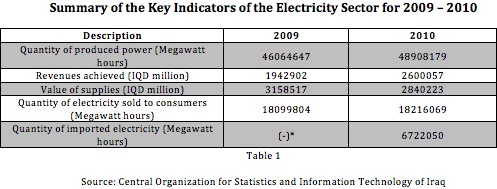
Electricity: Less than 50%
Eng. Mehdi Farhan, networks specialist at the Iraqi Institute of Technology, believes that the problem of electricity in Iraq lies in the need for new generating plants with double capacity, other than the current plants that have old equipment, with a significant deficiency in power generation, relative to the required power. The total power generated by all these plants is less than 50% of the power required by the country, which causes the continuous cuts of electricity on a daily basis in Iraq.
He added that the current electricity distribution system suffers from very big problems, mainly due to not observing scientific and modern methods in the management of this system, in addition to the negligence of the officials at the Ministry of Electricity, which led to this significant deterioration in the provision of electricity power to the consumers.
Farhan pointed out that the shortfalls of power in Iraq require efforts from the Government to establish new thermoelectric power (steam) plants, and gas turbine power plants, in order to increase the efficiency of this type of plants. The Government has begun to reconstruct the plants operating in the electricity system, without seriously considering the establishment of new plants, under the pretext that international companies are not able to work in Iraq because of security reasons.
A report issued by the Iraqi Ministry of Electricity last October, emphasized that the electricity crisis in Iraq will end by mid-2015, with the completion of the long-term plan implemented by the Ministry. It added that the hours of electricity cuts will be reduced to eight (mid 2012), with the completion of the short-term plan implemented by the Ministry of Electricity, and the number of hours of electrical power provision will increase to 16 per day upon the completion of the short-term plan.
The short-term plan, which will start in the middle of 2012, will include the establishment of 50 plants in the various provinces of Iraq, each plant consists of 25 units and each unit produces 4 MW. Caterpillar Inc. (American Company), Man German and STX Corporation - South Korean will take over the supply and installation of these plants, as well as the surveillance of their commissioning, in addition to the training of the engineers at the Ministry of Electricity.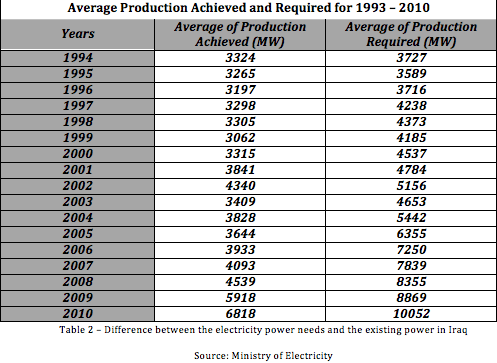
Eng. Laith Maamouri, General Manager of Contracts and Investments at the Iraqi Ministry of Electricity, stated that the Ministry has signed two contracts last month, in the context of its efforts to increase the electricity supply. The first contract signed is with Hyundai Engineering & Construction Co. for the construction of five units in Rumaila, each with a capacity of 292 MW, for the value of USD 308 million, and the second contract for the construction of a plant with only one gas turbine unit, with a capacity of 292 MW at Taza - Kirkuk in northern Iraq, for the value of USD 88.5 million. He indicated that Rumaila contract is expected to be completed within 21 months, while the contract of Taza will be completed within 18 months, and they both will add 1,752 MW of electric power in Iraq.
Government Plan
Mus'ab Sari Al-Madras, Director of the Information Office at the Iraqi Ministry of Electricity, stated that the Ministry prepared three plans to improve the production of electric power in Iraq: The first is a short-term plan that depends on the rehabilitation of some units and plants that already exist, which may add around 1,000 MW to the electricity system. Some plants have already started to operate, including Sadr gas power plant, of which the first unit generated 160 MW at the end of last April, and the second unit generated 160 MW in last May, which adds 320 MW to the system. In addition to a huge electrical line between the Iraqi system and the Iranian system, Karkh - Amara, that is pending the completion of the Iranian side to add 200 MW to the Iraqi system.
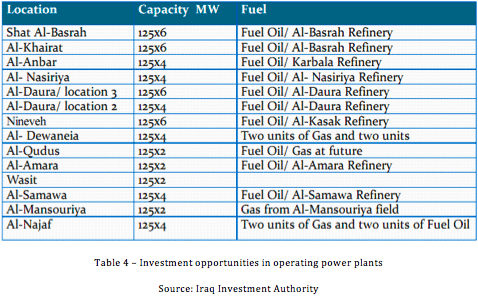
As for to the medium-term plan, he added, the Government contracted with a number of international companies for the installation of units, namely General Electric Company, with 56 units and a capacity of 7,000 MW, Çalık Holding A.Ş for the construction of Al Khairat power plant in Karbala province, with a capacity of 1,250 MW, as well as Hyundai Engineering & Construction Co. for the construction of four units with a capacity of 500 MW at Al-Qudus power plant. There are also four investment projects for the construction of four plants at Shat Al-Basrah, with a capacity of 1,250 MW, and three plants at Al-Dewaneia, Al-Amara and Al-Samawa, with a capacity of 500 MW each.
He also added that the short-term plans will be completed by the end of 2011, for the medium-term plan, it will continue until mid-2012, by virtue of which the electric power will be provided for up to 16 hours and the crisis will be finally resolved before the end of summer 2013, which forms the long-term plan.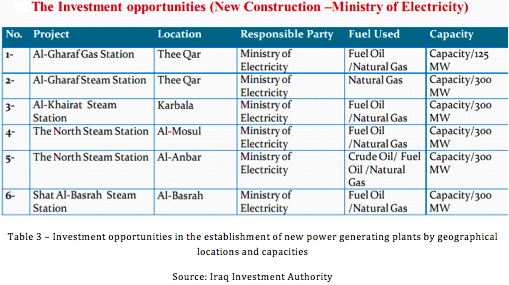
Opportunities in Kurdistan
According to a report issued by the Investment Authority in Kurdistan, proposals were submitted for the establishment of power plants with a capacity of 4,500 MW, to increase Kurdistan's capacity to 6,000 MW.
The ministry solicited in a statement proposals to build an electricity network of 400 KV to be connected to the existing network in the region of 132 KV. It added that the deadline for receiving the proposals will be the mid of December 2011.
It is worth mentioning that Kurdistan region receives 17% of the total federal budget that amounted to more than USD 82 billion in 2011.
By: Mohamed Abdulzaher
mohameda@zawya.com
© Zawya 2011