14 December 2011
Iran may not be able to maintain its oil output by 2016 due to sustained international sanctions, but Iraq should be able to step into the breach, says the International Energy Agency.
Adding to the alarm bells surrounding Iran's oil production, the International Energy Agency (IEA) says that there is a real danger that Tehran will not be able to maintain its oil output under the weight of international sanctions.
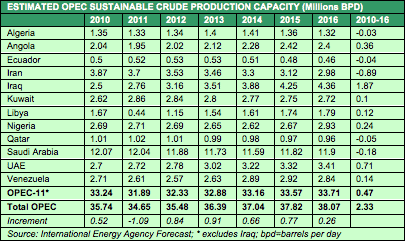
The agency, which is the energy advisory unit of OECD, says Iran's oil output could be cut by as much as 890,000 barrels per day (bpd) to just under 3 million bpd by 2016.
The EU is considering an embargo on nearly 600,000 barrels per day of Iranian crude oil imports, in addition to the U.S. and EU sanctions already in place that target Iran's upstream oil and gas sector by closing a loophole that will bar exports of oil related equipment, drilling rigs or engineering services.
There have also been market discussions about the potential for more far-reaching oil sanctions, including Japan and South Korea, while the US Senate has also voted in favour of sanctions against foreign and commercial banks that undertake business with the Central Bank of Iran (CBI).
In any case, Iran's exports are falling due to rising domestic consumption. The country which produced nearly 5.5 million bpd in 1976 has not matched those numbers due to a domestic religious revolution, a costly war with Iraq and international sanctions.
A high rate of natural decline in Iran's mature oil fields has also prevented a return to pre-70s production levels. An estimated 400,000-700,000 bbl/d of crude production is lost annually due to declines in the mature oil fields.
The production losses come at a time when Iran has benefited from high oil prices.
Iran's oil revenues have risen sharply in 2011 and will reach an all-time high of more than $100 billion for the year, according to estimates by IHS Cambridge Energy Research Associates (IHS CERA). The revenue increase--nearly a third higher than 2010--has been the result of high oil prices driven upward in part by increased tensions related to Iran's defiant pursuit of nuclear technology.
"Relations between Iran and the West have gone from bad to worse this autumn at a time when spare capacity in global oil production is relatively tight," said Bhushan Bahree, IHS CERA senior director for global oil. "As a result, markets could increasingly factor in the risk of conflict and supply disruption in the price of oil."
RISE OF IRAQ
While Iran could well see its dominance in the global oil industry diminish, the IEA expects neighbouring Iraq to pick up the mantle and lead OPEC production growth over the next few years.
The IEA report comes a day after Iraqi President Nour Al Maliki met U.S. President Barack Obama on Washington as the American forces withdraw from the country, signalling a new era for the war-ravaged country.
"Crude oil expansion plans in the medium?term are moving apace, with capacity now forecast to increase by 2.33 million bpd to 38.1 million bpd by 2016. Iraq accounts for 80% of the increased capacity, followed by the UAE and Angola. Capacity growth is 200,000 bpd higher than our previous forecast for the 2010?16 period, with upward revisions to Iraq partially offset by delays to Iranian projects," says the IEA.
The agency has revised Iraq's crude oil production capacity upwards to more than double to 1.87 mb/d, to 4.36 mb/d on average by 2016.
"Downside risks remain, with the end?2011 withdrawal of US troops uppermost on the list and fears of escalating instability as insurgency bombing increases. IOCs also report that continued bureaucratic, logistical and operational constraints are posing significant challenges and delays to project work, which we have already largely built into our forecast," says the IEA.
There are also hopes that ExxonMobil's recent oil deal with the Kurdish government, which sparked anger in Baghdad, could mean that the country's draft oil and gas law may be approved by next year.
MORE OPEC OUTPUT
Other OPEC members are also expected to raise output, though none would match Iraq's growth rate. The agency notes that the UAE has fast-tracked a number of projects, with capacity revised higher by 180,000 bpd since its previous report. Total UAE capacity is now forecast to rise by 710,000 bpd, to 3.41 mb/d by 2016.
Libya will also see capacity return to pre-war levels of 1.6 million bpd by 2016, and Angola will also raise capacity by 360,000 bpd by that period.
"Kuwaiti production has surprised to the upside, with capacity boosted 300 kb/d over the 2010?2011 period, though longer term there is a lack of new projects on the books. Kuwaiti capacity is forecast to rise just 100 kb/d over the 2010?2016 period, to 2.72 mb/d. Indeed, the latest rise in capacity levels reflects a marked increased in active drilling rigs and debottle-necking at the Mina al-Ahmadi oil terminal, which has enabled increased production from its giant Burgan oil field."
Overall, OPEC production will rise 2.33 million bpd over the next five years to reach 38.1 million bpd. Still, non-OPEC growth will beat that number by a full million barrels per day.
Non-OPEC exports are set to rise 3.4 million bpd through to 2016.
"Almost 3 million bpd of growth comes from Canada and the U.S., 1.4 million bpd from Brazil and Colombia, while processing gains and biofuels add around 0.9 million bpd. North Sea production decline reduces robust non?OPEC growth by 80,000 bpd, while continued investment uncertainty and mature field decline will curb output by almost 0.5 million bpd in non-OPEC Middle East," says the IEA.
Also Read:
OPEC Countries Worry About Future Energy Supplies
Exxon Mobil's 2040 Outlook
alifarabia.com 2011